Too New To Be Named

“A lot of kids just trying to waste time creatively, I guess” ~quoting Peter Buck prior to the description of “So. Central Rain” as a song too new to be named on David Letterman, 1983.

Last week I was among the faculty of the Institute for New Faculty Developers (#INFD2015), and I feel so fortunate that I got to meet, network, and converse with the people that I did over those five days. Once again, I somehow got in on a gig that expanded my network in ways I could have never imagined. Should I not have the funding to go to the POD Conference in San Francisco, I might make a road trip just to see these lovely people.

And I have to be honest, I’m not really sure I am the “typical” person chosen for this Institute. Even though I had the title “Faculty” I am very new to this network, this field, and this experience. What I learned connects to larger interests of mine, so I want to be very clear when I say: I’m so completely shocked that I was in charge of anyone’s learning. In charge of anything. A leader of any session. Much less three of them! Each and every day felt like my on-going research with The Impostor Syndrome. A state of being also known as my career.

Being called “Faculty” with this institute made me think about labels, identity, and the state of faculty development. So when in doubt, I turn to research. The words of others. The history which precedes me. The history. People’s words that are smarter than anything I could produce.

Here’s what I read:

DiPietro, M. (2014), Tracing the Evolution of Educational Development Through the POD Network’s Institute for New Faculty Developers. To Improve the Academy, 33: 113–130.

I made some notes, and below the words in bold are to emphasize my experience using DiPietro’s article:

Having INFD faculty who have moved up in leadership positions on campus (such as associate provosts) is important for two reasons. These roles are involved in campus-wide change initiatives, and thus have experience with organizational development. Additionally, they provide participants with models of career development in a field that does not have a predetermined path.

On the emotional side, most participants bring considerable anxiety about their ability to be successful in their new roles. From its inception, INFD has explicitly addressed this anxiety as part of its goals, and anonymous evaluation comments through the week reveal more positive and confident attitudes by the end (e.g., “I learned that I am not alone,” or “I learned that I might just be able to do this job!”).

At the same time, we need to weave ourselves at the core of our institutions, by expanding its offerings beyond instructional support to supporting faculty across the career span—from graduate students to new faculty to the tenure and promotion process, to fixed-term faculty and to mid-career faculty and chairs and administrators. In addition, educational development needs to expand our scope beyond working with individual instructors and get involved in strategic initiatives around teaching and learning, whether it be accreditation initiatives, quality enhancement plans, general education, or program reviews.

I discovered Michele DiPietro through How Learning Works: Seven Research-Based Principles for Smart Teaching (2010). And at the time of this publication, I was searching for what was next for me. I didn’t know about the POD Network. I didn’t know there was a field for people involved in professional development. I just knew that I loved working with teachers. I had some pedagogical framework and theories for learning from my MA in English. This book helped me find researchers that contributed to the next four years of my M.Ed research.

If I was a manager, director, or professor of people who are new to the professional development field, I’d send them to this Institute. You could see it all over people’s faces that they felt relief they were not alone in their struggles. Their self-doubts. Their anxieties. Their own private hell of the Impostor Syndrome.

So let’s pause for a second and return to my epigraph. Watch this video. Check out how confident Peter Buck is, how wonderfully nerdy Mike Mills is. How Bill Berry hides behind his drums. But really, where the hell is Michael Stipe?

He’s hiding.

He doesn’t say a word. You can’t even see him. He has yet to grow into the Michael Stipe that would become the Michael Stipe we all know now.

A force of nature. Worker of the crowd. Red eye shadow decorating his brow. Confident. Full of brazen confidence. Fully out. The Lead Singer. Fully the poet with a backup band.

This:

Yet, he was always the same poet. He just needed a decade to figure it out. How to own it. To be what he wanted to be. To own it. And I love both of these songs equally. For different reasons. They are two different Michaels, yet they are the same. Sometimes in life, I’m convinced, we just need time to figure it out. To sort it out. We need time to figure out the “rivers of suggestions that are driving us away” so that we can say “I need this. I need this.”

And that’s what I observed of my beloved new faculty developers. They just need time to figure it out. And they will. The INFD attendees were empathetic, compassionate, smart people who want to improve teaching and learning. Fantastic caring educators.

I didn’t have anything like this when I got into this field–I’m still not sure I’m apart of it, honestly. And although I fit the model of somebody who has “moved up in leadership;” it’s all been an accident. In fact, I spoke on a panel recently and I described myself as the “Accidental Leader” because everyone else seemed so together. So sure. So very sure.

Basically, I jumped right into the deep end of the pool, and I’ve been treading water barely staying afloat ever since. Whether you see me that way or not, that’s how the last few years have felt. It doesn’t have to be this way for newbies. It doesn’t have to be this hard. There are people, very cool people, all over this country and around the world who can support each other. I just didn’t know it. It just took me time to find them.

Here are the questions I’m grappling with lately: How do we connect people involved in teaching and learning? Why did it take me so long to find them? Why do so many people feel like they work isolation? How can I help end this feeling for people? Can Ed-Tech folks help Faculty Developer folks connect? Aren’t we one and the same?

When I started one of my presentations, I admitted that my research interests can be very depressing. There is more resistance towards what I advocate for then there is acceptance. OER, adjunct equity, and educational technology are magical ideas to people who are allies. For the haters? Not so much.

But I stay optimistic and I keep trying because when I meet like-minded folks, I can see small bits of change for the better. Small bits of hope. Small bits of ideas that need a way to connect. Small bits that connect to the larger picture of life-long learning.

And let’s be honest: Teachers hate the phrase “Faculty Developer.” They think it’s condescending and presumptuous. If they distrust theories from social-scientists, it’s even worse. If you have a Humanities background, it’s an even deadlier association. Say you’re a “Faculty Developer” and you’re already losing a battle with some teachers. They roll their eyes. They don’t come to your workshops. They delete your emails.

They think “I don’t need your advice on pedagogy, I need discipline-specific tips and training.” Or they balk at the idea that somebody who is not a part of their discipline can help improve their teaching. What can you possibly know about MY classroom? What. Can You. Possibly Know.

In Washington State, we’ve toyed with the idea of calling this field “Professional Learning.” For me, this label is an improvement because it gets away from a deficit model and embraces more of the life-long learning ethos that we want to see for our citizens. Our teachers. Our students. Our classrooms. Our learning. Our. Learning.

You’re right, I’ll tell a Chemist or an Engineer, I’ll never understand your field, but I think I can save you time. I have some ways that I think will help you do the stuff you love as a teacher. Let me show you. Sometimes it works, sometimes it doesn’t. Let me try.

And it’s so hard. Faculty professional development is the one area that has been hit most with budget cuts during the recession. We are being asked to do more with less. Those Chemists and Engineers don’t get to go conferences like they used to. They are seeing more adjuncts in their departments. They are seeing fewer resources for their teaching. They see your salary as a faculty developer and they blame the administration for taking their funding away to pay somebody like you. The disconnect amplifies as budgets shrink on the state and national level. The disconnect amplifies.

So what is the state of professional development on a national level? From what I’ve experienced through this institute and by attending a national conference in the last month, I hate to say it, but it’s not good in America.

We’re being asked to do more with less.

Faculty are bitter, angry, dissatisfied. Administrators are misinformed or stressed beyond capacity. Upper-administrators are employing business model tactics that don’t work because education should never be a for-profit enterprise (a memoir).

Students are paying more and getting less. The cognitive load on everyone is killing motivation for life-learning. The erosion of tenure and the rage of adjunct faculty makes this gig pretty depressing. In short, we want to be the own-it-all-with-eye-shadow-Michael-Stipe and we’re being forced to hide behind the ever badly behaving cocky Peter Buck.

It seems, truthfully, to be business as usual in higher education. Only a bit worse. Nothing changes while problems amplify. The problems amplify. The disconnect amplifies.

What we want and what we need has been confused. Been confused.

So what do we do? How do we improve the conditions of people involved in education? How do we make their lives easier? Better? More productive? More satisfying? Happier.

We can create connections. We create networks. We mentor. We organize. We talk to people. We can listen. We can create organizations of mentorship and networks.

Allow me to give you an example how challenging this work can be.

At the start of the Institute, the guy who was employed to help with the technology was tasked with passing out paper booklets so that people could take notes by hand. I cracked a joke with him thinking about things I’ve read about Ed-Tech.

And I said: “How fitting that the Ed-Tech guy is passing out paper notebooks. What’s up with that?”

He said, “I know, right?” I looked around the room, and out of a 125+ people, most of them were writing notes by hand. And there is nothing wrong that. Don’t get me wrong. I love me some pen and paper writing. I love journaling. I love writing by hand. I love writing. Obviously if you have made this far in this post.

But here’s the thing. The Thing:

Every reflection in those notebooks was written in isolation yet how many people were writing the exact same thing? How many people would have benefitted from knowing “I’m not alone?” How could their level of anxiety have gone down with sharing their writing with others? How many ideas could have spawned meaningful collaboration? How many plans for individual institutions could have been amplified by collaboration?

And yes, there are things that I write that I would never want anyone to read, but really, when it comes to my work, I don’t feel satisfied unless I’m sharing what I’m doing. For better or for worse. Complete or not. Published or not. Good or not. In the last six months, I’ve gone through a massive change in the way I see my learning. My philosophy of learning has changed. For the better. I feel more satisfied with my writing.

During one of my presentations, I shared the need for having a philosophy of technology as a teacher. One of my graduate professors emphasized that it’s not enough to have a philosophy statement of education; you also need one for technology. So here’s mine from 2012, and please note that super stressed tone in my voice is because was teaching four composition courses while I was attending graduate school. My statement would sound different today. Don’t judge me; it was three years ago.

I would also add that you need a philosophy statement for social justice. But what then? You have three philosophy statements! How do you combine them? How do you encompass what you would like to be as an educator with who you are?

It takes time. Think of the timeline from young Stipe to fabulous Stipe. Think of the brilliant REM songs. The awful. The not-so-great. It just takes time to sort it out.

One of the sessions on creating an identity as a faculty developer made me think about how I would label myself in this field. Somebody shared that if we don’t label ourselves then somebody else will. If we don’t own our power, then somebody else will. If we don’t claim our notion of success, then somebody else will define us as a failure.

I was present. I was reflective. I felt part of community of learners. I thought about my career and how it connects to others. And how it doesn’t.

I wrote typed the following sentences on my magic typewriter:

I would like to be an instructional designer who advocates for the poor, the underserved, and the underprivileged. I’d like to examine the necessary balance of power and influence to support open education in my corner of the world. But maybe what I want to do is just too new to be named.

Maybe. What I’m achin’ to be. Is too new. To be named. I know I’m not alone.

What about you?

Posted in All The Things | Tagged , , , | Leave a comment

Community: One Book At A Time

If suppressing objectionable material amounts to ‘civil disobedience’…Mr. Thoreau, Mr. Gandhi and Dr. King … are rolling over in their graves. 

~Chuck Robinson, co-owner of Village Books, former employer, hero, fellow bike geek, friend. Quoted from “Booksellers The Battle Joined,” The Washington Post 1990

I started this post awhile back when there was a call for stories about relationships that started at Village Books. My inner nerd started to sing, and I went straight for my notebook. I wrote long love letters to the friends that I’ve made as a result of my two-three years as a bookseller. It’s a rambling mess of gushing love for people, and really it’s not very interesting if you aren’t those people. And I’m sure, over the years, I’ve told each of them in my own way–either over drinks or during random chats–how much they mean to me.

In short, I’ve met all of my closest dearest lovingest bestest friends because I worked at Village Books (VB). And the folks who aren’t in that BFF category are some of the most interesting people I know. This bookstore is more than a former job to me, it’s the hub on the wheels of my life and education.

credit: http://basecamp40daysoneverest.com/tag/dianne-whelan/

One the wall of the VB extension photo credit: http://basecamp40daysoneverest.com/tag/dianne-whelan/

I feel like I worked at VB during the golden years. The best years. When the coolest booksellers worked there. When the place was in its prime. The best. But really, I bet every employee feels that way. Every alum must have that feeling. When I got my personalized party invite post-card in the mail with a handwritten note, I got weepy. How sweet that Dee did that for every alum! For me.

There are also many people who have remained working there since I’ve moved on. How many readers can say they know people who have retired from an independent bookstore in this era? Sadly, very few.

And that’s what’s cool about VB. They not only created a vital corner of the Bellingham community, they are A Community. We are a community. When I first got hired, somebody asked me how I got hired without an PhD! That’s how smart the booksellers are to folks in the community. Like every great job I’ve had, I just got lucky. I was in the right place at the right time. Right Place, Right Time: A Memoir.

Back then, VB had just celebrated their 20 anniversary, and I remember how young and kinda hippy everyone looked in the photo of the “first booksellers” at VB. What a bunch of long-haired, long dress wearing, long beard growing, unkempt outdoorsy au natural hippies, I thought. I may have hugged the photo thinking “My People.” My lip prints are probably still on the glass of that photo frame.

Thanks to Colophon Cafe, which is adjacent to VB, for taking a chance on me as a waitress (and putting up with my smartass mouth); I was able to get to know the bookstore folks. I would shop for used books using my discount pulling dollar bills from my African peanut soup stained apron, I would talk with whomever was working the desk. When one of the employees admitted she was going to quit, I made my pathetic pitch to Chuck and Dee when I was serving them lunch. I told them I was an English major, and that I would love to work for them. They encouraged me to apply, and I spent hours crafting my sentences, checking my spelling, and dreaming about finally leaving food service to sell books. Out of a five-inch high stack of applications, I got an interview, and ultimately the job.

Little did they know how horrible I am with numbers, and what a complete mess I was with cash registers, money, and bookkeeping. For every mistake I made with bookkeeping, I tried to make up for it by creating meaningful book displays, alphabetizing children’s books, and being a good listener to folks who liked to talk books. I also tried to maintain my “Alyson’s Picks Shelf” like a shrine to my nerdness. And truly, some of the conversations I had behind the counter with my fellow book employees are some of the best examples of geeking out that I’ve had in the workplace. It’s a special place, and I’m honored to be an alum.

When I got into graduate school (the first time), Dee wished me good luck and told me I’d always be welcomed back if I needed a job. Turns out, two years later, I needed just that. I spent two months at VB before I moved to Seattle to work as an adjunct, and that’s when all of my VB relationships flourished and became the beautiful part of my life that I call my friends. How can I ever thank you, Chuck and Dee, for giving me so much?

In the years since I’ve left VB, the economic and political times have not been easy to independent bookstores. To anything independent. To anything I care about, really. I kept a watchful eye on the news of independent bookstores and what I observed from afar made me proud. Chuck and Dee weren’t going down easy nor without a fight. Par for the course with those two, really.

They have a long history of fighting censorship and when it comes to Banned Books, they don’t just teach adults, they get the kids involved. How many kids have grown up reading books in VB? Chelsea Cain, a NYT bestseller claims to still have the thesaurus her mother purchased from VB. I still have my discounted used copy of Cain’s Wild Child: Girlhoods in the Counterculture.  All of my VB friends from that era had toddlers or small children when I started working there. Those kids are now in college or in their 20s.

I recently counseled one of them about not getting accepted grad school. Even his safety school rejected him. He said, “My mom told me we should talk because you’ve been rejected a lot and you might make me not feel like such a loser.”

[Thanks! “Friend.” Talk to Alyson, she minored in Loser Studies.] But yes, I said, Aunt Alyson knows what’s that’s like, and it sucks. It’s the worst. But. Something else will come about. Something else is waiting for you. Something. I promise. You’re a good guy destined for happiness. You already have somebody who loves you for you, so that’s a start.” He said, “I just don’t feel like an adult and I think I should by now.”

To which I responded: Welcome to the club, kid.

And you see, time has passed. Quite a bit. The building has changed. The whole place is different, but VB is going strong. Like public libraries in Bellingham. VB is an ally to the public library system and they support the Whatcom Community college and Western Washington University. If you do a search of major fund-raisers in Whatcom County, you’d be hard pressed to find something that VB was not a part of in some way. They are a model business. For a community. By a community.

VB helped my career in ways I would have never thought of when I was scheming to get hired there. I got my first experience talking to large groups of people by introducing authors. I learned how to type faster with the data entry I did with new books (I loved that mindless work just as much as I loved the new books). I wrote my first book reviews. I got to help the book buyers select new books for the upcoming seasons. I made connections who eventually published my first hiking and cycling articles. I got to work as a volunteer tutor with the Whatcom Literacy Council thanks to the VB connection.

When I sat for one of my first community college job interviews, we talked mostly about VB because the chair of the English department loved VB just as much as Powell’s in Portland, OR. In fact, we talked so long about books and VB, I wasn’t sure if I made a new book geek friend or if I got the job when I left. I was hired to teach two classes, for the record, yet she barely asked me about my teaching. And most of all, I learned how a business can make a profit while still being a vital part of the community. One book at a time.

And these days, people think that I want to kill the publishing industry. Books. Writers. That I want to kill bookstores. Publishers. Authors. The Printed Word. And that’s simply not true. No, that’s not it.

I want to end the large-scale exploitation of students by corporations who want nothing to do with community, people, education, and equity. They only want profits. If I can’t make education free for all people everywhere all the time, then I at least want a hand in killing the profits of corporations who prosper off of students. When I advocate for Open Education, I’m not saying that books shouldn’t exist. I just want a college student to have some disposable income to buy comic books, trashy vampire romances, heady classic literature, magazines, young adult fiction, cookbooks (even the anarchists), fiction, and of course, memoirs for their free-time. For life-long learning. All from a place like VB. From a community of people. Of readers. Of people.

While I was an adjunct at Everett Community College, I shared an office with the brilliant Dr. Charles Fischer, a fellow former indie bookstore employee. We’d spend our office hours geeking out on politics, books, and teaching. He published an article in Seattle Magazine titled “Seattle’s Disappearing Bookstores” and he shared the link with me, writing, “Man, this research was depressing, but I think you’ll dig this. I hope you like it.”

Let me share my favorite quote from Charles’s article:

While I was in graduate school in the ’90s, I worked as a clerk at Magus Books in the University District—a neighborhood that has consistently defied gentrification. Magus is arguably one of the best bookshops in the city. Much of its spirit goes back to Dave Bell, who bought it in the 1970s and was its longest and most formative owner, giving the store its distinct shape and personality. An outspoken advocate for civil liberties, the late owner kept a brand-new copy of The Anarchist Cookbook, along with psychedelic mushroom kits, in the locked display case in the front of the store. Though Bell had a science background, he made a point of hiring liberal arts people, many working toward advanced degrees or already with them. Rhodes scholars worked side by side with graduate students in English and philosophy. A day spent in Magus was a day spent in the best class you ever had in college—I remember talking about the pattern of human carelessness in The Great Gatsby with Dave Heller, who now teaches philosophy at Seattle University, and having Bill Kiesel, now publisher and editor of Ouroboros Press, break down the dialectical gymnastics behind Malleus Maleficarum, a medieval treatise on witches. Hanging out in Magus was like hanging out with the knowledgeable and quirky clerks in High Fidelity. Perhaps the only reason Hollywood has never made a hit movie about used bookstores is they don’t come with a soundtrack.

What a great writer, that Charles. I loved it.

Every one of them words rang true/And glowed like burning coal/Pouring off of every page/Like it was written in my soul from…Wait. Sorry. I’m ripping off Bob Dylan here (but it works, right?). This is exactly what I felt. What I lived. What happened to me. How a job felt like part of my education.

And so this Saturday, I’m going to attend the party celebrating 35 years of a village of books. A village of people. Of readers. If you’re in Bellingham, I hope to see you there. We need to celebrate what Chuck and Dee created for us and anyone who walks into the door of their bookstore. A Community.

Expect me to ask you, “What are you reading?”

Posted in All The Things | Tagged , | 1 Comment

Getting Upstaged By An Emoji: A Memoir

A couple of blog readers shared with me that I need to lighten up a bit. Pet some puppies. Laugh a little. Share the love. You know who you are, and I suggest that you listen to some Black Flag and mind your own damn business.

But I jest, dear friends. I know you mean well. And I love you.

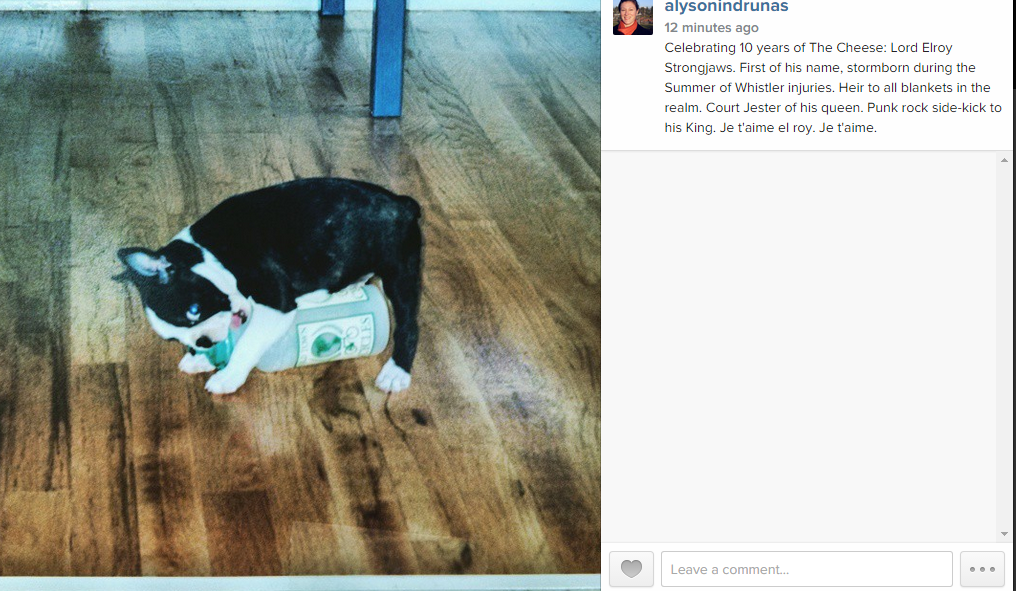
Speaking of petting some puppies, we picked up our discount-low-rent bulldog, Elroy, ten years ago this week. Time is a jet-plane, Bob Dylan, you’re right!

Check him out with his homemade-my-new-owners-are-super-broke-toy! His look says, “Damn, I could been purchased by two East-side Seattle yuppies, and I’m going home with these two broke book nerd losers? I have to chew through my rage. I need to chew this.”Elroy

No. His look says, “I’m going to be your Brah with fur, Broke Book Nerds, and you’re going to love me. ”

And we do, little guy. We do. And we know you hate our bikes. (Bikes mean Furry Brah stays home). Happy 10 years of Elroy.

So now, let me share some love and a funny story. This may be of particular interest to my OER friends.

Last month, we did a bit of celebrating our faculty who are engaged in implementing OER. They are the second cohort of my Alternative Textbook Committee. The yin to my yang. Faculty whom I adore. People who are interested in student success. Democracy. Creativity. The advancement of our citizenry. True Teacher Leaders. You know, all the stuff that makes my heart race. We invited teachers to show what they did, to talk a bit about their work, and eat some food. It was fun for me.

The attendance was a bit low, but I embraced that as a way to show the faculty the administration’s level of interest in OER. There were two deans there. And they both work in my department, but I digress. Keep it funny, Indrunas. Puppies. Happiness. Yep. Right.

There were also two student reporters in attendance. They were taking notes. I was looking at them directly as I addressed questions. Laser beam focus on those young writers. Then I hopped on the soap box and started listing things the faculty should talk about with their union negotiations. Listing things that would help their departments and professional development funding. Listing things that need to happen to advance the good work they do.

Then the sweet journalist students came up to meet me. Shake my hand. Talk about writing. A unicorn flew over the building. It was a lovely day. I went home and petted my decade old puppy.

A week later, I’m getting interviewed by a reporter. Rumor has it, the students are fired up about textbook costs. They’re asking other students about OER. Hot damn. Another unicorn flies over the campus leaving stardust and glittery light. Finally, I think, after three years of trying to drum up some OER interest, I finally have some student activist momentum. Finally.

I speak my truth. The Truth as I’ve learned from others in this movement. The Truth as the folks who have taught me much about OER have spoken before me. Before I knew the acronym OER. I made sure I didn’t drink too much coffee that morning and talk this female reporter’s ear off. We had a lovely chat. Another unicorn flew by and left a rainbow in its wake.

Then the student paper came out, and yours truly is the headline. Hot damn. There is also a tweet about it from somebody I don’t know, which is beyond cool. A herd of unicorns gathered in the sky. They started to synchronize as a swarm of unicorns spelling out the letters, O.E.R and big giant heart.

A bald eagle, the spirit of American freedom and democracy, was perched on the back of the head unicorn. He wore a cape made from the stars and stripes. He winked at me. All was well in the universe.

I emailed some friends and said, “Hey, check me out in the student newspaper. When this hits the fan, can we camp out in your backyard? Surely this is material worthy of getting me fired. I’m pretty sure these folks have had it with me.”

They wrote back enthusiastic invitations and welcoming words. My friend who works at a university sent the article to her student employees. One her students responded with “Fuck yes, OER is the shit.” I shared those emails with the unicorns. The eagle blew me a kiss.

I texted the mister: HolyF. Might be in trouble for this one. Check out the Clipper headline.

His response: Power to The People.

Then The People started to read the newspaper. The unicorn wings stopped flapping. The eagle dove down into the bay to feed on a fish carcass. The sparkle dust from the unicorn horns blew away. The head unicorn shed a tear, turned her wings and flew to the north.

Everyone, I mean, everyone was talking about the review of the campus bathrooms titled “Where Do You Poop on Campus?” Everyone. As in everyone. Everyone.

From students, to faculty, to staff, to administration, to my team. Albeit this is clever useful journalism, my story was totally upstaged by the use of poop emojis as a ranking scale. And before you hop on the make-fun-of-millennials-and-their-short-attention-span-bandwagon, let me tell you, faculty were digging it. Cracking up. Sharing horror stories of bodily functions and the humiliation of public bathrooms.

Some of them learned what an emoji is, so really, I should chalk this one up as a victory for online communication tools. (Unicorns! Come back. Wait…)

On another day, I would have reveled in this banter. Added a few stories of my own. Made up anecdotes about the linguistic origins of the word “emoji” and how we can implement them into formative online assessments.

Not today.

Dammit. Everyone was talking about the clever use of poop emojis and not OER. You read that right. Poop emojis. Not OER.

So tell it, Uncle Henry. You’re right. Annihilate this week.

Posted in All The Things | Tagged | 4 Comments

The Fortune In Your Head

Let’s pretend that you know two companies.

One company has active scholars and folks who have been long-term advocates of open education. You’ve met several of them. Talked on the phone. Collaborated via the magic of the Internets. Your teachers really like them. Teachers who are typically hard to please. Are happy. Kind of excited about that they do. You like this company because they talk about helping the poor. Making things easy for teachers. They seem like Good People to you. Your gag reflex was silent the entire time you were introduced to their company’s ethos. In fact, they’re kind of thrilling to watch. They use the word “learning” a lot.

Then imagine the opposite company. Imagine you felt ill during their entire introduction, the biographies of the people made you suspicious. Kind of nauseous. Imagine your department had no say so in the acquisition of a project yet your department’s reputation helped land a grant project. Imagine. This company is repackaging the openly licensed content already created with no stake, claim, or history with or among advocates of open education. What they call “open” isn’t open. Their main concerns are with the companies they have surveyed about job skills, skills gaps, and employers. Imagine their pitch upset the people you supervise. They know how little you agree with these types of companies. You’re livid, really. But there’s nothing you can do. You turned it into a joke and made fun of their company’s name. Your “expertise” (so you’ve been told) will help with the implementation of a style of learning you know doesn’t work. This company mentions the word “learning” very little.

Both companies–let’s pretend–connect to your day job—that you like to think is connected to meaningful teaching and learning. Imagine you’re involved with two grants involving the foundation of a certain couple from the Puget Sound who have been very successful with computers. Everyone tells you how great this is for your career. Your future. The lines on your CV. Amazing work, kiddo. Sounds important. [Gag]

Then. Get this. There’s more to this scenario.

Imagine that you try to contribute to group working on a very simple tool for writing and research. On your free time. Breaks between meetings. At night. On the weekends. Not nearly enough. Sometimes what gets written it about goes right over your head. Sometimes you think you get it. You don’t really know what they’re doing. You kind of lucked out with getting in on it. Sometimes you interact with the people working on this project and you’re surprised they don’t tell you to beat it. Like how an annoying flea can fly around the ears of a dog. I’m the flea. You understand it to be a volunteer effort, but you really have no idea. Somehow using this tool has helped you as a writer in ways you can’t even describe. You just like using the tool. The guys working on it are Good People. You can see ways to use it for teaching. You see how hikers and mountain bikers could use it for reporting trail conditions and trailwork.

Quick federated wiki digression: Imagine having the history of the trail by the day, the week, the season, the month, and the year. All by clicking on a series of boxes. All of the history of the trail in a series of tiny little symbols that have a narrative all their own. [[By The Season]] would be so useful and revolutionary to cyclists and hikers.

You mention the word “learning” every time you talk about it. You learn every time you use it.

So here’s the thing. Here’s the thing. My favorite blog transitional phrase, by the way. It does not work on paper. On the magic typewriter it does.

Here’s the thing:

The thing is open education. OER. It’s being repackaged. Prettied up. Marketable. Buzzwordy. Worthy of buzz. Praisable. Sorta shiny. Sorta the thing. Sort of not the thing. And holy hell, somebody trademarked the word OpenEd. I thought that was Friday Internet joke, by the way. Surely, I thought, nobody is that out of touch. Turns out they are. Wow.

Either way, everything concerning open education feels a bit misunderstood. So misunderstood. So misunderstood. So misunderstood.

This week I’ve returned to Wilco’s Being There as one of the albums I listened to during my soul-killing commute. I got to thinking this week that I’m rounding the corner to my 13th school year of commuting up and down the I-5 corridor for work. In my next life, I think I could be a long-distance truck driver. Or a bike commuter. Or a bald eagle who nests on the Skagit River. Maybe the river. Just not anything involving the I-5 Hwy. Unless it’s a road trip. Where was I? Commuting music, right.

Being There is an album I usually have in my car beginning circa 2004. And it got me thinking a bit about “Misunderstood”–one of my favorite songs from that album. Tied only with “Sunken Treasure.”

Could this song match the current moment of the OER movement as I understand it? Can I appropriate a song to explain how I feel about what I’m doing both personally and professionally? As I’ve mentioned, I’m pretty new to this gig. I have so little history.

Let me try to explain by remixing and rearranging lyrics and ideas.

First you have to listen to the first song:

The start of “Misunderstood” is so slow. Piano. Almost painful. Some of the lyrics make sense. Some don’t. Tweedy is singing so sweetly. At his best, thus far. For sure. Hope he ages like Willie Nelson and Johnny Cash. Not a huge fan of the stuff he’s doing with his son, but I think it’s cool. Tweedy looks happy rocking out with little Tweedy. Why not?

When you first hear this song, you think it’s a slow love song.

Guitar. Short on long-term goals. There’s a party there that we ought to go to.

When Wilco was writing “Misunderstood,” do you think Jeff Tweedy said: You know what? When we play this song live, I might scream “Nothing” 17 times towards the end of the song. Is that cool? I think it’ll make me feel better.

When I heard them play this song live, I smiled and laughed as Tweedy was somewhere on this 30th “Nothing.” Giggled like a toddler. I thought Tweedy was going to blow a vocal chord or shout his head off Scanners style. Wigging out on the stage yelling “Nothing” over and over again until it was making people feel uncomfortable. He went from beautiful sad song singer to fuck-up-your-hearing punk rock. It was awesome.

And this song is good. It winds up a bit like The Beatles’ “A Day in the Life” in the middle. Like Tweedy was having his own McCartney/Lennon split of creative vision with himself. Why not join two songs? Or is it one long song?

Even this audience didn’t know what was about to happen:

They start to applaud like the song is over. Then Tweedy wrinkles up his nose and face. Starts yelling. Transition from alt-country guitar sad song singer to punk-tastic screamer.

Thank you all for nothing at all comes into play and the whole song changes. I’d like to thank you all for nothing at all. Nothing. Nothing. Nothing at all.

And you see, remember those two companies that I mentioned above? One makes me feel like sweet sad Jeff Tweedy. I can see getting sloppy happy drunk on whiskey while watching their company evolve. I’d tell them I love them sometime around last call. I’d play whatever they wanted to hear on the jukebox. I understand them.

The second company (that I can’t link to because the press-release hasn’t come out yet) makes me want to wrinkle up my face and scream over and over. They make me want to bust out the whiskey and not talk to anyone. Glare at people. Be kinda mean and bitchy. Doubt the good in humanity. This company? You, so misunderstood. You love her but you don’t know why. I’d like to thank you all for nothing at all. 

And the group working on the thing I don’t really understand that I mentioned above? Their work feels like the build-up of reverb, drums, and sounds of transition in the middle of this song. They’re like an outdoor festival of all of my favorite bands. That I wish I had more time for. I do what I can. When I can. I have no idea what the hell I’m doing. Take the guitar player for a ride. There’s a party there that we ought to go to.

Here’s the other thing: We have this amazing tool to share information. In this cultural moment. It’s fun. I want to see better uses of it. The “it” is the Internet. I love talking about the potential of online education. Yet all I do is defend it. Explain it. Justify it. Defend what I know is right. As I listened to Wilco, I thought about what Lisa Chamberlin brilliantly shared: “I’d like to plan for 2020 instead of reacting to 2010.”

What she said.

Here’s what I’d like to think about: Unstructured time for structured and aligned learning with the use of the magic typewriter that connects us all. Life-long learning when you’re motivated to spend some time with ideas.

Does that explain the Internet and the tools that we use to learn with it? Usually when I’m trying to sound brainy-like, I feel like I’m creating platitudes. And imagine. Wouldn’t that be great if you could create the future platitude about education? Something everyone will take for granted as commonplace someday?

How do we advocate for unstructured time for structured and aligned learning with the use of the magic typewriter that connects us all?

I don’t know. When somebody figures it out, will they trademark that idea? WTF.

All I know is when you talk about OER, it helps to mention students, learning, democracy, teachers, and The Public.

Not profits, the marketplace, capitalism, money, and the fortune to made from what’s in the heads of The People. All you touch turns to lead. 

There is no sunken treasure/rumored to be.

These are people’s lives. This is about educating The Public. Not ownership. Not profits. Not about making a fortune with what’s in the heads of The People. So misunderstood. And here Tweedy helps me get to what I’d like to say to that second company and those who are tapping their greedy fingers together like Mr. Burns.

The Thing:

You look honest when you’re telling a lie. 

Blog title credit: Jeff Tweedy/Wilco.

Posted in All The Things | Tagged , , | Leave a comment

Watching the River Rise

Hi Magic Typewriter, I’m back! My last post was kind of all over the place, so let’s see if I can write about one idea in a style that honors some narrative cohesion. While I was traveling I took some notes on random observations, if you like. All of these notes appeared in my tiny paper journal that I carry with me when I need a break from the glowing screens.

Observation 1: If you are traveling, and there is rain in the forecast, do not assume that just because you’ve lived in the rainy Pacific NW that you will be handle it. The rains in Austin were unlike anything I’ve ever seen, and it further confirmed that I have no business living in that climate. Note to future self, bring an umbrella and read the weather reports closely. Scattered rain showers mean something totally different in the South, and I should know better. I’ve lived through hurricane rains in Georgia. It pained me to buy an umbrella when I have all the gear you need to sleep outside and ride bikes in the PNW rain. Rain by the Bucket: A Memoir.

Observation 2: I really really dislike cockroaches, poison ivy, large bugs that bite you, spiders, and humidity. Albeit, I really loved Austin, Texas, the items in the sentence above thrive in this town. I am meant to visit again to be sure, but I don’t think I could ever live there. The flora, however, is so spectacularly different that I took many photos of plants that I have never seen. Or it’s been a while since I’ve seen hot climate plants. Evolution is an amazing thing to witness in a state where they teach Creationism as if it was plausible. Go figure.

Observation 3: There are tons of free music opportunities but they charge you out the nose for drinks. Mixed well drinks in plastic cups and $6.50 for beer? Just charge me a cover and give me a glass. The musicians mostly play cover songs for tourists, so albeit it was cool, I’m not a huge Stevie Ray Vaughn fan. Sheesh already, coverbands, play something else, like the music you mostly write together when you’re practicing. Halfway through their sets, bands would devolve into “Pride and Joy” or “Voodoo Chile.” I can’t say it made me want to stay, so I’d leave. It brought the touristas to the dance floor and thus to the tip jar, so I get it.

Two miles away, I’m sure there was a little club playing the music I wanted to hear, but I wasn’t hip enough to find them. One band I saw, and I don’t know their name, played the most wicked blistering cover of “Proud Mary” ala Tina and Ike. And it made the hairs on my arms rise with goose bumps. I’m sure I was grinning like a fool because the lead singer even had the opening banter that Tina does and all of the dance moves. It was awesome!

The lead singer had the Tina spins with her hips and the Tina kicks down pat. She was maybe 22 or 24 and totally owned that song. Out of breath and sweating at the end of the song, she dedicated her sexy as hell song and dance to the memory of B.B. King. That gives me hope for the future, y’all.

Observation 4: Late night public drunkenness is a menace to society when there are car-free streets. Pedestrians and cyclists have full domain, so that’s cool, but it’s also a sketchy mix of drunken chaos. It’s fun when you’re in a group, I imagine, but if you’re just drifting around solo–like I was–you just start to feel bad for drunk cowgirls and sorority girls. The scent of heavily cologned men gave me a headache. I wondered how many ankle surgeries have resulted from such drunkenness wearing such ungodly high-heels on cobbled streets. I pondered the success of the chest waxing trend for men. I got bored with the people watching and realized the same meathead style mating ritual exists in Seattle. I became more interested in eating the fares of food trucks than drinking and listening to music. Maybe I’m old.

I also heard a band play a cover of one my favorite alt-country bands The Meat Purveyors who have sadly broken up.

For the record, “Tall Boy” and “Morning After” from More Songs About Cows and Buildings are two of my favorite songs from my favorite album of theirs, and if they get back together I’d sell my left kidney to see them. One of the best bands I’ve seen live. Hands down.

Observation 4: The no-helmet law in Texas is shocking. I get that motorcycle folks don’t like to wear them. It’s cool to live out some Easy Rider fantasy, I suppose, and it’s hot. But cyclists? Wow. What the hell? Seeing a large group of cyclists riding in a group without helmets made me want to lecture all of them. These were serious riders mind you (I can tell by their massive leg muscles and their skinny arms), so it shocked me to see them riding on streets where people speed like there are no laws and who seemed to be mostly driving drunk.

I understand that the popularity of helmets is relatively recent, but we now know how important the brain is to who we are and what we do. Beloved Austin folks, you should be wearing your helmets. You protect your $5,000 frame (that’s not including any of the parts, I know) with canvas shields when you put your bike on the car, yet you don’t wear a helmet. You have helmets on your kids in trailers but you yourself do not wear one. If you value that kid and the frame, why don’t value your own brain?

Observation 5: The Mexican free-tailed bat migration of the Congress Avenue Bridge did not disappoint, and I loved seeing the sky turn into bits of wings. Swarms of flying bits of black. Flits of unpredictable flights. Swarms of black dots swirling. That was an incredible night where I ran from the shore to the bridge so I could see both perspectives. I was so lucky that I chose to check it out that night because very next day the river had covered that area and there was a flash flood warning. Twelve hours later there was madness along the shore with the river rising.

What an amazing spectacle of people watching at the bat exodus! It was truly inspiring to see how human architecture can foster a creative habitat for the bats. I also fell in love with the hippies—the generous kind hippie types, not the self-righteous-holier-than-thou-hippie-types—who lectured the crowds about the disappearing bat populations. I gave them $5 because they had a solid lesson plan with outcomes, engaging crowd interaction, and a fun assessment for the kiddies. They had posters and pictures. It was old school table-style protest teaching with the aim to educate people about the misunderstood yet pretty darn cute bat. Winged wonders, those bats. One man in the crowd said it well as I murdered the bugs feasting on my legs, “The bats come out to feed on the bugs and the bugs come out to feed the people. Don’t they, baby?”

Observation 6: A man with an American southern accent can call me baby, sugar, shoog, darling, sweetie, honey, honey-babe, sweet-thang, and I’m not offended. It doesn’t make me angry. It’s like hearing a man from Maine call me Dear (pronounced Dee-Yah), and I melt. Or somebody from the mid-Atlantic states calling me Hon. For some reason, those terms of endearment make me blush and smile. Anywhere else in the country, I’m ready to lecture you about misogyny and/or spit in your face. It makes no sense. I listened to a busker play the “Last Thing I Needed First Thing in the Morning” on my way back from the bats fly from the bridge show, and so now I’ll always think of those bats when I hear this sweet sad song from Willie:

I gave the guitarist a buck, and he said, “Thank you, baby” and he winked at me. Tipped his cowboy hat. I smiled, and blushed. What the hell is your problem screamed my inner feminist? Shut up, he played me a sweet Willie song and he has a southern accent, I tried to tell her. Eye roll and gag sounds, responded my inner feminist. It makes no sense, I pleaded. We ducked into a bar to drink away our fighting words. We made up. It’s cool.

Observation 7: There was no evidence of Lance Armstrong pride anywhere. No place. Nada. De rein. Zilch. I went into three bike shops to find a souvenir for the mister, and there were posters of Iban Basso, Richard Virenque, Marco Pantani (rest in peace, Il Pirata) and of course, Tyler Hamilton (my own personal heartbreak because he was a rising star just as I discovered the joy of the sport). All of whom have admitted to or tested positive for doping. Why have posters of those folks yet scorn Lance? Those former dopers, I guess, unlike Lance, did not mess with the reputation of Texas.

I understand the level of hatred that people have for Lance, but I didn’t find the unveiling of truth surprising; he’s always been kind of a dick. Unlike a lot of people I know, I still respect what he did for cancer research and awareness. I can forgive that he’d go on mountain bike rides with George Bush the younger and not elbow him off a cliff. I can forgive that he lied and went on Oprah to confess his shame. I can forgive that his entire career was a lie. For every terrible fib he told during his career, I think his work with cancer foundations was sincere. He gave a lot of people hope. His story taught a lot people about cancer. Ever seen that commercial when he rides his bike by a cancer ward and a small bald child waves to him? I cried every time I saw that Nike commercial during one of the Tours de France. We’re all deeply flawed in some way. Some of us are just more flawed in public.

Observation 7: There is an entrepreneurial spirit about the under-30 crowd that is inspiring in Austin. No job but you like to ride bikes? Join the Pedicab crew. Want to open a bar but you can’t afford a food license? Open the bar and find food truck friends who park outside. Have a badass etoufee recipe from your mom? Open a creole food truck! Want to play music at night but you need to pay the rent? Rent a seriously dilapidated house and let people park their traveling vans in the driveway while they’re on tour. There’s a real DIY spirit happening there that used to exist in Seattle and Portland, that’s slowly getting killed by gentrification. See also San Francisco. When The Swells move in, the DIY artist folks can’t afford the rent. The same thing seems to be on the horizon for Austin, but for now it’s still funky and weird.

Observation 8: I miss people from the East Coast and The South (US), and I need to get back across the Mississippi River more. I have some amazingly cool friends who grew up in the NW, so not all folks are strange, so don’t be offended, my PNW besties. If you’re my friend, you don’t fall into this category. But generally, people who grew up in the West are not as friendly as my East Coast kin. Kind of judgmental. Insular. Quiet. Odd in a way I don’t get. Hard to talk to talk to. Can’t seem to figure out the ins and outs of geeking out.

Case in point: I had many conversations with people in Austin who ascribe to a certain fashion look and if we were in the PNW, they would have never ever talked to me. Ever. Example: I paused to take pictures of these clouds, and this dude stopped to do the same. He had a Joey Ramone meets Tom Waits kind of look to him. Maybe 25 or 28. Facial hair but no chest hair (a signifier of the millennial male). He said, “This is what the End Times must look like, for sure, right?”

I said, “Maybe. I’ve never seen clouds like this, it’s truly cool. This light in the sky is glorious.”

He said, “Well, my mom taught me that when the weather turns bad you should hole up with a bottle of liquor. Where you from?” (hold pronounced like hole).

“I live north of Seattle,” and he said, “Oh man, I fell in love with a girl from Bellingham once. Damn, I love that town. I’d never leave if I lived there. Why come to a shit hole like this?”

Turns out, that’s where I live. Bellingham. Austin is far from a shit hole, in my eyes. We talked for like a half an hour. Random people say hello and good morning. Austin felt neighborly and sweet in a way that I miss. That guy’s doppelgänger in Seattle would have been too cool to talk to an unhip lady like me. What would his friends think?

Observation 9: We need more public parks and sidewalks in our communities. There were these public xylophones in a park near a popular swimming hole. I noticed some folks playing a riff over and over again. I recognized the tune but couldn’t place it. I could see they were dancing. There was beer. Kids hula-hooping. As I rode my bike closer, I could hear they were streaming Book of Love’s “Boy” and I noticed it was two men with their children. The kids with two Daddies were singing along. Dad and Dad smooched. The kids yelled for them to play again. One dad had better dance moves than the other. Their eyes sparkled when they looked at their kids. Love.

Thank you, Daddies, for reminding me of the Book of Love. Circa 1987, I had that hair of the first keyboardist with the pearls. And oh, those dance moves!

It’s not my fault that I’m not a boy. Magic from the mid-80s!

Observation 10: When the rivers started to rise, people had parties on bridges! They literally made a party out of watching the river rise. My people! I decided to go for a run because I had no more dry clothes to ruin on a bike. I got so much mud on the back of my dress from riding that I’m hoping the dry cleaners can do wonders to save a staple of my work drag. Despite the fenders on the bike, the mud went from my ankles to my hair. Exercise and sight-seeing by running is my usual MO while I’m on a trip, but this was special. What a sight-seeing treat.

Drinking on the bridges? Yes! One side was flooded, so the cars couldn’t get across so it filled up with people and their coolers on wheels. People drank and literally watched the river rise. I stood there dripping with sweat, and took in the sights of what a true community of people making the best of Mother Nature’s chaos looks like. When The Public gathers for a bit of celebration and holiday. There are many sad stories to this weather event, to be sure, but I was unaware of them as I was witnessing the river rise in my corner of Austin. All I could see was joy and wonder. I was lucky.

Although the humid climate is not for me, I really do hope Austin stays a bit weird until I get back again.

Posted in All The Things | Tagged , | 3 Comments

I See A Thousand People Just Like Me

If I read one more report about how online education is failing at community colleges, I’m going to jump on the ranty rant bloggy blog train until it derails. But right now, I’m in a fantastic mood because I spent most of the day sightseeing by bike in Austin, Texas. I was in a bar when they declared a tornado warning, and some guy bought everyone a shot. I talked to a musician who told me about how hard it is to make it in Austin. A bartender read me his poetry. I’ve got a bit of sunburn. But since I brought it up, let’s just say, Researchers in The Ivory Tower, it was super swell of you to publish your reports during budget season. Are you aware there is such a thing as budget season? That’s what I call it, and I’m sure it doesn’t appear in any administrator training manuals. This is the season that little worker bees like me try to make the case to the Queen Budget Bees on why we should continue to fund projects that we think will help improve learning at our institution. Researchers, your timing with these reports is truly awful. May I ask you wait until July 1 to publish? This would help my hive make it to another fiscal year. Allow me to translate, Overlords of Research, “budget” is the fiscal budgetary term we use in lieu of “funding” and I know you know that word.

As in, “I will dismantle any incremental success at community colleges with my Big-Time Report because I have funding to research. Man, I’m awesome! Look at me getting published.” Meanwhile, back at the hive, little bees like me are working on “the budget” to fund our plans for upcoming year. The Queen Bees are looking at how to make cuts because of the Queen Bees above them have sent the slash and burn budget mandate. Big Dogs like you are just looking to get published with your analysis of our data; you could truly care less about what these means to the lowly community college worker bees. So instead of getting ranty rant bloggy blog, I’ve got some ideas for your next IRB approval process.

Here’s what you’re missing, Dear Overlords. Hot insider tip! Here’s what’s absent from your impressive reports. From your publications. From your public service announcements. From your publications. From your articles. From your data on our students. From your shiny pamphlets. From your declarations.

  1. We, as in community colleges, honor the open door policy from the Truman Commission. Look it up. We teach damaged soldiers, sex offenders, former/current/future prisoners, broke single parents, the homeless, the semi-homeless, the future homeless, the sisters and brothers of the down trodden, the fathers and mothers of generational poverty, the lower-class cousins of the slowly disappearing middle class—you name it. We open the door. To teach. For learning. We welcome people who are willing to better themselves. We call them “non-traditional” students and they come with all kinds of challenges before they get to our classrooms, be it virtual or on-the-ground. That outside-of the-classroom may or may not affect their ability to perform as students. In the brick and mortar. OL. You pick. None of your reports contextualize their reality. Look at that data. Google the phrase “working poor.”
  1. Check out the ratio of full-time to part-time faculty at community colleges and then dig deeper. Look at how we fund (or don’t fund) their professional development to learn how to teach OL courses. Look at how little we invest in them, yet we expect them to perform miracles with the students listed above. Interview upper-administrators and ask them if they think it’s worth it to support the professional learning of their adjuncts. Ask those same upper admin folks if they think adjuncts are committed to their institution. Then look at how many adjuncts have been at the same institution for more than a decade. Correlation? Causation? Significant? Unreliable? Valid? It’s up to you, Overlords.
  1. Check out the course load of community college teachers. Look at how many of them teach 5-7 courses every quarter. All year long. Including summer. Look at their class enrollment caps. Ask yourself if that student-teacher ratio serves the needs of community college students described above. Ask the teachers why they teach so many courses. Ask them if those course loads would be possible if OL education didn’t exist. Don’t interview Directors, Deans, or VPIs. Ask the faculty. Ask the teachers. Talk to the teachers. Listen.
  1. And lastly, research student motivation for taking OL classes. Ask the students why they sign up for OL courses. Ask them. Listen. It will change the lens that you use to examine your data, I promise. While you’re at it, ask them about their textbooks costs. Ask them if they pay tuition with a high-interest credit card in addition to their federal and private school loans. Ask them if they took a class but didn’t purchase the required textbook. Ask. Listen.

Then let’s see if you feel like swan diving head first out the window of your Ivory Tower.

I’m not going to link these reports because I can’t stand to look at them again. You’ve most likely seen them on listservs, Twitter, and the like. The last three weeks have been a nightmare sequence of discussions about money, vision (or lack thereof), and institutional priorities. In my little bend of the Puget Sound, OL education lost quite a bit on the big spreadsheet of the future. Yay you, Researchers of Mighty Reports and Big Data. Have fun on your summer holiday! Enjoy updating that line on your CV.

Speaking of holiday, I’m in Austin! So shut up, Negative Ed. Tech Nelly. Who cares? Where’s Happy-Go-Lucky Alyson?

Here I am! Let’s talk books. And forget about the rest. Forget. About. The rest.

I’ve been slogging through David Mitchell’s The Bone Clocks, and I’m usually a fan of the time-bending multi-layered narrative, but this book is a slow read for me. And not in a good way. It may have dust on it sitting on my bedside table. But a friend I love adored this book, so I’m going to stay with it to talk to her about it. I loved the story of the girl running away to work on a farm. Everything else has been kind of a slog.

So I got distracted from it. I bought my husband I’m Sorry to Think I Have Raised a Timid Son by Kent Russell, as a souvenir gift from a far away indie bookstore, and I told him that I’ll give it to him when I finish reading it. Dreamy wife, right? Russell’s chapter on Juggalos is pure genius. For those of you unaware of the Insane Clown Posse (ICP), let me admit I’ve never been able to sit through an entire song of theirs. Imagine that the Cookie Monster took LSD, drank a bunch of sugary soda, and then tried to sing and/or rap surrealist illogical sentences while music-like sounds played in the background. That’s the gist of the ICP oeuvre. I don’t want to get too into it for fear that members of The Family (not Manson, the Juggalos) will attack me.

Let the record note: I’m a big fan of Faygo Root Beer. Rock on, Juggalos, you live in America. You can do what you like. You don’t have to like me and vice versa.

When my husband and I get into a dark place about academia, he makes me laugh with his idea for a niche political literary genre called “Juggalo Studies.” Imagine that you went to a conference and somebody asked you about your research; you got to say “I’m really into Juggalo Studies these days. Are you familiar with Slavoj Zizec’s take on Juggalocity?” The Hack will say yes, but of course! A potential friend and/or ally would say, “What the blazes are you talking about? Juggalo Studies? WTF?”

What Russell does well is he takes this subculture seriously (something I can’t do). He examines race, class, generational poverty, and their notion of community through the eyes of a journalist on assignment. I’m very interested in people who share “a cause” or “an identity” and what that means to them as a people in a community.  A favorite dig on the ICP is that you’ll never find a Juggalo Brain Surgeon (ouch, right? But damn, that music is awful). What’s up with bands from Detroit who wear face paint? Do Juggalos see themselves as inheritors of what Kiss started? What will the kids be like who are growing up in this subculture? Why are women not enraged by their sexism? Case in point: a woman who is attractive is called a Neck Snapper. The males will yell at them and request to see their naked breasts. How sweet.

Here’s my working title for a feminist Juggalette conference paper: “Can The Neck Snapper Speak?” Or “Save The Faygo Shower For Your Friends: Neck Snappers Don’t Need Ya!” (We’ve joked about this genre niche more than I’d like to admit, it cracks us up). The Family and their Juggalocity kind of fascinates me, and Russell’s examination of the “American Juggalo” is brilliant. That chapter originally appeared in n+1, a journal I’m going to guess isn’t on the bedstand of any Juggalette or her Juggalo. Just sayin.

Okay, Ninjas (a Juggalo term of endearment), let’s move on to another book.

I’m also reading The Shallows, What the Internet is Doing to Our Brains by Nicholas Carr, but I keep putting it down to check Twitter and Instagram. Kidding.

Really, I feel like I’ve already read this book because so many people that I respect have already blogged, talked, and/or presented his ideas. I’m moving one chapter at a time because it’s on my iPad, and I don’t always feel like reading the eBook. Because here’s the thing; I’m a total bibliophile. Hopelessly devoted. For all of my OL-This and Digital-That, I love me some good books. When I go to a dark place about leaving the community college system to try to work for The University, I start to drool just thinking about having access to their libraries again. So in the meantime or erstwhile or in lieu of, thank you, public library for helping me curb my outdated addiction.

Speaking of the library, I picked up How to Be Alone  by Sara Maitland randomly on a “Newly Acquired” shelf and I thought it might be a gag/comedy book. My favorite all time gag/comedy book, by the way, is In Me Own Words by Graham Roumeiu. I laugh every single time I think about this book. The first time I read Roumeiu’s book to friends (like they were very drunk kids that I was babysitting), I thought we were going to pull stomach muscles from laughing.

Turns out, How to Be Alone is a serious book on a topic I’ve thought a lot about since the federated wiki came into my life. Is the room of one’s own in the magic typewriter? Do I care if this gets forked? Does not knowing who the audience might be completely kill all audience awareness thus eliminating the impostor syndrome and fear? Does anyone give a rat’s ass? My fedwiki thinking kind of devolves from here, so let me move on.

When I picked up this book, I saw a blurb from Alain de Botton, and I like his writings on Proust. So I thought, okay, this is a small book, I can finish it in one sitting. Surely I’ll be able to read it quickly as escapist history, I need something to take me away from the horror show of what I have to read these days for the daytime gig (refer back to the beginning of this post).

Wrong!

Maitland has made me think long and hard about my life, my values, my struggles with creativity, and my grouchy longing for solitude. This is a philosophy book where readers learn a lot without the author being preachy or life-coachy. It’s my kind of memoir, if you will. She designs the narrative arc of this book meaningfully and she tells you why. Her ideas are like a buffet allowing readers to pick and choose what works for their needs and moods. In addition, there’s homework for further reading and thinking at the end! Be still my little nerd heart.

I recommend Maitland’s little tome. Turns out when you read this book in public, people look like at you like you’re a sad pathetic person. You can see it in their eyes when they read the title of the book. “Poor woman,” they must think, “she’s most likely going through [enter life horror here] and she needs to learn how to be alone. I bet her therapist assigned her to read that. Sad.” At the airport, I saw a woman hug her boyfriend tightly as she looked at me taking notes from this book (he was staring at his phone and barely looked up at her, so maybe he should read The Shallows).

Maitland lists out that craving solitude in our current cultural moment is perceived as self-indulgent, escapist, antisocial, and evading social responsibility. Yes! This could be my new Twitter bio. My jobby job makes me feel like I have no control of my life in the M-F, 8-5 (I know I’m not alone. Yes, I’ll have some whine with my cheese. I’ll pause here for you to either want to smack me or for you to say Amen).

Because of this workaday I’m in right now, I skip out on humanity, friendships, and the outside world at night and on the weekends. I also reflected that I’ve been powerfully attracted to loners my whole life, and albeit I can be incredibly social, a lot of the time, I just want to be left alone. Like the loners that I love(d), it ain’t easy loving me (so I’ve been told). I often get the words wrong. These last few days, leave me alone. Leave me alone. From my head to my teeth to my nose. I get the words wrong. Every time. Leave me alone. Leave me alone. Wait, I’m ripping off New Order here. This song kills me. All these years later. Every time. I see a thousand people just like me. That may be my problem.

Blog title credit here:

Here’s a passage from Maitland that makes me think Greta Garbo would have been a pal:

In retirement she adopted a lifestyle of both simplicity and leisure, sometimes just ‘drifting.’ But she always had close friends with whom she socialized and travelled. She did not marry but she did have serious love affairs with both men and women. She collected art. She walked, alone and with companions, especially in New York. She was a skillful paparazzi-avoider. Since she chose to retire, and for the rest of her life consistently declined opportunities to make further films, it is reasonable to suppose that she was content with that choice (42).

It’s magic, this book. Aside from the woman lovers and avoiding the paparazzi part, I think I can name my retirement strategy The Garbo Drifter Plan. Everything else sounds totally ideal. I’m going to read all of the books in this series now. There’s one on how to think about sex more, so I can’t wait to see what kind of stares I get with that one at the airport.

One of the chapters is about going on a solo adventure, and what do you know, that’s what I’m up to this weekend! I’m attending a conference in Texas, and I’ve rented a sweet little backyard cabin in Austin’s Sixth Street District neighborhood. I chose not to stay at the hotel because it’s so expensive and I want to get out of the hubbub of the conference gig. I’ll do my jobby job obligations, don’t you worry. But I’m also going to live it up solo-style. I’m in a city where I know not a soul. It’s a solo adventure that’s work-related. A bit hobby. A bit jobby. (a memoir)

All of the conferences I’ve gone to this year, I’ve known a lot of people. It’s been a beautiful year for networking and making new friendships. The acceptance to this conference is because the kind folks of NISOD published an article of mine a year ago and two years ago they asked me to do a webinar. Swell folks, right? I’m excited to meet some of the faces I know by Twitter avatar or by email. But mostly, I’m going to be a drifter Greta-style, collect some art in the form of cowboy boots and clothes (fingers crossed for cheapy boutiques), ride the bike-share bikes, and I’m going to write, read, eat, and drink. I’m going to go out to see music and if it’s warm enough, I’m going to swim in some southern warm waters. My only obligations are a presentation and one coffee date with a book editor who may (or may not) be serious about my work. It’s hard to tell whether it’s a spammy-recruiter-style-editor inquiry or if she’s really interested in my writing (whatever that may be). Quick side note to said to editor should you stumble on this post:

If you are serious about my writing, then I’ll buy you a coffee. I’m drop dead serious about finding time to write these days, so you need to be honest with me. I can take it. The second I smell a sales pitch, I’m out the door. Your email came at the right moment, and I can’t tell you how surprised I am to get this invite. If you’re not truly interested in what I’m up to these days and if this meeting is just a work quota for you, then let’s just go to the hotel bar and have a drink. I’ll help you fill your quota, just don’t waste my drifter time. Writing and research is not in my job description, so whatever we talk about will be on my own time. What I call the hobby job. The products of my loner solitude. I don’t mean to digress into warning-like words here, lovely editor person, I’m just really burned out the workaday bullshit (see the beginning of this post).

And these days, when it comes to my adventure time, my ideas, and my passions; I’m only adding people to my life who are as awesomely wonderful as Greta Garbo and this Grant Lee Buffalo song:

Otherwise, leave me alone.

Posted in All The Things | Tagged , , , | 6 Comments

Humanities Lecture 2015: Book Nerd, Meet Tech Geek

Back in the halcyon days of my undergraduate years, I took several classes from a William Blake scholar, and my favorite class was titled The Word and The Image.

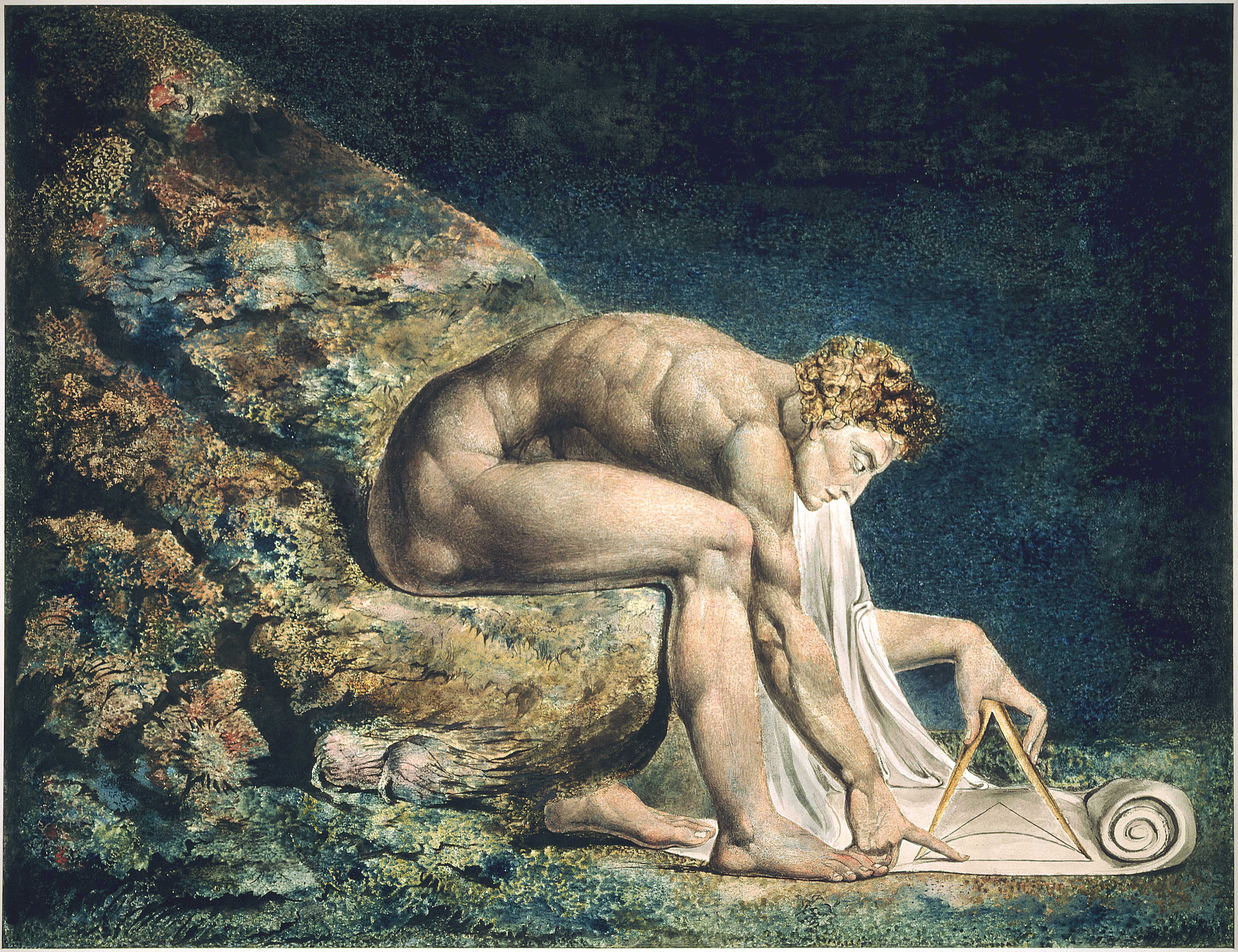
We talked quite a bit about this plate from Blake, and I remember our teacher pointing out the the sharp straight lines, the curves, the use of darkness and light. About his medium. His message. His art. The Science of his Art.

http://www.blakearchive.org/.  Licensed under Public Domain
http://www.blakearchive.org/ Public Domain

I remember thinking (maybe for the first time) about how science and art are intertwined. How I had to look up information about a scientist because of poet’s drawing. How we can learn from art about science. How science informs art.

How The Word and The Image are symbiotic teachers to the students who want to sit with those ideas. My teacher said something that changed the way I thought about time and learning.

Here’s what I remember her saying:

I like to take one idea and stick with it for a year. Like the letters of John Keats or the many sketches of William Blake or the phases of Henri Matisse. A true artist sticks with an idea for a year or more and tries to reach as many audiences as she can. The Image is simultaneously The Word when you consider teaching others about your passion.

Here’s how I carved out some time to sit with the same idea in the last year, I pitched the same title to five different audiences. This “Book Nerd, Meet Tech Geek” idea gained acceptance for me to speak at the Bridges Conference (about OER as professional development to tech people), which led to an invitation to speak at Western Washington University (John Farquhar’s team and colleagues), a Humanities Lecture at EvCC (for students taking Humanities 101 and their teachers), at NISOD (about professional development for trainers, professional development coordinators, and grass-roots OER organizers), and at Institute of New Faculty Development (a POD organization for higher education professional development).

I got lucky with this one idea this year, right?

And I realize that when you look at my presentation titles for 2014-2015, you’d think I’m just recycling the same ideas, but I’m not. My audiences change every time, so I need to focus on different ideas. My Images may mean different Words to different listeners. I may use the same Images but I have different Words. Otherwise, I’d bore myself and I’m too selfish to do that! Since I’m going to stand in front of students and teachers and debunk this separation between STEM and The Arts, I better walk my talk and use the Internets to draft some ideas.

So here’s a working draft of what I’m going to say tomorrow at the Humanities Cafe talk. What follows is what I may or may not say. I’ve been known to improv at bit when I’m speaking to people. Turns out that’s good for my brain. Read on.


“Read not to contradict nor to believe, but to weigh and consider”~ Francis Bacon (1561-1626)

Some of you may recognize this epigraph from Joyce Walker’s email, and this is what I’d like for you to do today. Weigh and consider my ideas about art and technology. About STEM and The Arts. Here’s the first thing you should know: This division only exists because of funding. Because of money. Because of who decides what to support, how, and why. Because of policies about what you should learn and why. Because of what will get you a job and what won’t.

“Bacon-Rose” by Francis Bacon – Sylva Sylvarum. Licensed under Public Domain via Wikimedia Commons – http://commons.wikimedia.org/wiki

I did not get to attend all of the talks in this series. My job on this campus is to support faculty and students with their online, hybrid, web-enhanced, and face-to-face courses. When things go awry with some technologies, it’s my team who helps put everything back in order.

Sometimes our work with technology, teachers, and students is chaotic and unpredictable, so although I wanted to go to hear all eight talks, I only got to attend two.

They were both about the arts, and here’s the thing: I used technology to reflect on what I learned.

I used Twitter to live-tweet Mike VanQuickenbourne’s lecture. Because, let’s face it, live-tweeting a philosopher with tenure is amazing! He can say things I can’t because he has tenure! It’s my version of fist-pumping and woofing in the crowd. I can’t help myself these days; I like to share via the Twitter machine.

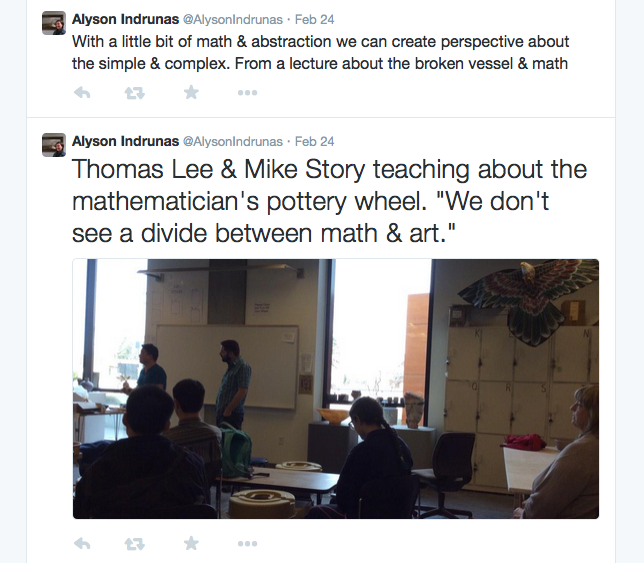
I attended the lecture of Thom Lee and Mike Story in the pottery studio. A space meant for the creation of art but we talked about math the whole time. Later that day, I wrote about what I learned using the federated wiki. Another technology that I used to prepare for this talk.

Photo Credit: C'est Moi

Photo Credit: C’est Moi

I took the words and the images from a math teacher and an art teachers, and I made something of my own. What I created is now openly available for anyone to read, revise, remix, or re-envision for their own.

By using this Venn Diagram, (that I will draw on the board before the audience gets there) I want to talk about the perceived division of STEM and The Arts, as it relates to my interest in open educational resources.

Prior to coming today, you had access to the blurb that wrote about this talk, and some resources to read as homework. I’m going to assume that you did the optional reading (wink), and because I also taught first-year college students for ten years, I’m also going to assume you might need a review because you have two or three other classes that are stressing you out right now (most likely STEM courses).

And yet, you’re here for an hour to listen to some woman who writes stuff like this:

How did a book nerd become a tech geek? In my work as the Director of eLearning, people are often surprised to learn that my background is in English Studies. I want to highlight that when we put the technology first as the ‘good idea,’ we lose momentum. The ‘slow idea’ is OER (Open Educational Resources) and open learning, but it takes people connecting with people to make it happen. I’d like the audience to leave with thoughts on the way they use technology to connect their ideas with other people.

Then you were asked to Read “Slow Ideas” by Atul Gawande,

Watch this video:

Listen to a short video about Open Educational Resources (OER)

AND Check out Fools Who Do Art  on Instagram

You may have thought to yourself, “Wow, I’m really glad this woman doesn’t teach anymore because I don’t see how all of this comes together. I really hope Dr. Walker doesn’t make me write an essay based on this lady’s work. I wonder if she’s going to ask me to join a cult. I wonder if I’ll get extra credit. Am I being punked by Dr. Walker?”

I promise I can make this all come together. Let’s start with two terms that have been re-purposed and appropriated since I was your age.

Nothing was more insulting than being called a nerd or a geek. If you were smart, you were decidedly uncool. Popular myths about smart people didn’t help.

If you were a smart young woman, you were even more threatening. Hideously unattractive. Undesirable. If you were a smart young man, you were kind of a loser. Hideously weak. Undesirable.

So let’s look at how these words are defined on Wikipedia. Before we do that, I have a question for you.

Photo: Stina Jonsson on Flickr.com

Photo: Stina Jonsson on Flickr.com

How many of you have been told by teachers to never use Wikipedia?

[Pause for hands, quick discussion]

How many of those teachers told you why they didn’t want you to use to Wikipedia?

[Pause for horror stories from teachers of the past].

Here’s the thing: I love Wikipedia.

I’m not an active editor or contributor but I love, love, love reading what other people have created. I’ve learned so much about art from that technology. I’ve learned so much about that technology from the art of Wikipedia.

Let’s now look at the words “nerds” and “geek.”

Nerd (adjective: nerdy) is a descriptive term,often used pejoratively, indicating that a person is overly intellectual, obsessive, or socially impaired. They may spend inordinate amounts of time on unpopular, obscure, or non-mainstream activities, which are generally either highly technical or relating to topics of fiction or fantasy, to the exclusion of more mainstream activities

Geek is a slang term originally used to describe eccentric or non-mainstream people; in current use, the word typically connotes an expert or enthusiast or a person obsessed with a hobby or intellectual pursuit, with a general pejorative meaning of a “peculiar or otherwise dislikable person, esp[ecially] one who is perceived to be overly intellectual.”

When you aren’t a student, what do you geek out or nerd about in your free-time? How do you learn about this topic?

[Pause to listen to audience members. Write on the board in a giant Venn Diagram whether they learn about The Arts or STEM. Write in the center when some topics sound like both.]

Let’s allow this collection of ideas sit for a second because I want to bring in OER and Gawande here since that’s what you watched and read for homework. Let’s start with some quotes from Gawande that I think apply broadly to anything innovative.

All of the following sentences are from Gawande. I deleted all of the information about medical innovations and kept the statements that I think apply to this talk today about OER, STEM, and The Arts.

[Here I will point to my Venn Diagram of STEM, OER, The Arts]

People talking to people is still how the world’s standards change. Why do some innovations spread so swiftly and others so slowly?

In our era of electronic communications, we’ve come to expect that important innovations will spread quickly. Plenty do…But there’s an equally long list of vital innovations that have failed to catch on. The puzzle is why.

To create norms, you have to understand people’s existing norms and barriers to change. You have to understand what’s getting in their way.

In the era of the iPhone, Facebook, and Twitter, we’ve become enamored of ideas that spread as effortlessly as ether. We want frictionless, ‘turnkey’ solutions to the major difficulties of the world–hunger, disease, poverty. We prefer instructional videos to teachers, drones to troops, incentives to institutions. People and institutions can feel messy and anachronistic.

They introduce, as the engineers put it, uncontrolled variability.

https://twitter.com/hashtag/et4online?src=hash from a presentation of @bonstewart

https://twitter.com/hashtag/et4online?src=hash from a presentation of @bonstewart

Here’s the most “uncontrolled variability” that all of us face: We have no idea what the future holds. Contrary to all of the advice about STEM jobs this and STEM jobs that, we don’t know what the future holds. Your education has to prepare you for a future you cannot see or predict.

Had somebody told me when I was your age that I would work in the technology field and that I would love it, I would thought you were a cruel liar out to sabotage my future self.

Yet here I am. A “technology person” talking about the value of The Arts.

Here’s the most radical thing I’m going to say today: Any scientist who is worth a salt does not see this STEM/Arts distinction. Any artist who worth a salt does not see this STEM/Arts distinction. It’s the institutions that fund and employ these researchers, creators, and educators that have created this divide.

The question is: How do we as learners value both The Arts and STEM?

In my corner of academia, the answer is OER. Here is where technology is helping to spread the “slow idea.” In the short video about Open Educational Resources (OER), you saw an example where scholars from one corner of the world connect to other scholars in the world. Ideas from one area connecting to others ideas not just here in America but around the world. By the click of a mouse. By the Internet. Ideas. Words. Images. All of it. That’s how we learn. That’s how ideas spread.

That’s how people learn. We are nerds and geeks of our own learning using the Internet.

For example, let’s take a non-scholarly interest of mine to examine how I use the Internet. My most cynical colleagues say that Internet has done little for us except to expedite how we buy things, waste time with meaningless social interactions, and gain easy access to pornography. That’s all true, I will point out. There is still the power of the Internet and its potential that we have yet to figure out how to bring into our institutions and classrooms. That’s a slow idea.

For example, I learned how to knit from a woman who lives in London who posted a video to Vimeo. I watched it over again and over again until I could knit on my own. I then made friends locally in my community who knit. They are now friends I knit with when we can and we connect by email. Recently I became friends with a woman based on our mutual interest of knitting and connected learning. In sum, I have made meaningful relationships with people using technology thanks to my interest in an art.

We can access ideas from one area by connecting to others ideas not just in America but to people around the world. By the click of a mouse. The Internet. Ideas. Words. Images. All of it. That’s how we learn. That’s how ideas spread. That’s how people learn.

Yet here you are taking classes in STEM and The Arts to check boxes to fulfill requirements. Yet here you are being asked to synthesize ideas that seem very either/or but it’s really both. Your curriculum forces this separation even as your teachers are friends with people on both sides. And get this–some of the artists have spouses who are people in STEM, and STEM people are married to artists.  Some of you may be products of that STEM and The Arts Venn Diagram (wink, you know what I mean).

What’s been created in this division in education is not user experience with learners on the Internet. It’s careful design and labeling as determined by funding. Who pays for what, how, and why. How we fund the Liberal Arts degrees.

This is all over Twitter.

This is all over Twitter.

When I did a search for “Liberal Arts Education” the first hit was from University of Phoenix. A for-profit university.

Somebody from their marketing department had clearly paid for that link to appear above Wikipedia.

I scrolled down and found this:

The liberal arts (Latin: artes liberales) are those subjects or skills that in classical antiquity were considered essential for a free person (Latin: liberal, “worthy of a free person”)[1] to know in order to take an active part in civic life, something that (for Ancient Greece) included participating in public debate, defending oneself in court, serving on juries, and most importantly, military service. Grammar, logic, and rhetoric were the core liberal arts, while arithmetic, geometry, the theory of music, and astronomy also played a (somewhat lesser) part in education.[2]

In modern times, liberal arts education is a term that can be interpreted in different ways. It can refer to certain areas of literature, languages, art history, music history, philosophy, history, mathematics, psychology, and science.[3] It can also refer to studies on a liberal arts degree program. For example, Harvard University offers a Master of Liberal Arts degree, which covers biological and social sciences as well as the humanities.[4] For both interpretations, the term generally refers to matters not relating to the professional, vocational, or technical curricula.

Yet here you are taking classes in STEM and The Arts to check boxes to fulfill requirements. Yet here you are being asked to synthesize ideas that seem very either/or but it’s really both. It’s really both.

Both.

The reason I had you watch TED Video on “The Neuroscience of Creativity” is because Charles Limb researches something he calls “magical that isn’t magic.”

And that’s a powerful idea. That’s, in essence, a really powerful way of thinking about your passion. What’s magical to you that isn’t magic?

He also takes a stab at rapping, and that’s the kind of giggly awesome that is only possible thanks to the Internet, right? Hell yes! A Brain surgeon by day, Rapper by night. It’s only a matter of time until he has a Kardashian sister stalking him, I’m sure.

Limb says, “Artistic creativity is a neurologic product that can be examined using rigorous scientific methods.” He asks, “Why should scientists study creativity?” And then did you see those brain waves during improv? Wow. That’s magic.

He also makes a radical claim about brain research as a case where, “Science has to catch up to Art.” Note that he does so not by saying one is better than the other. He simply asks questions that lead to more questions.

That’s why I’m involved with education. I like to see people asking good questions. In The Arts, STEM, and The Social Sciences. I like to see teachers and students learning from one another. I think that’s everyday magic.

I like to think that there’s a creative science to the art of learning. There’s an art to scientific creativity. That’s magical.

When I sent my lecture topic idea to Joyce, she and I had a lovely email exchange. I had asked her if she checked out Fools Who Do Art. She had, and she wrote:

I recall that Tableaux were still being “performed” in the evenings at the Laguna Beach Art Festival in California, which my mom and I always went to every year when I was a kid. I also recall that Virginia Woolf’s 1941 novel, Between the Acts which describes a church bazaar at which Tableaux were performed. At least, I think I remember it 🙂

Which led me to look up some ideas on…you guessed it…Wikipedia!

I found this blurb explaining the tableaux vivants (high-five Wikipedia writers):

Before radio, film and television, tableaux vivants were popular forms of entertainment, even in frontier towns.[2] Before the age of color reproduction of images, the tableau vivant (often abbreviated to tableau) was sometimes used to recreate paintings “on stage”, based on an etching or sketch of a painting. This could be done as an amateur venture in a drawing room, or as a more professionally produced series of tableaux presented on a theatre stage, one following another, usually to tell a story without requiring all the usual trappings of a “live” theatre performance. 

They thus ‘educated’ their audience to understand the form taken by later Victorian and Edwardian era magic lantern shows, and perhaps also sequential narrative comic strips (which first appeared in modern form in the late 1890s). (plural: Tableaux vivants)

I read a bit more Laguna Art Festival: 

The Pageant is held eight weeks each summer and consists of 90 minutes of “living pictures” accompanied by a professional narrator, an orchestra, and period songs by professional vocalists. It hosts more than a quarter million people each year. 

I found this image Two dimensional painting on Three dimensional actors. I also found this website about Renaissance Festivals. An hour later I realized I needed to email Joyce back to thank her for her thoughts.

Thoughts that I weighed and considered.

All of this was available to me with an Internet connection and my computer. I taught myself a lot about art using technology. By reading. By sitting with an idea. By sharing those ideas with others. You. Now I’ve left a digital footprint of my own with this blog. Maybe somebody else will do their own magic of learning with the Internet. That’s magical.

Let’s pause now to use some technology to talk about art.

What’s your take on Fools Who Do Art? Is this a magical representation of the blending of The Arts and STEM?

[Pause to show images, to listen to the students, show them my favorite]

I looked up all of that information above because Joyce said, “It’s important to note that this new fad has a history.”

Yes, this new fad. The history. Yes.

Originally I thought I would conclude this talk with trying to make the case that students and teachers should care more open educational resources. To talk more about this fad that has a history. Here in Washington State, we have some momentum with this slow idea. We have some risk taking teachers who are already on board with this message. We are going to celebrate them later today at our OER Festival. This movement makes my inner geek and nerd sing.

I invite you to come to my office, respond to my blog, tweet to me, send me a hand-written letter, send me a carrier pigeon with a scroll, or call me. I’d love to talk more about the future of OER on this campus, and I have a few ideas on what we could do better.

It’s important to note that this new fad has a history.

For now, I want to conclude by reading you a bit of poem:

Degrade first the Arts if you’d Mankind degrade.
Hire idiots to Paint with cold light and hot shade:
Give high price for the worst, leave the best in disgrace,
And with Labours of Ignorance fill every place.
~William Blake (1757-1828)  Marginalia

Thank you for (reading) listening to my words and images. This is magic.

Posted in All The Things | Tagged , , , , , | Leave a comment

The tea cosy that taught me – a story about knitting and learning

francesbell's avatarFrancesbell's Blog

Saartje bootees Saartje bootees

8059202995_4ed5a6ae77_m Berry hat

I am a fairly unprolific knitter who loves knitting. I do knit repeats of things I have knitted before, like the berry hat and Saartje bootees that I have knitted for many babies of those connected to me.

But what I really like in a new knitting project is a challenge, that it pushes me to learn new things. My most recently completed project is a the very lovely “I’m a little Teapot” tea cosy designed by June Dickinson of Simply Shetland. Here is the finished article in use today.

Cosied tea and biscuits Cosied tea and biscuits

I discovered the pattern through my Twitter friend, a great knitter, @glittrgirl who tweeted her finished teacosy last year.   I was also attracted by the promise from the pattern that it’s “a good small project for learning Fair Isle knitting and steeking”.  Steeking – what a fabulous word – I wanted some…

View original post 680 more words

Posted in All The Things | Leave a comment

Chumps, Champions, & Chicken Littles

I’ve been thinking and talking about leadership quite a bit lately. It’s somehow bringing all of the research I’ve done on teacher burnout, motivation, educational technology, mentoring, adjuncts, and faculty learning communities together. Who knew?

Somebody called me a “thought leader” and I had to look up what that meant. Was it an insult? Compliment? A Monty Python joke I should get? A movie reference from Blade Runner? A song I should know? Merde. My mind went instantly to Orwell’s thoughtcrimes and thoughtpolice. Oh dear, that’s not me.

And thanks to Wikipedia magic, I found that reference. I also found an article with that phrase in the title, so I clicked on it. I got to the fourth paragraph and decided I was wasting my life reading David Brooks’ version of Thought Leader (I didn’t look at the author at first. #Ick).

Then I said to a friend, “Ever heard of a thought leader?” She asked why and I explained.

Huge explosion of laughter.

She now uses this phrase when we’re trying to make a decision, say, like where to go for dinner.

She’ll say, “I don’t know. Let’s ask the Thought Leader.”

Me: Damn. All. Y’all.

Huge explosion of laughter.

Here’s another:

Me: “Where should we hike on Saturday?”

Friend: “Don’t know, Thought Leader, why don’t use the fancy-pants Internets and find us a place?”

Huge explosion of laughter.

Me: [Eye roll] Large sip of beer. Middle finger points to the sky.

So here’s the thing: I’m not a thought leader. I just read a lot and I try to synthesize the ideas of people that I think are smarter than me.

I’m thinking there are three broad categories of leadership. So here goes:

You can be a Chump, a Champion, or a Chicken Little.

Let’s start with some low-culture and work our way up. All text below is from Urban Dictionary and Wikipedia.

Chump Someone who does not understand the basics of life on earth. Confused easily.  ‘My friend Ali is such a chump. She talks a lot but nothing of any relevance comes out. In fact she is a world champion chump’.

Chicken Little The story is listed as Aarne-Thompson-Uther type 20C, which includes international examples of folktales that make light of paranoia and mass hysteria.[1] There are several Western versions of the story, of which the best-known concerns a chick that believes the sky is falling when an acorn falls on its head.

The chick decides to tell the King and on its journey meets othChickenLittleer animals (mostly other fowl) which join it in the quest. After this point, there are many endings. In the most familiar, a fox invites them to its lair and there eats them all.

Alternatively, the last one, usually Cocky Lockey, survives long enough to warn the chick, who escapes. In others all are rescued and finally speak to the King.

Champion It is also possible to champion a cause. In an ideological sense, encompassing religion, a champion may be an evangelist, a visionary advocate who clears the field for the triumph of the idea. Or the champion may merely make a strong case for a new corporate division to a resistant board of directors. Such a champion may take on responsibility for publicizing the project and garnering funding. But in this case he or she is beyond a simple promoter. The word is thus used as a verb.


The Chicken Little story stuck with me because it makes a lot of sense if you help people who teach with and without technology. The sky is falling! The sky is falling! The acorn is a new LMS! The acorn is new software! The acorn is big giant budget cuts that are going to gut everything you’ve been doing! The sky is falling! The sky is falling!

It also applies to leadership because you can tell your team “Chicken Little don’t work here, y’all. I didn’t hire him. The sky is not falling. We just need to _________.” And they laugh. It helps to diffuse the pressure.

I read this “Chicken Little don’t work here” advice somewhere by some thought leader but I can’t remember who. Hence my problem as a researcher who cares little about attribution lately. I remember the idea not the person. Sorry.

A Champion is a bit more poetic. A bit more romantic. A bit more heroic. A bit more intelligent. A bit more versatile. Not quite religious. Not quite corporate. I’m thinking Knight In Shining Armor type-champion. Brienne of Tarth badassness. It’s a noun. It’s a verb. Thought Leaders champion ideas and people they like. Ideas and people they can trust. Ideas and people worth following. They look up and down to make sure it’s the acorn and not the sky. They don’t use exclamation points lightly. They don’t run around getting everybody all worked up.

Thought leader, as a phrase, just sounds a bit new-age-like. Too life-coach. Too touchy-feely. To me. Maybe I’m wrong. Maybe I’ve spent too much time with dystopian literature.

Here’s what I know: I’ve had quite a few Champions along the way in my career and I think it’s worth-while to champion for people and for ideas. When I spoke to the SBCTC New Faculty Institute last September, I asked everyone in the room to think about the champions who helped them get there. My audience was newly hired tenure-track and FT temps in the CC system. They got that rare full-time job. That even rarer tenure-track position. Here I was talking to the very people I had at one point in my career hoped to be. I stared down a room of teachers and asked them to think of their Champions. I saw some smiles. Nodding heads. Some furrowed brows lost in thought. I paused for silence.

It was the moment I felt a real connection in the room among the group. If there were thought bubbles above their heads, I would have seen photos of their Champions. And then I asked them to champion their colleagues who are adjuncts. Help them get here next year or some place else someday, I said.

And thus, don’t be a Chump. And don’t be a Chicken Little Thought Leader Chump. Don’t champion bad ideas.

Here’s a quick recipe for avoiding Chumpiness–Read people’s work you think have smart ideas. Read the people they think are smart. Think. Talk to people. Listen. Synthesize ideas. Talk to people. Listen. Read. Write. Listen. Look up. Look down. The sky is not falling.

I’m on a panel next week where we are talking about the lack of leadership opportunities in higher education and I’ve decided that my alliterative Chump, Chicken Little, Champion may be a Leadership Trifecta that I can use. Why not? (It will be easy for me to remember, and I need to prepare for something to say. #Yikes).

Here’s my (choke, cough) *leaderly* thoughts/advice:

Don’t call yourself a Thought Leader if you are trying lead people with your thoughts. (That title is for others to decide about you. Don’t call yourself that. You sound like a Chump).

Talk down the Chicken Littles (they are reactive Chumps, not proactive leaders who think).

Be a Champion (somebody was for you, right?)

Don’t champion Chumps who lead like Chicken Littles. (A Memoir).

And if all else fails, I’ll quote this Pink Floyd song.

Image credit: http://en.wikipedia.org/wiki/Henny_Penny

Posted in All The Things | Tagged | 1 Comment

Shrink It & Pink It: Lady Leadership

When I dare to be powerful, to use my strength in the service of my vision, then it becomes less and less important whether I am afraid. ~Audrey Lorde

Dear Readers,

I am going to return to recent events in a few days, but I need to finish this post first. Nothing is sweeter is to my ears than the Baltimore accent calling me “Hon”–male or female. You should read about the Bali Nine. Thank you in advance for reading my thoughts when there are far greater things to think about today.


Up until recently, I thought my husband had taught me the marketing phrase “shrink it and pink it.” When I mentioned it to him, he said, “No, I learned that from you. Remember when you got kind of pissy at a bike shop when everything was pink and pretty? Don’t you remember going off about the ways they shrink and pink things for women?”

I don’t remember. Too many times to count I’ve been pissy about this very thing. Now I have no idea where I learned the phrase–quite possibly when I worked for REI for a short ill-fated couple of months. Or from a friend who works in marketing. Don’t get me wrong. I love pink. I love pretty. I’m small in stature. Shrinking and pinking gear does not offend me so much that I won’t buy it. I just would like more choices. Nonetheless, “Shrink it and Pink it” is  marketing term for athletic gear made specifically for women. If you just make it smaller, then women will buy it. If you make something pink, then it’s instantly for women. Viola!

Since I’ve become a lady in leadership (such as it is). Below are comments that have been said to me within the last three years. I’ve italicized the things I wish I had said or things I thought but didn’t say.

Clearly you haven’t dealt with your gray hair yet, but you will.

I like my gray hair. Dying my hair at this point in my life feels pathetic and not very late-in-life punk rock. Roots look like too much maintenance. Wait. What?

You can only get that much accomplished because you don’t have kids. Let me guess, you’re a “child-free” person who isn’t “childless.”

Maybe that’s true, but then why are some of my most successful colleagues mothers? Why is my choice to not have children any of your business? Clearly I’d rather be asshole-free in life but there isn’t any “control” for that.

If your husband does all of the cooking then what the hell do you do?

I am the breadwinner in my household and my husband’s a better cook than me. What is this 1950? We could switch at any time and that wouldn’t make him more of a person to me. It just is the way the shitty cards have landed for us. Our situation sucks for humanity and education–especially my adjunct husband. Every time we go out to eat and I pay, the waitresses and waiters always give him the card to sign the bill. Clearly he looks more like an Alyson than I do.

Who is his dissertation advisor? I might know him.

It’s a goddamn HER. A HER. SHE. Here’s a shocker, he sought HER out because she’s a genius. SHE was his first choice as an advisor, and I love her work. HE applied to that school because of her scholarship. SHE selected him because she respects his work. Wait. What?

Don’t you think that outfit is kind of wild for this meeting?

I’ve never once heard this type of comment about a male’s outfit. But thank you. 

You need to not be so nice. People will just walk all over you.

True, I’m willing to deal with that. I like myself less when I’m mean.

Being charming doesn’t hide the fact that you think you’re smarter than the rest of us. You can be such a snob. Nobody likes a smartass.

Sigh. I didn’t realize I was charming and if you’d ask me, I’d say I have a lot to learn from the people in the room. Always. And for the record, I love smart-asses.

It’s not rocket science, sweetheart.

True, but I don’t think very quickly when it comes to numbers. I need more time; that doesn’t mean I’m stupid. Hearing you call me sweetheart made me blind with rage for about ten seconds. It wasn’t the complexity of the numbers.

When you’re older and jaded like the rest of us, then you’ll see it’s not worth it to work that hard. You’re a bit too bossy for my taste.

If I ever become like you, I hope I retire and get out of the way. Saucy Bossy: A Memoir of Retirement.

People might take you more seriously if you wore more make-up and dealt with your nails.

I also feel like look like Dee Snyder when I wear more make-up. It’s expensive and I think I look like harlot. Every man I’ve ever loved has always preferred me with less make-up. They look at my face more than me so I took the hint that less is more circa 1991. Fake nails? For fuck’s sake.

All of those comments have been said to me by women. Not men. By women. Not men.

So I write these responses not just to get it off my chest or to take back the night, but to point out that Lady Leadership never gets away from the “Shrink It & Pink It” labels in the workplace and in reality. These comments are tailored made for women. By women. The more exposed you are as a “Leader” the more people feel the need to express their advice it seems. I’ve done a fair amount of research on mentoring and when I talk to some people about these ideas, there usually creeps in some advice that maybe I can use. Those comments listed above are some of the main ideas I’ve been told in the last couple of years.

And here’s the most dangerous that I have to express: The people who have been the worst to me as a “leader” have been women. They’ve given me dirty looks, said nasty things, written gross insults, said horrible things behind my back–and I’ve had very few men mistreat me. In fact, my greatest advocates have been male. So what do I do with that?

Maybe men have been rude to me but I’m so not-shocked by that kind of behavior from them. In fact, I can laugh it off or I can insult them back. Or I can destroy them in my mind. It’s business as usual.

I expect more from women, and I think that’s wrong of me. I expect that if you are part of the sisterhood and that you should support me. When you don’t, I get very confused. I think you’re ice-queen asshole. It makes me sad. It makes me want to run from leadership.

And here’s another thing that’s dangerous to express: My biggest advocates who are female are either widely-loved or widely-hated. There is no middle-ground with these women, and I dig it. They’ve made unpopular decisions and they are articulate. If I am their “Mini-Me” then you’ve already judged me before I even open my mouth. Thank you for your feminism. (That’s sarcastic, I know how unbecoming it is).

I’m writing all of this because there were a lot of amazing posts via Twitter last week because of #et4online. There was a panel about being a woman in educational technology. There were lovely photos of Lady Leaders looking happy. Thoughtful men wrote words of encouragement. Here’s the thing; I’m relatively new to this gig, and I honestly didn’t know that the lack of women in this field was an issue. Most of my ed. tech friends are male. All of my male colleagues in the WA State system are truly cool. Like BFF material cool. I’m lucky to work in the system that I do. We have strong Lady Leaders that I’ve looked up to for years.

I don’t even think about being one of the few women (that’s dangerous to admit too). It’s just like the cycling scene. Being a snowboarder. Being a hiker. Being sporty.

I’m usually out-numbered by men. And here’s the thing–the guys that I think are assholes are usually thought of in the same way by my male friends. Being an asshole has very little to do with the penis, the vagina, or gender identification–it just comes naturally for some folks.

And it makes me very sad to think this is not the case for many women in this field. It makes me sad we have to have a panel about this very issue in 20-fucking-15. It makes me sad that Audrey Watters gets harassed so I can’t comment on her blog because she removed that feature. It makes me very sad for my male and female friends and colleagues who have daughters and they want a very different world for them. I’d like to say things will be different for them. I’d like to invite them over to Aunt Alyson’s house for stories about feminist success. My husband would cook us dinner. He reads more feminist theory than I do these days, so we could listen and learn while he stirs the sauce.

So let’s pause for one story that I think can give you hope about generational differences that shows some progress. This is a story I need to remind myself.

My great-grandmother was a high-school dropout who had 12 children (poor, not Catholic). Of the 10 who survived, one child was a female. That’s my grandmother. She too is a high-school drop-out who had my father at 16. He likes to brag he’s the product of the 1950 sock-hop dance and a big backseat. My mother graduated from high-school and shared with me that marrying my father at 20 helped her move out of her mother’s house. They are still together, so I know that love was also a factor. Going to college was never an option for her. She did very well on the corporate ladder until she needed a college degree to advance. At that time in her life, she was worried about how she was going to pay for me to go to college. I later learned the phrase “glass-ceiling” in a Women in Literature class and I knew exactly what it meant without looking it up. I had seen my mother hit the glass ceiling. I got a B+ in that class, by the way, because I was working two jobs and I didn’t own a computer. I always got hit by the red pen because of errors on my papers that I knew I would have caught if I had more time with my typed work. If I had owned my own computer.

I got lucky. My parents moved to an area where I had access to friends who were way above my class status. Their older siblings were worldly, interesting, and college-bound. I learned the value of reading and writing from people I thought were smart. Cool. I travelled a bit and realized how stupid I was and tried to fix that the best that I could. I didn’t get married until my late 30s. I’ve chosen to not have kids. I’ve done a lot things that the three generation of women who spawned me could have never, ever done. I got lucky in the life lottery. My struggles are nothing compared to theirs. My great-grandmother washed diapers by hand for almost two decades. My grandmother packed boxes to move from rental to rental her entire life. My mother trained college graduates who were younger than her daughter to do the job she should have been promoted to do. And I feel guilty complaining about what I’ve got. What I don’t have. What I wish my life was like.

So here’s the thing: I care a great deal about educational technology. About education. About technology and how it’s used to teach. About learning. About teachers. About your daughters. About your sons. About students who don’t have computers. About students who have the same or worse class background than I do.

So I’m writing today to not add my voice to that hashtag but to maybe connect with somebody who feels a bit outside of that conversation. Pull up a seat. None of those ladies in leadership are going to say the crap that I’ve listed above–they won’t. Trust me. If you want to comment on their blogs, you should. Write what you would say to Audrey Watters if you could comment on her blog. I do.

I had a lovely conversation with Amy Collier  and I shared with her this phrase: Shrink It and Pink It. And I got to share with her that one of her posts really helped me at a time when I was feeling a bit down about the judgmental sisterhood. About events for Ladies in Leadership. About the direction I was taking in life. She asked me good questions in turn.

So seeing all of the smiling faces involved in this panel really got me thinking. I have to work harder on being more inclusive with women. I want to make sure they have a voice with me whether they have fake nails or not. Whether they dye their hair or not. Whether they have children or not. Whether their husbands have gotten a raw deal in their careers or not. Whether their clothes are wild or not. That’s their call. Rock on your own sense of fashion, just give me your ideas. That’s all I care about really. Just give me your ideas. That’s what feminism taught me. That’s the sisterhood I want for your daughters.

If you could shrink and pink that feeling, I’d buy it.

If I could shrink and pink that feeling, I’d make it open source and I’d share it with everyone.


Posted in All The Things | Tagged , , , , | 20 Comments