Adjuncts Who Fly Under The Radar

Writing about open education and textbooks on the day after such horror in Paris, feels a bit useless. A bit insensitive. So unbelievably futile, and I’ve been staring at this post for about an hour thinking about whether it should just live in my Drafts folder for a bit.

Then I read Maha Bali’s A Sad Look At Human Empathy, and here is my favorite part:

I have no idea what the non-passive thing to do is. None. I’ve been trying to think about this all day, in the midst of painting with my daughter and taking care of some work things and meeting new people online. And worrying. Worrying that the world is not a safe place for anyone anywhere. And wondering. Wondering what can be done to make it better. I don’t believe the answer to stop violence is violence. I have seen how violence breeds violence. But I also don’t see the violence as rational or centralized in the sense that I can’t see what action on whose part could guarantee an end to it. I can see, however, that violent responses by those in power tend to breed more violence. I just don’t have an alternative solution…

And I know that this matters because it is more shocking than other events where other lives seem not to matter as much, but should.

It’s not about me. But we all need to start somewhere. And ourselves is the first place to start.

Thanks to Maha’s post, she helped pull me out of a bit of despair and back into productive thinking on a rainy Saturday. There is really nothing I can do to help anyone anywhere near that situation in Paris, so I’ll share my thinking today and perhaps my post will do the same for somebody else.

Last night I caught up with the news via Twitter and sites on my phone as we drove from Portland, OR back to Bellingham, WA, which is about a four hour drive, and I took in the full horror of what was happening. All I could think about was how young I was when I first visited Paris at 18 years old. How something like that didn’t even cross my mind when I posed for photos by the Eiffel Tower, Notre Dame, and the Louvre. How beautiful that city of lights is in my memory. How little I knew about the world then. How that trip helped me realize that I needed to travel a bit, shut my mouth, grow up, and read more books.

I am so very sorry we live a world where this kind of violence happens. How to even write when such horror exists? This may sound cliche, but I heard the voice of Edith Piaf in my mind as I read tweets and stories.

Il y a des étoiles/There are the stars
Qui sont plus belles que les bijoux/Which are more beautiful than jewels

Edith sings it way better than I ever could:

Now that I’ve sailed from the lowest depths of humanity to the highest art of Edith Piaf, I’d like to blog a bit about the conversation I witnessed this week about textbooks. I didn’t respond at the time because I was trying to focus on my new job and all of the new things I have to learn to be an effective member of my new team. Holycats, did I luck out on interesting work with amazingly cool people, y’all! More on that later.

Let me first start with some full disclosure that I have a connection in some way to some of the bloggers I am going to cite. I now work for the company that David Wiley co-founded and he’s somebody I’m very excited to get to know better. I just met Bracken Mosbacker (yay!) in real life and I’m beyond thrilled to be working on a project with him that I think fully supports a good future for online learning. Mike Caulfield is already a friend and I’m an enthusiastic supporter of his project with the federated wiki (you know this if you follow my blogs). And I have not met Phil Hill, but I follow his work, Micheal Feldstein’s e-Literate blog, and the e-Literate TV series. The ones on Middlebury College, in particular, have influenced my thinking quite a bit over the last year. I’ve cited Hill, Feldstein, Caulfield, and Wiley in papers I wrote in graduate school.

So if there is a camp, so to speak, my tent is already there and I’m toasting s’mores by the fire waiting for anyone who wants to learn more to stop by. If you have read all those posts above, you’ve got a seat next to my campfire. Bring a mug for hot cocoa!

I don’t have any data to substantiate my ideas, but I have to take up a point by GalleryP, who posted a comment on Mike’s blog because it’s been on my mind.

It’s like a rock in my shoe that I can’t find, so I have to write about it. Je suis desole.

This person posted:

And one reason students don’t always buy required course materials is instructors, often adjuncts who don’t choose – or like – the required book, tell them they don’t need to.

Sigh. Here we go again. Right. Blame the adjunct!

Who requires the book that adjuncts supposedly tell students not to buy? In my experience, it’s full-time faculty who have all of the power of decision making. A lot of times, the books are ordered before the teachers are even hired. You know, because that makes sense.

Why don’t those defiant adjuncts like the book? Probably because they’ve been hired at the very last minute and they don’t have time to fully adopt the required textbook so they make tons of handouts or post information online. Ever tried planning a class that starts on Monday, say on Friday, with a new textbook that you’ve never read before? I have, and it’s awful. Ever work for an institution that made your students buy a handbook that you did not agree with and labeled it “required” so the students had to purchase it? I have, and it’s maddening.

Why don’t students know that they should blame adjuncts for textbook costs? Probably because they are always listed as “Staff” on course schedules so they can’t Google anyone to blame. If you look at “Staff” in course catalogs, you’ll see she is a multi-disciplinarian superhero. A real ubermensch of higher education who can teach all things to everyone.

Why is there no citation of a study or data that supports this attack on adjuncts? It’s probably in the same magic land of nonexistence where my research study lives.

Here’s the difference, in my magic land, my research study supports the majority of teachers who staff our colleges rather than blaming them for a systemic problem in higher education.

My magic land of research supports faculty who are just trying to make a living in an unfair system rather than pointing out their flaws as educators.

My magic land of research honors adjunct faculty who fly under the radar because their working conditions do not support student learning. Blaming adjuncts comes from a place of privilege from the worst tenured faculty and the worst administrators.

It turns my stomach when I see adjuncts being blamed en masse, so if you are going to point the finger at adjuncts, it would be nice to substantiate that claim with at least a good anecdote if not some data.

Here’s my story that I’ve told many times: I flew under the radar when I was an adjunct because I was scared I wouldn’t get hired back if I was out of step with the policies and procedures of my institutions. I got really sick of my students not having their textbooks so I turned to open educational resources before I really understood the movement. Before I even knew there was a movement. I felt like a better teacher when I stepped away from the status quo of ordering books for my students. I stopped working for institutions that didn’t give me a choice.

Let me tell you, it wasn’t easy and I was very lucky. OER adoption was a lot of work then, and there were people working really hard against the status quo trying to make it easier for me and my students. I just didn’t know it.

Wiley writes:

…faculty also overwhelmingly agree that OER are a viable solution to the problem of textbook costs: more than 9 in 10 faculty believe that they should be assigning more OER. Now we just need to help and support them as they make that change.

If almost 80% of our faculty are adjuncts, then that 9 out 10 ratio gets a bit more interesting in terms of support for OER. Adjuncts have a lot of power here, but really, they don’t when the 20% of full-time faculty or increasingly administrators make all of the decisions about curriculum and textbooks. Some schools do not consider adjuncts “faculty” so this may be a moot point in surveys unless the data is broken into categories. Every adjunct I know understands the reality of not having enough money to make your bills, so they are usually more empathetic towards students who are trying to save money.

Caulfield makes a very good point in his post about vulgar reality of being cash strapped when students choose which textbooks to put in their bags. Why they choose to leave some on the shelf. Why they choose some books and not others. Why they choose to rent and why that may hurt them in the future. Why some are more savvy at consuming than others. His main point was about understanding the role of socio-economic cultural capital in a marketplace system. His parable about Perdiem was for those of you who can’t imagine a college student who can’t even afford a backpack much less their textbooks.

Hot tip: Those students walk through doors and log-in to OL classes at community colleges everyday.

Bracken responds in support of the teachers who assign optional texts:

Teachers may make those optional because of costs and because maybe only portions of them are relevant.

So, to me, the ideal bag is bigger than these money-centered posts are discussing.

What if students got what they actually needed, not just a subset due to costs? How many more things would teachers actually like to have students access that just aren’t practical?

I don’t see how we could deliver on the real needs without OER.

High-five, Bracken. Comments like this, folks, is exactly why I’m going to dig working with him at Lumen Learning to continuously improve teaching and learning. Hot damn!

Really, the main point of this conversation for me as a blog reader is to examine the overlap of OER adoption, adjuncts, and professional development.

Here are two points that rocked my world:

What Hill said:

I strongly feel that this type of discussion (as well as media quotes, policy, and legislation) should use the best data available, describe that data accurately, and ask for more data where there are holes.

Second, what some responders missed with Caulfield’s first post:

The chances of getting everything you need as a rental are low. Sure, you could be the super-prepared student who knows how to work the system and get them *all* as rentals — but not every student can be first in line at the bookstore.

I’ve bolded parts of their comments to show what I care most about in this conversation. What I’d talk with you about around the campfire if I could. What I’d research if I didn’t have important work to do with my new job. What I’m throwing out there just in case you’re looking for a research question.

I’d look for the holes in the data to support those students in the back of the line who are purchasing books for classes taught by “Staff.”

Here are some questions: Who are the faculty who use OER, educational technology, and alternatives to what’s “required” in order to best serve their students? Why do they fly under the radar? Why don’t they have institutional support when the data is growing that open educational resources help students?

During this week of super-awesome bloggery was yet another article about adjuncts. “Supporting Online Adjuncts” by Carl Straumsheim appeared which quoted Maria Maisto, president of the national adjunct advocacy group, New Faculty Majority,

Ultimately the survey shows that we are right to be concerned about the quality of higher education when institutions refuse to provide the majority of the instructors who provide that education with the basic support that they need, both online and in person,” Maisto wrote. “The existing system cheats both adjuncts and their students.

Sigh. I feel like I read this kind of article every six months. And if I can quote noted philosopher Yogi Berra here, it’s deja vu all over again.

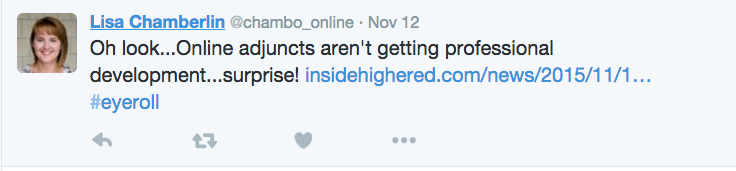
Lisa Chamberlin snarks it best in a tweet:

Screen Shot 2015-11-14 at 12.07.17 PM

I’m not sure how we bring adjunct/casual/sessional labor/labour into the discussion of open education data, but I’ll keep posting questions and thoughts on my own questions. Bashing and blaming adjuncts is not the path forward.

We need to find the ones who fly under the radar and learn from the miracles they perform with students everyday.

So let me conclude here by thanking all of the scholars who are going to gather at OpenEd15. I look forward to reading your tweets, your blogs, your slide shares, and listening to your virtual connections. I’ll be asking: how can your work help our adjuncts and improve our community colleges? How can your work help the student at the back of line at the bookstore get her dream job some day? How? Sounds like I’m a dreamer, right?

Oui. C’est le verite. J’adore le liberté, égalité, fraternité et Vive Le France.

Posted in All The Things | Tagged , | 1 Comment

Full Circle Thoughts

A friend of mine has been reading one poem a day as her practice for 2015. It’s November now, and there are not that many days left in this year. This practice is interesting to me, not so much as the act itself but of the time commitment. The weather in my corner of the world has turned autumnal with all the glory this time of year offers. Plants in the garden are dying. Birds are building thicker nests. The leaves are turning as the winds swirl and rain falls. Pours. It makes me want to brood, read, write, and listen to sad music.

I was reminded of this one-poem-a-day practice as The Pen and The Bell writers sent out a new blog post. I have not read the book (yet) but I read this blog–which is interesting when you think about it. How very meta–I read a blog about a book’s teaching that I have not yet read. This is a practice.

Our practice(s) of reading and how we think is something I’ve been chewing on a bit about since I have some unstructured and unscheduled time on my hands. 147223287_3fe48d5260

It’s truly a blessing to have very little on my calendar aside from trying to pack up my life to move to a new city. Going through pictures, files, books, papers, and gear has me a bit reflective about the time that went by so quickly while I’ve been living in Bellingham. It’s a different kind of cycle. Of housekeeping.

Holly Hughes writes

We need only to look out the window to be reminded that this cycle of life is all part of the natural order. Today, take a few minutes to reflect on the transitions fall brings. Even better, take a walk outside and mindfully kick a few leaves to fully get in the spirit.  Then write down what that felt like, letting the description of fall carry you into your inner landscape and the changes you’re sensing may be ahead.  Whatever you encounter in the months ahead, know that mindfulness and writing will be good companions if you, too, are navigating the waters of uncertainty. 

And this is what I like about their blog. They give you stuff to think about as a writer along with sources you can explore on your own. They don’t write very often, but when they do, I spend some time reflecting and I usually follow their prompts. Through this blog post today I discovered Life, Interrupted by Suleika Jaouad and her words got me thinking about the changing seasons Hughes had asked me think about in her post. A link to another link to come full circle in my thoughts.

Jaouad describes her journal practice, and here are my favorite quotes:

It was a way of organizing my days around one small, simple act of happiness. It helped me to reconnect to myself when the person staring back at me in the mirror had become unrecognizable. Keeping that journal showed me how to write my way out of my private hell. It gave me a voice when I felt I had none and a job to do beyond simply trying to survive. To set a 100-day plan was to will myself into the future, no matter how uncertain it seemed.

It has been a little over a year since I finished my cancer treatment and left the kingdom of the sick.

I joke that I am stuck in the Michael Jackson phase of healing. I’m moonwalking: simultaneously gliding forward and backward but not really going anywhere.

Jaouad charmed me, and I plan to follow her journey. She appears both in photo and on the page like a happy young woman exploring life. She made me smile. Discovering her work made think about how it’s been a long time since I’ve committed to any consistent practice–like my friend who is on her 11th month of reading a poem every single day before she goes to bed. Or first thing in the morning.

One hundred days does not seem like that long, but I can’t imagine what my life will be like since so much is unknown. Uncertain yet certain. Yet this young woman did it in a terrible time of illness. A cycle of illness.

This all takes me back to mindfulness, practice, teaching, learning, and writing.

So here’s what I’m going to do. I’m going to take up writing for the Federated Library Project at least one post a day. I began a new blog a few days ago and in one hundred days since I started it will be February 9, 2016. One post a day. Until then.

Like the post I mentioned above from The Pen and The Bell, I’m drawn into invitations to write. One of the guidelines, so to speak, for this style of writing is to think about how others will use your words. This type of writing is hard for me, and that will take practice. I already see this improvement in what I’ve produced in the federated wiki.

I want to get better with this style of writing because I think it will help me both personally and professionally. This style is hard for me because I want to tell you a story. Argue a point. To journal. To digress. To dream. To blather about what’s in my brain. To you. Not for you.

There’s a difference.

So I’ll do that blathering here on this blog, and I’ll chronicle my 100 days with the Federated Library Project here.

Some days will be better than others, I‘m sure, but here’s the goal from the call for writers:

Write for reuse in this space. What you post should be easy for others to reuse on their site with modifications. So no posts trying to prove a personal point or narratives that wouldn’t make sense out of someone else’s mouth. You are contributing words to your wiki that someone else can use with minimal modification. 

In M Train, Patti Smith starts her latest memoir with a moment of truth, and I’ll leave you with this thought:

It’s not so easy writing about nothing. 

Posted in All The Things | Tagged , , | 4 Comments

Listen-only-mode: A Tele-Town Hall Meeting

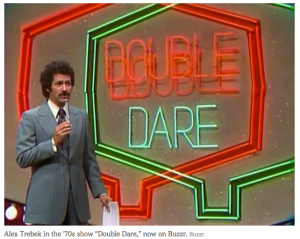
The other night right before Jeopardy, the phone rang–the land line that we are forced to pay for by some giant company who insists that we have to “bundle” a home phone in order to have access to the Internet. Anyone I want to talk to either calls my cell or they know better than to not call my house during the airing of Jeopardy. I loves me some Alex Trebek; it’s one of my favorite television shows. Nerdtastic, I know.

Screen Shot 2015-10-30 at 11.06.25 PM

Lately I have to answer the landline. I’m trying to sell my commuter car because I’m about to start a job where I can take public transit or ride my bike [cue the sound of unicorns galloping in sparkle-dust here].

Soon after saying hello, I expected to hear some bozo trying to talk me down on the price. Instead I hear this polite invitation to join a tele-townhall meeting on education.

Well, pray tell. What the blazes is that? I think.

Some polite woman explains the protocol of the tele-townhall and that I am indeed connected but nobody can hear me. The town hall meeting is in “listen-only mode.”

All the while, the Washington State Superintendent of Instruction Randy Dorn and another administrator give their introductions. Imagine me sitting on the couch with a dusty phone to my ear yelling “What is Punxatawney?” or “What is a Tooth?” or “What is Hungry Hungry Hippos?” Hardly the vision of civic engagement in a democratic town hall meeting, really.

My ears perked up when I heard one them reference open education resources. Hot damn. That’s when I got up and started pacing back to my office. Interesting.

Then there was a question about teachers complaining about too many standardized tests. Hot damn. I went to the fridge for another beer. Interesting.

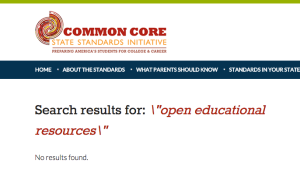
Then there was a poll about the Common Core State Standards Iniatives. I pressed the number one. My response was recorded and put me in the majority of listeners who had heard of  the Common Core prior to this tele-town hall. Interesting. Who are the other 25% who have not heard of the Common Core? (Allow time for journalists who have been writing about this since 2007 to die a small death here).

For my readers outside of the US, the very simplistic summary of the Common Core is an effort to streamline the curriculum of our individual states via federal governmental policy. I’m not an expert to explain this beyond reading the newspaper and listening to public radio. Here’s an even more simplistic summary:

Put your hand on something really big (it may be an elephant, you don’t know). Turn out the lights. Tell me what you see. How does the part connect to the whole? It’s like that. Surely you have an equivalent of some policy confusion in your country. Maybe not.

Let me pause right here to tell you that this was not a town hall meeting in the way that I have experienced them in person in the past. My experiences with town halls involve elementary school gymnasiums, bad coffee, and outspoken self-righteous hippies or conservatives. People taking the microphone with shaky voices. Panels of politicians trying to explain policy. I’m usually in listen-mode then as well, but this was different. I could multi-task with Trebek, drink beer, and say my thoughts aloud. Rude behavior in public.

Some woman started her comment with the lead: “Since the beginning of time humans have…”

I was in “listen-only mode” so nobody could hear my very loud sigh or my disgruntled voice when I said aloud, “For the love of cats with fur, lady! Oh. My. Gawd.”

These platitudes were the exact thing I’d warn my students about when I taught writing. “In society today” or “People today” or “Since the beginning of time” or “Americans in modern society”—write that phrase if it helps, I’d advise, then cross it out and don’t use it.

It’s a waste of space on the page for your argument. Just get to it. Unless you are an anthropologist or historian, don’t talk about the beginning of time. Ever. Just get to it.

Then a mother launched into her concerns about this “new math” and how she doesn’t understand all of the steps. Why we can’t just use the same math she learned. Why do we need five steps when two will suffice. Why did we need to change what worked for others in the past. Why is it that old way of doing math works for successful people she knows now and why we can’t teach that way to our children.

When you cut through her lack of understanding of conceptual mathematics, her very real frustration of not knowing how to help her children with their homework became painfully apparent. After what sounded like a bit of rant, she asked for examples that parents could review so they could help their kids. Teachers were marking down their kids because they were helping children using the old method. Teachers are accountable for this new method so they mark the kids down for not using the process they are teaching. The mother wanted help so her kids grades wouldn’t suffer.

It was a simple request that made my heart ache a bit.

Then another woman shared an example of how she saw a presentation about the Common Core and there was little emphasis on getting the correct answer. The right answer. The process, so to speak, was way more important than the right answer.

This was appalling to my tele-townhall fellow citizen. Appalling! Is this the future we want for our kids? We, as Americans, no longer care about the right answer. I half expected her to build on some platitude about how we would have never landed on the moon if we didn’t care about the right answers. Sigh. Deep sigh. I decided to pet my dog and take a long pull off my beer. I’m sure a vein in my forehead started to pulse.

I was losing interest as I listened to Dorn and his colleague repeat themselves.

Meanwhile, I answered a few Jeopardy questions. Got right back into Trebeck-help-me-pay-off-my-sch00l-loans-study-mode. Bring it!

I’ll take Place Your “Bet” for $800, Alex.

Jeopardy answer: “Your future spouse is this word.”

What is Betrothed?

Jeopardy answer: “To hurt somebody who trusts you.”

What is Betrayal?

To his credit, Randy Dorn handled the next question about the future of our kids’ education quite well by pointing out that American children are creative. Despite the amount of standardized tests, our kids are still praised for being creative. He’s often asked by other countries to speak on ways that we encourage American children to be creative. How our kids think this way. Creatively. How Americans are creative. Interesting.

And thus, I was back in the town hall again. I’ve been arguing that standardize tests kill this very creativity while I’ve been simultaneously cashing a paycheck for grading such work. I’ve been dealing with this guilt of what was necessary and what I believe in as an educator/citizen.

Jeopardy answer: “Pair it with “between” to mean in an awkward middle position”

What is Betwixt?

A few readers have asked about those awful jobs from my last post, and it’s those testing companies again, y’all. Again, I’m not going to move to Texas. New Jersey. New York. My name, my resume, my skills as a fast reader still remain in several databases. If you know Dungeons and Dragons, suffice it to say I was a Level Five Magic User to those companies. And I’m not proud of this. Time is/was money. People who can read and score quickly, well, help those companies earn money. The more we can read and score, the fewer people they need to employ. Magic!

And let me be clear, I really liked some of my co-workers. Some of my managers. I was thankful for this work because it helped me understand the K-12 system that dropped my community college students off on my doorstop so woefully ill-prepared. I understood better how to help them become “college-ready” or “transfer-bound.” I was thankful for this paycheck. I’m not very proud of this era of my life, and I’ll get over it someday.

I am the last person on this planet to defend or explain the value of the Common Core or anything about the true benefits of the “mathematical processes employed by experts” espoused by the policy makers of the Common Core.

Listen to this video where they try to explain why the Common Core is good for students and the future. Note that Eddie, like many of us when we were kids, envision a future of robots who can help us with our lives.

My ethos as a writer, for some readers, will erode as soon as you realize I do not have children and I’m not a K-12 expert. However, I care a great deal about education and my fellow citizens, and what I learned from this tele-town hall is that people do not understand the benefits of such standards, but they care about their kids.

They want to be able to help their kids with their homework. They care about helping their kids. That was common core of parenthood.

Dorn’s colleague mentioned the value of helping teachers understand assessment as a learning tool. I don’t think he meant to belittle teachers at all; he pointed out the changing culture where the value of formative assessments is becoming a “learning tool.” How we need to help teachers understand assessments differently. Many of whom came up in a culture of teacher education where the golden prize was always on the summative assessment. The final grade. The mark on the transcript. The gold star. The GPA. The threshold of whether your students made it or they didn’t. Whether students got it or they didn’t.

Whether you win or you lose.

I’ve been on both sides of this equation and I bet you have too. The absurdity of this whole game became crystal clear to me when I completely lost my mind when I earned an A- in a graduate course a few years back. I cried like a banshee. When I showed up to my friend’s house for a dinner party, he looked at my bloodshot eyes and said, “You look awful, Alyson, what’s wrong?” I got weepy again, and shared my devastating news. I would not be a 4.0 student. Again.

He looked at me and said, “You’re working full-time between two community colleges and going to graduate school. Geez, you need a drink. Academics are so weirdly perfectionist. That’s awesome you even got an A. Minus or not. It’s still a goddamn A.”

And it’s true. I was teaching 6 composition courses and going to graduate school. Add it up. Six sections times 25 students and one little ol’ me going to graduate school trying to be brainy for a second masters degree. Still, I didn’t get that perfect A. That crushed me, and I didn’t give myself any credit for what I did well. For the love of cats with fur.

There is a lot to critique about the Common Core, but there is also something to be said about what it might be doing well in the conversation about educational policy.

Case in point: Superintendent Dorn brought up military families of which there are many in Washington. He used an example of a child moving from North Carolina or Oregon to Washington. If the Common Core works to its potential then that child won’t be so behind. Won’t be so lost in the conversation when her family has to move for economic reasons. Won’t be so behind. Won’t be so close to the A minus when she should have earned an A.

And really, Jesse Stommel’s keynote at NW eLearn helped me see the banality of the whole system of grading. Of scoring. Of evaluating. Of comparisons. Of what we do now versus what we could do as educators. Of the educational mechanism we’ve been taught is the core of our common good.

Here’s the thing.

The telephone. The 20th century mode of  technology for communication we call the land-line sent me into hours of thinking about K-12 education. The telephone connected me to other people who care about education. The telephone helped me see a potentially missed opportunity of open education in this new policy.

Screen Shot 2015-10-31 at 10.02.20 AM

The telephone brought the voices of politicians and policy makers to people who cared enough to answer the phone.

Is this a new form of democratic participation? How many others let the call go to voicemail?

Better still, who are the 25% who listened to that call and thought that K-12 education should not prepare students for college. Do they want students to go into trades? If so, do they know colleges teach those courses too? Are they pessimistic about the future? Do they see education as needless situational trivia that won’t create systemic change?

Why bother, do they think, when an education didn’t help me get a leg up in the world?

Better still, how can we help that mother feel more confident when she sits down to help her kids with homework? More importantly, how does/how could open education fit into this model of standards for a common core of American education?

I’m not sure, but I’m very much in listen-only-mode.

Posted in All The Things | Tagged | Leave a comment

Remixing The Memoir: I’m Moving To Portland, OR

Over the last two weeks, I’ve been offered two dream jobs, two awful jobs, one job that would kill my soul, and one delayed rejection from a job I had already assumed I did not get back in August. Checking my inbox these days, in short, has been a bit weird. I accepted one job with great public gusto, and threw myself into the reality that I was going to move across the country to work for one of my favorite scholars/women. Discussions with my spouse have left me sleepless at night because my new opportunity did not quite align with his career plans. Again.

After putting in my two-week notice at my last job, I passed on responsibilities, nominated replacements for my duties, wrote how-to manuals, cried through many goodbyes, advocated for the promotion of my Instructional Designer, and stumbled through the awkwardness of an exit interview. It’s been an incredibly emotional month filled with big decisions and questions about my little family’s future.

The Monday after #dLRN15, I roamed around SFO looking for a plug to charge my laptop and cell phone. I pulled up a chair to check my correspondence as one does at the airport, and there was an email from Kim Thanos, the CEO of Lumen Learning. This was not entirely odd since she and I were scheduled to present together at NW eLearn in a few days.

I’ve been working with Lumen since the start of the year on the Next Generation Courseware Challenge grant as one of the two liaisons for my beloved SBCTC, and I’ve helped several faculty adopt Lumen’s textbooks. Correspondence with somebody from Lumen Learning has been a regular part of my professional life and I have been an enthusiastic supporter of their company. Unlike many vendors who have hounded my inbox when I was Director of eLearning and Instructional Design, they were the only company who talked about helping first-generation students with OER. The poor. The disadvantaged.

The People who struggle in higher education with what Marcia Devlin brilliantly summarized as “cultural capital” in her #dLRN15 keynote.

These are topics near and dear to my heart because 22 years ago, that was me. Thankfully I had a mother who drove me to the public library book mobile and a father who helped me believe in myself. My parents did everything they could to teach me the value of a college education and continued to love me as I struggled to find my way back to college. Teaching community college students for over a decade made me realize how lucky I was that my home life helped paved the way for me to figure out what cultural and social capital was necessary to make it in higher education.

The open door policy of community colleges is worth fighting for, and open education, I believe, is not a utopian ideal but a real tangible solution for students and teachers during ever increasingly austere times. The very real binary thinking for community college students is that they can either afford their textbook or they cannot. They can either afford college or they cannot.

Hearing people talk about these ideas at #dLRN15 was inspiring and meaningful to me. These were the ideas very much on my mind as I dialed Kim’s number last week.

During our call, Kim and I exchanged pleasantries, and she got right to the point. She told me that she and David Wiley had discussed that they would like to hire me for an Instructional Designer position. My jaw dropped as I listened to her offer. To her ideas. To her plans. To what she and David had discussed about my work. To her invitation to hire me. To hire me for her team at Lumen Learning. To hire me. I don’t think I closed my mouth the whole time she talked, and I’m sure my face went pale.

After gathering my wits enough to ask her for some time to think about it, and I sat there and stared at the people in the Cinnabon line. Took deep breaths only to become nauseous from that sickening sweet smell of cinnamon roll chemistry. People passed by in the usual hurried pace that you only see at airports. I listened to the sound of luggage wheels. I listened to flight cancellations and calls for lost people.

Then I called my husband and said, “You’re never going to believe this, but Kim Thanos just offered me a job as an Instructional Designer.”

He started laughing really hard and said, “Nobody gave a rat’s ass about anything you did for ten years and now look at you. Getting offered two of your dream jobs in one week! Damn, I’m so proud of you.” He continued to laugh really hard.

I asked him to cancel our dinner plans that night with our friends in Seattle and I gave him a list of links to check out and do some research about Kim, David, and the Z Degree so that we could talk about this offer.

Then he said with some glee, “There are so many places I could work in Portland. I’ve been really worried about my future possibilities in rural Vermont. Portland is a place that has always been on my list of cities I think I would love. The cycling scene is awesome.”

With that, we hung up and I got on my plane to Seattle. Flying out of the Bay Area into the clouds gave me time to reflect on how much I disliked living in California back in the late 90s. How much I felt like a fish out of water. The oddball. The weirdo. I then ran through a list of places that I have lived where I have felt like an outsider. Where it’s been hard to make to friends. Where it was a risky move that either left me broke, broken hearted, and/or depressed.

Last week after dinner, Scott and I paused to watch the sunset by Bellingham Bay and he said, “you know I thought we were going to grow old here together. Going back to New England is something that I thought I’d always do, but you know, I really love the life we have in the Northwest.” We watched the sun slip down and under Lummi Island on the horizon.

It’s been very difficult to imagine leaving my friends, my network, and the only place that has felt like home. The Pacific Northwest is the only place I have ever felt at peace since my parents and I moved to Georgia when I was nine. In some ways, I’ve felt like “the new girl” everyplace I have lived except for the Pacific Northwest.

The plane descended and the giant mound of Mt. Rainier came into view. The plane tipped west towards Seattle and we flew right over the Space Needle and Frank O. Ghery designed Experience Music Project. There were two ferries crossing in the water. Mt. Baker was in the distance, and the Olympic Mountains were out.

That’s my favorite NW saying, by the way, “The mountains are out.” It’s optimistic code for it’s clear enough to see all of the mountainous glory that made me fall in love with this place. This region. These people. These mountains.

It was a picture perfect PNW afternoon. I knew then, I had to stay in the PNW.

Scott greeted me at the airport and launched into an enthusiastic summary of what he had learned about Lumen Learning from the interwebs. What he had thought of their work. Their goals. Their mission. Their leadership. Their scholarship. Their location. He said, “I think you’re a perfect fit for this job, and they are doing some really interesting and cool work. I am really impressed with Lumen. Plus, Portland could be so much better for me.”

He then launched into the nightmarish logistics that were starting to mount about our move to Vermont. Our semi-reliable 1987 VW van wasn’t selling. Nobody was interested in my commuter car because of the VW lawsuit. Danke shon to that liar at VW, my car now books 5k less than what it should be worth.

Finding a place to live on the other side of the country was proving to be a lot harder than we thought. The mister had been hiding how worried he was about his employment opportunities because it was such a great job for me. Like any devoted spouse who is also an academic in the humanities, he put on a good face on to support me.

Moving in five weeks in the winter, in reality, was stressing us out. To complicate things further, I am going to China for two out of the next five weeks to present about American OL education on behalf of the SBCTC with Jess Thompson. I’ve also been gone a lot in the last weeks with the last two conferences, so he has been unfairly left with all of the crappy logistics of moving. [More on China later, readers, I am really over the moon about this opportunity.]

Listening to him objectively list out the positive and negative about both jobs, everything that was once a cracked abstract mosaic swirled into concrete beautiful picture of our future.

When he finally paused, I said, I’m going to take the Lumen job, but it’s going to be very difficult to turn down the opportunity to work with Amy Collier. I regret that I had been so public about my decision, but really, who knew that this would happen? I applied to Lumen Learning back in November 2014, and didn’t hear back from them then. This offer was so completely unexpected and beyond my wildest dreams.

Scott drove us to Capitol Hill to my favorite sushi restaurant Ha Na, and then we got coffee from my favorite barista stand, Caffe Vita. We sat on a bench and people watched. Reminisced about the first time we moved together. How things have changed so much. How it would be easier for him to defend his dissertation if we lived in Portland. How he’s had a recent breakthrough that his advisor supports so his writing has been productive lately. How much easier it would be to move and look for a place to live. How Portland has such an amazing cycling culture. How I’ll still be within train/driving distance of my best friends who feel like the sisters I never had. How it’s so perfect for both us in so many ways. How it will be a big change yet familiar at the same time. How I know I will love working with Lumen Learning.

A few friends gave me advice and talked me through this decision, and I love you all. Amy is going to build an unbelievable vision for the future of her college, and I am deeply sorry for any delay in momentum this decision may have caused. The work that they have already begun will be exciting to watch from afar.

So let me riff of one of the five R’s of Openness, and share with you, dear readers, that I’ve decided to remix my memoir a bit. I am the newest team member for Lumen Learning, and I’m moving to PDX to be their Instructional Designer. Wow!

I am still processing the joy of #dLRN15, the difficulty of giving up one dream job for another dream job, and the homecoming of NW eLearn, so I’m just going to close with one of my favorite Replacement songs. I really need to curl up with a book and take a nap with the dog.

Posted in All The Things | Tagged , | 22 Comments

Chihuahuas Among the New Foundlands: The Need For Communities of Practice 2.0 #dLRN15

I’m not ready to reflect on dLRN15 yet on the interwebs, but here is the paper that I presented there at Stanford University, October 17, 2015. Thank you, lady leaders Amy Collier, Bonnie Stewart, Lee SkallerupAdeline Koh, Kristen Eshleman, and (and others) for supporting me in the audience. Joshua Kim, thank you for the encouraging smiles–there were several frowns as I sped up and totally lost control of my slides. Also, the mention/misuse/idealization of the Amish in the preso before me got my heart rate up, so allow me to recommend The Devil’s Playground.

I’m still in awe that anyone missed Rolin Moe to listen my train wreck preso, so my sincere gratitude for attending. For those of you who could not be there, here is the draft in its entirety. I tried to cite scholarship that is available on the web so that any adjunct, sessional, casual, or part-time teacher can access this work when you are in between contracts without access to data-bases.


In one year, my position in at a suburban community college’s eLearning department changed four times. First I was hired a consultant, then as a faculty-in-residence Instructional Designer with an eventual promotion Instructional Designer. After a failed national search, I was promoted to director, largely in part because I told the dean, nobody knows what an instructional designer is, but they all know we don’t have a director. Thus I moved into administration taking a giant leap from an adjunct to an eLearning Director. The move was a bit controversial among my colleagues who were also friends. At the time, we were going through an LMS transition and many of the faculty felt relieved because they knew me; I had an established network of colleagues from a variety of disciplines.

Amidst their congratulatory messages, they felt quite comfortable telling me that I had “gone to the dark side.”

Or my personal favorite tongue-in-cheek congratulatory remark: “I was now at the table with the big dogs.”

For my friend/colleagues, they took to making fun of “my big dog status” on campus. As somebody with an English Studies background, I couldn’t help myself; I could only think of clichés or sayings involving dogs.

“If you can’t run with the big dogs, you better just stay on the porch.”

Or this endless thankless job in EdTech makes me “dog tired.”

Teaching with technology is hard because many believed that “you can’t teach an old dog new tricks.”

The cliché, however, which sums up my experience as an administrator is “so little of the tail wags the dog.”

It’s true. This position gave me access to the truly big dogs, but really, I lacked power and influence. My first quarter in the position, I made a point to network with the major power players on our campus—the tenured faculty. More than once, they would greet me, get up and shut their office door, and advise me on “what to tell the big dogs.” My inner labor activist felt honored that they thought I could do something to improve their working conditions. Another part of me knew the reality that I had little, if any, power. During one of these eloquent speeches faculty usually employed the phrase “You’re good with technology, all I want to do is teach [enter discipline here]. Now that you’re a big dog, I’m feeling optimistic because you understand our world as a teacher—us little dogs.”

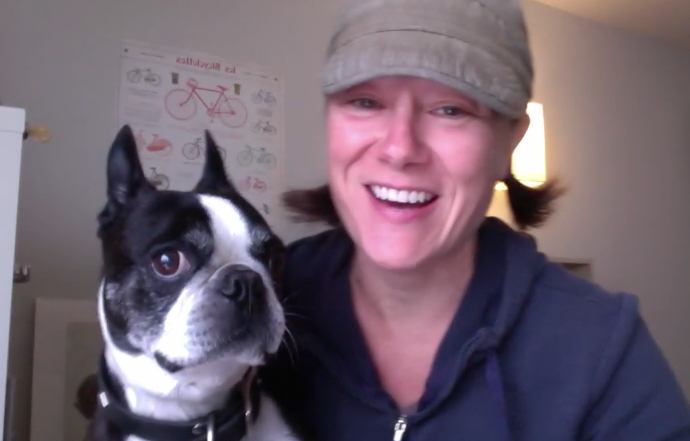
Allow me to pause here and admit that I have a bit of an abnormal affection for little dogs. The best little dogs do not know that they are little dogs. Have you ever observed a little dog among larger breeds at the dog park? Once at a dog park in Seattle, my beloved Boston Terrier, Elroy, knee-high at just a year old and 25 pounds was too rough and rowdy for the quarantined small breed dog park. He overwhelmed small dogs that should have been his peers. When I let him off the leash in the big dog park, he would look for the biggest dogs and engage them to chase him. My heart was in my throat the day I watched four muscular pit bulls chasing him like he was a mechanical rabbit at the dog track. I’d never seen him so happy as he cut them off with a 180 degree turn tricking all of them.

It dawned on me, he had no idea he was a little dog. In that space, he was just another dog burning off excess energy as a “pack agitator.”

note missing teeth. Bar fight 2006.

Missing teeth? Rowdy bar fight 2006.

This all got me thinking about the little dogs, who know they are little dogs in organizations in higher education. When those little dogs ask hard questions, the big dogs see you as a pack agitator. Or worse still, they ignore you and you don’t exist.

That’s a bit what it feels like when you’re an adjunct seeking professional development funds among full-time faculty.

Often, it seems that all but the most barren peripheries of the park have already been well marked, and that which is ostensibly the community water bowl has been placed just beyond your reach.

Depending on the institution, the title “faculty” may be defined by administrators as either tenured or tenured-track. Why invest in adjuncts, administrators will ask, when they will just get jobs someplace?

Participate in CogDog's narrative call, for Christ sake.

Participate in CogDog’s narrative call, y’all. He shares so much. Hook a brother up.

When I shared this sentiment with my colleague and fellow open education Christie Fierro from Tacoma Community College, she said, “Alyson, please don’t ever say that to me again unless I have a bourbon in my hand.”

She and I, in the grand scheme of the open education movement are little community college dogs, yet we know the real power of the big dogs.

Sitting here today, I feel very much like the Chihuahua among the new foundlands of educational technology scholars. Reading your work—on Twitter, on blogs, in academic journals—helped me situate what I could and should care about as an educator interested in technology. My philosophy as an instructional designer is to help create what did not exist for me as a student, as a teacher and—especially—as an adjunct. Today, as I have access to some of the best minds in this field, I want to ask questions of how to advocate for that untapped potential of the digital space for adjunct faculty collaboration.

The efficacy of online instruction is comprised by the lack of collaborative professional development opportunities for adjunct faculty. The way we change this locally and systemically is to fund, support, and advocate for faculty learning communities—but they must be online with flexible course design.

Most of the scholarship about Faculty Learning Communities, or FLCs, ignore the digital space and assumes that meaningful faculty collaboration must take place in the synchronous face-to-face setting. What would it look like if we connected a regional consortium of faculty using the digital space? What would it look like if we connected a small liberal arts college with its satellite campuses and institutes to the main campus community? What if meaningful faculty collaboration was an institutional priority? What if we funded asynchronous networked learning within such a consortium or organization? In short, we need to imagine a Communities of Practice 2.0 that incorporates the digital space. How we can network, motivate, and mentor a new community of practice(s) for teaching and learning in the digital age?

Let’s start with defining a community of practice with a faculty learning community (FLC). For the purposes of this paper, I’d like to use three frameworks: The Milt Cox Miami University model, Lave and Wenger’s definition rooted in anthropology, and John Dewey’s notion of “learning through occupation.”

The Miami University definition is “an FLC as a cross-disciplinary faculty and staff group…who engage in an active, collaborative, yearlong program with a curriculum about enhancing teacher and learning with frequent seminars and activities that provide learning, development, the scholarship of teaching, and community building (Cox, p. 8).

Lave and Wenger’s anthropological definition from the 1990s, put simply, is a community of people who share a craft. All of which have roots in the foundational ideas of John Dewey’s notion of “learning through occupation.”

Who better than teachers to explore learning through their occupation as a community of people sharing a craft? Consistent attendance is a requirement cohesive sense of community. Maintaining a network takes time. Learning takes time. If we think of teachers sharing their craft in a community of learners, then the question of how and when to practice is what I tried to investigate when I co-facilitated an FLC in 2014-2015.

For our FLC, we were ambitions by trying to connect five colleges within our consortium who were facing a similar challenge. We agreed to meet face-to-face and online using Blackboard Collaborate. By setting up a book club where we all read the same text; we also got to select a text to match our individual research. The conditions of the grant allowed us to buy books and some refreshments, but we could not pay for labor. Books, I thought, could be a generous gift to encourage conversation and participation. Agreeing to be a part of this FLC meant taking on additional work, or “other duties as assigned,” and in theory, we had a fantastic plan for meaningful discussion and sharing of research.

My failure was in the way I connected members of the FLC. Everything fell apart with the usual complications of diminished administrative support, varying teaching schedules, and the loss of any momentum when our primary mode of communication was email.

Three months into the FLC, the specter of failure loomed as my emails and Doodle polls got lost in the eFlood. Knowing that it was going to be my job to report on the budgetary substantiation from a theoretical standpoint, I redirected my focus to explore what an FLC might look like if it was completely online from the beginning. Send the books, read, think, and then post. Just like that. Like many researchers with a failed research plan, I used my mistakes as a way to experiment with questions that I knew might take me years to answer. With the right encouragement, I thought, maybe I could take this old FLC dog teach it a new trick.

From when I used to entertain myself on Pinterest. Labor is political.

From when I used to entertain myself on Pinterest. Labor is political.

As I read about the history of FLCs in the United States, I grew frustrated with the privileging of the synchronous. What we used to/still call brick and mortar model of collaboration. I needed to look at the history.

In “Assessment of Faculty Learning Communities: Considering Social Dimensions of Participant Choice” Goto, Marshall, and Gaule (2009) explores how faculty learning communities are a powerful means to encourage vibrant intellectual exchange and professional growth on college campuses. Moving educators out of traditional departmental and disciplinary silos helps to foster an institutional culture of collegial interaction (emphasis in italics mine, all quotes below from this report until next link).

This report focused on the creation of Teaching Labs, where the authors give a brief mention of the use of technology with this description:

The innovative part came with the follow-up meeting, during which participants were expected to devise ways of applying the e-learning tool that was demonstrated in the workshop. This went beyond the typical drive-by tour of gadgets that sometimes occurs in technology workshops.

Instead of just training faculty on where to click, the Teaching Lab helped teachers contextualize how integrate and experiment with the tool into their classes. What is also interesting to note is their astute reflection on the power of the FLC grant locally by invoking the clout of the state board, which “elevates the status of FLCs in the eyes…of the administration.” In yearly reports and other forms of braggadocio, upper administration could say that their institution won this prestigious grant. Administrator ego, like that of the academic, can be a powerful motivator for institutional change. Administrators need wins. The support of administrators at local institutions to pay adjuncts was mentioned briefly, and most of the analysis centered on faculty who participated in these FLCs.

Financial incentives, in the way of stipends “sen[t] a clear message to faculty that these activities are valued by the college.” A few years later, as a result of this study, the state board created training for the facilitators to mentor new faciliators using ten methods of consideration. They advocated for the need to establish safety and trust, openness, respect, responsiveness, collaboration, relevance, challenge, enjoyment, spirit of collaboration, and empowerment. An esprit de cour is also important during the yearlong collaboration.

My fur went up, so to speak, as I questioned how do you initiate an FLC with adjunct faculty when they often don’t know their teaching schedules with a few days of the start of the new quarter? How do you include people who may or may not be employed at your institution for a full year? As explained by the grant guidance for WA SBCTC:

FLCs increase communication and collaboration amongst faculty who, by the nature of their work in individual classrooms, are often isolated from their colleagues.

How do you establish an esprit de cour with people who feel isolated from the very model that is trying to include them? Cox, Richlin, and Schulman answer this question by stating “the challenge for campus leaders is to devise an implementation strategy that pulls people towards voluntary FLC acceptance. It is easier to implement a change with people than to change people” (p. 45).

In Creating the Future of Faculty Development: Learning From the Past, Understanding the Present, Sorcinelli, Austin, Eddy, and Beach (2006) conclude their anthology with a chapter titled “Faculty Development in the Age of the Network.” As with most educational theorists who are trying to engage readers with more questions than answers about the future (high-five!), they present their ideas as the fourth stage of the history of faculty development. The Age of The Network has roots in the movements from the Age of the Scholar, The Developer, and The Learner.

Although the titles of these historical movements suggest a focus on the people, the institution still values the investment in faculty development as either prestige or proof of accreditation. The Age of the Network suggests that we are now more enlightened about professional development.

I’m not sure that’s true.

They pose the following question:

As the context for higher education changes and faculty members assume new roles and responsibilities, faculty development professionals and senior institutional leaders must grapple with the question of the place of faculty development within the institutional landscape. Will faculty development be a useful but marginal resource, or will be conceptualized and organized in ways that make it central to institutional quality, health, and excellence, and essential to individual faculty members’ growth?

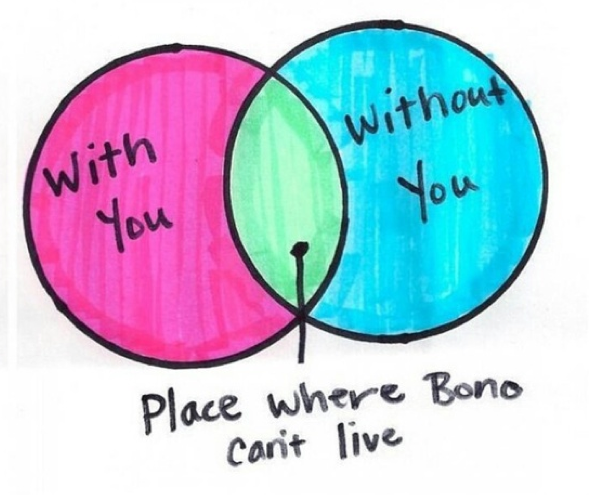
Where Bono can't live is what does not get funded.

Where Bono can’t live is the space between the past and the future. What doesn’t get funded with professional development in EdTech.

When the author posed this same question to the attendees of a POD Network conference, they created wonderful images of faculty developers as Venn Diagrams, sherpas, or candle bearers.

Many of the developers’ images of the future of the field of faculty development were about linkages and connections. Faculty developers drew themselves creating opportunities for faculty and other constituencies to network, communicate, mentor, and learn from one another (p.176).

Yet, those connections are not what is valued in tenure portfolios, scholarship, and nor is it encouraged among our adjuncts. Usually, in my corner of academia, and perhaps in yours, the network has been something people create on their own time. This divide is counter-productive to sharing meaningful ideas for professional development.

My day job, so to speak, was to investigate the use of the digital space for the revamping of our teaching and learning center with this FLC. During that time, I participated in the two Happenings facilitated by Mike Caulfield using Ward Cunningham’s federated wiki as my volunteer night-time/weekend job.

What I affectionately call “the hobby job” or what others may refer to “Scholar Sunday.” Initially what I perceived as two completely different spheres started to overlap, and during the day I was being told this asynchronous learning couldn’t work for professional development. Not yet at least. During the day I was experiencing what Amy Collier and Jen Ross have called notyetness, which is the practice of

creating space for emergence to take us to new and unpredictable places, to help us better understand the problems we are trying to solve.

One institution’s notyetness may not even be on the radar of another institution. Lisa Chamberlin captures the complexity of emergence brilliantly as quoted by the fabulous Frances Bell:

The ideas of not-yetness at an MIT or Stanford are so far beyond the realm of my little community college that they would intimidate or even shut down emerging technology is a discussion for all but a few of the most technologically-edgy of faculty at my school.

Collier, Ross, and Chamberlin summarize the day job notyetness, yet night and on the weekends, pardon the pun, it was happening.

Since December 2014, I’ve been a part of a life-changing network that feels more like community with the federated wiki. I’ve learned the power of The Newfies who nudge the Chihuahuas.

And this process has taken time. It’s been a meaningful practice with my learning and the learning of others over time. Time.

It’s my lived experience in “the garden” that Mike Caulfield got us thinking about in his keynote that I am attempting to advocate for others.

And it’s hard to give people–teachers–time to learn when they aren’t around. Sessionals. Casuals. Adjuncts. Part-time.

In the Special Report from the CCCSE 2014

The roles and concerns of part-time faculty differ from college to college, and in fact, considerable differences emerge across divisions and departments with the same college. But what really should and often does matter most to part-time faculty is the same: effective instruction and support for students. It is the institution’s job to create the conditions that encourage and enable that work (p.3).

Did you hear that last sentence? It’s the institution’s job to encourage and enable that work.

They go on to report:

Data on the structured group learning experiences also show that part-time faculty are rarely engaged in any role other than teaching. Planning and designing the experiences, advising or referring students to them, training related to the experiences, and all other non-teaching activities are typically undertaken by full-time faculty (p.12).

As college leaders consider how to strengthen the roles of part-time faculty, a key element is the importance of faculty members’ interactions with one another, not just students. Part-time faculty need the opportunity to form collegial relationships, discuss data and the questions they raise, and to benefit from peer feedback on their teaching. In many cases, particularly for faculty who teach only in the evening, on weekends, or online, part-time faculty don’t have the opportunity to pass their colleagues in the hall (p.15).

Teachers who feel supported and valued transfer that satisfaction onto their students.

Instead of seeing this task as daunting, we can facilitate professional development by understanding the symbiotic nature of student and teacher success. As we look for more ways to ensure student success, we have to think of ways to support teachers who have long-term goals and short-term contracts.

This lack of collaboration also damages the institution’s ability to build a cohesive curriculum

If part-time faculty teach a majority of course sections, as they do at many institutions, colleges cannot implement a student success agenda without involving part-time faculty at a higher level (p. 17 of CCSE 2014).

We need a Communities of Practice 2.0 using the digital space. We need to blow up the edges of the FLC model and expand its potential to include the digital space. The FLC model, as it stands, works for small-scale professional learning that is campus-specific. Departments and divisions can change their cultures bit by bit with the FLC model. Administrators on campuses should fund their faculty to spend this time together. You can create an FLC where you tempt participants with free donuts and coffee or you can be honest. Teachers do not know up for professional development unless you pay them. You have to pay people or they don’t show up. You have to pay people.

Pike (2008) recommends

that assessments of learning communities take into account the nature of the learning community influences the outcomes, participant characteristics influence outcomes, effects of learning communities on learners are indirect, and well as effects of learning communities may vary among institutional types.

This work leaves me with more questions than answers. How do we define professional development for instructors in 2015? How can we foster professional growth that is situated and contextualized for faculty? Recently Mike Caulfield gave his students advice on a shadow syllabus: “Stop asking how technology can help you teach and start asking how technology should change how you teach.”

Why don’t we ask the same question about professional development? Why hasn’t technology changed teacher collaboration?

In “Institutional Considerations in Developing a Faculty Learning Community Program,” Despite seeing little reference to taking the digital space seriously, Milt Cox makes one comment that rings true.

Unfortunately, learning communities always seem to push against an institutional glacier that grinds away at innovation, smoothing it out and trying to make it like everything else (p.8).

Some Random Dude recently described this glacier in his blog post Adios Ed Tech, Hola Something Else as trying to get away from learning experiences where you “Sit and click.” He reminds us that “So much of learning involves decision making, developing meta-cognitive skills, exploring, finding passion, taking peripheral paths.”

To enable this mindset for faculty, there are three key conditions that help facilitate this work–access, authority, and resources—depending on your context you most likely have two of three.

I’d like to say that I have concrete solutions to share. I’d like to say that I’m telling you something that you haven’t already heard. I’d like to tell you that I have all of the answers grounded in theory and hard data, but I can’t. It’s not there yet.

I do, however, have access to some of the best minds in EdTech today. So I’d love to open up discussion by asking you three big questions for about professional learning.

My BIG QUESTIONS ABOUT PROFESSIONAL LEARNING

  1. What do you do at your college (and how well does it work)?
  2. What do you wish you did differently?
  3. What do you do to incentivize professional learning (for FT and PT)?
  4. What would you like to learn from your colleagues?
  5. What would professional learning look like on your campus if nobody could say no to your ideas?

Please respond to my blog, post your thoughts, or email me alysonindrunas@gmail.com. I’ve been collecting the responses from faculty developers since our Unconference last May. I realize this presentation is largely anecdotal. Soft-research. Not grounded in traditional data. I’d like to get serious about this research and help connect the dots to create the picture I’d like to see, but I need your help.

Screen Shot 2015-10-16 at 11.59.55 PM Screen Shot 2015-10-17 at 12.03.52 AM

I will conclude with a quote from, Jennifer Whetham, who is the program administrator with the Washington State Board Community and Technical Colleges who described the result of this grant as a

collaborative journey to continually push the purpose and function of the FLC grants is not a linear one.  It requires imagination and pushing boundaries and stepping well outside of our comfort zones.  It requires re-reading what could be perceived as “mistakes” as the potential for new direction and expansion.  We must continue to ask questions to which there are not simple or elegant answers.

If you’re here at dLRN, you get it and your ideas could make a difference somewhere in somebody’s network.  Your bark as a Big Dog gets heard; so I’d like to encourage you to howl.

Thank you.

Posted in All The Things | Tagged , , , | 6 Comments

Whirlwinds @vconnecting & #dLRN15

“Yes: I am a dreamer. For a dreamer is one who can only find his way by moonlight, and his punishment is that he sees the dawn before the rest of the world.”
― Oscar Wilde, The Critic as Artist

The last month has been a whirlwind. Despite the train wreck I sometimes appear to be, I am actually a bit of a planner. Sometime around August, I thought I had plenty of time to write my presentation for #dLRN15. How the bloody hell I got into presenting at this gig is still completely unbelievable to me. I thought I had plenty of time to write a fun article on hiking to fire lookouts in Washington State. Plenty of time to write. Plenty of time.

Then the whirlwind of trying to get the job of my dreams swept me up, and suddenly that time was sailing off into the sky. Putting a two-week notice in at work at a time when we were already short staffed felt like the winds of change had spun into a giant hurricane. Having worked at that college for 12 years left me with a ton of files. A ton of work to file. A ton to sort, transfer, translate, and delete. Saying goodbye to so many people I love, admire, and adore has been incredibly difficult. I feel like I’m leaving the department better than I found it, but I also know it’s not going to be easy for people I’ve left behind for the next few months.

Yesterday was the last day of the job and today I’m in airports traveling down the west coast to Stanford University for the Digital Learning Research Network (#dLRN15 on the Twitterific). For those of you unfamiliar with this conference, here is the blurb:

The dLRN Conference – Making Sense of Higher Education 2015 – will offer a state of the field assessment from top international researchers and educators. Conference sessions and speakers will explore the most pressing uncertainties and most promising applications of digital networks for learning and the academy through five lenses: The Ethics of Collaboration, Individualized Learning, Systemic Impacts, Innovation and Work, and Sociocultural Implications. 

When I first saw the call for participation, I started to carve out time on my calendar to read and follow along because there was no way in hell that anything I was doing would be interesting to these people. These people, unlike me, I thought, are the Big Dogs of EdTech. Of teaching and learning online. Of everything I find really interesting with teaching and learning these days. When I saw the names Kate Bowles, Bonnie Stewart, Mike Caulfield, and Dave Cormier–I thought, double high-five Random Dude for helping make this happen. You rock! I’ll watch with interest. I’ll read with inquiries. I’ll tweet. I’ll make a point to do what is called is lurking.

Let me tell you how much I hate that word. Lurk.

Lurk–rhymes with jerk. Lurk–rhymes with irk. Lurk–rhymes shirk. Lurk–rhymes with squirt. Lurk–rhymes with Kirk. As in Captain Kirk. Okay, that’s better.

But really, the term “lurk” makes online non-participatory readers and thinkers seem like creepy voyeurs. As people who are not invited. As people who are not welcomed. Lurking on the internet–that irks me. Can we please stop using that word to describe who learn with us? Who read with us? Who share with us?

Let me drop some wisdom from Captain James T. Kirk:

They used to say that if Man was meant to fly, he’d have wings. But he did fly. He discovered he had to.

Let me also drop some wisdom from some Random Dude who shares why he saying Adios Ed [to] Tech. Hola something [to] else. In the following excerpt, he summarizes my frustration with eLearning and something I was tempted to put in my resignation letter:

Sit and click. Sit and click. So much of learning involves decision making, developing meta-cognitive skills, exploring, finding passion, taking peripheral paths. Automation treats the person as an object to which things are done. There is no reason to think, no reason to go through the valuable confusion process of learning, no need to be a human. Simply consume. Simply consume. Click and be knowledgeable.

My framework for technologies in the edtech space now, those that I find empowering for learners and reflective of a human and creative-oriented future, includes five elements:

1. Does the technology foster creativity and personal expression?

2. Does the technology develop the learner and contribute to her formation as a person?

3. Is the technology fun and engaging?

4. Does the technology have the human teacher and/or peer learners at the centre?

5. Does the technology consider the whole learner?

A-frickin-men. What he said.

Kate Bowles takes up this radical notion of considering humans before the technology in the stitches of the day post:

First of all, what if we imagined higher education as a person? 
Would it be someone who shares our views, or someone different? Would we enjoy being around this person? Standing at the foot of this sign I realised that I often find myself thinking of higher education as someone I wouldn’t want to get stuck next to on a plane. This is even though I have inspiring and encouraging professional and academic colleagues, at every level including those who manage my work.

Kate’s use of an awful airplane partner reminds me of two things. 1] Richard Branson’s “disrupt education nonsense” that Alan Levine and others hopped all over to make fun of—thank you for the laughs.

And 2] recently I was stuck on a plane in the middle seat between two very large men. The sheer girth of their upper bodies crept into my middle seat, and I felt cramped. Grumpy. Bitter. Then the one guy said, “Well, I guess were going to get close on this flight. You’re the same size as my girlfriend and she always complains about how much space I take up. I’m really sorry.”

And he tried to pull himself in closer and shrink his upper chest. One exhale and his elbows were right in my seat again. I shrunk up my arms to type like a pterodactyl. Sorry, he said, can I buy you a drink?

I’ve used Sarte’s “Hell is other people” a lot but you know sometimes, it’s pretty heavenly. It’s genuine. It’s exactly what helps me make sure my inner moody loner doesn’t get lonely.

On Kate’s post, she picks up on this feeling with an excerpt from the fabulous Catherine Cronin:

what does it take to see something beautiful in the future of human learning, that makes it still worth working towards that future together?

As the terrain beneath and surrounding higher education shifts, what possible futures do you see? Are any of them beautiful?

Yes, a lot of them are beautiful. A lot them can be very beautiful.

Here’s the thing:

I never in a gazillion years thought I’d get accepted to present at this conference. When I asked my brilliant editor, aka my husband, to read over my proposal, he read it with the same obligatory gusto he normally does with my work. And he knew I was sad I got the diss for OpenEd.

So basically, you’re pitching the idea that institutions should pay adjuncts to collaborate online to improve their teaching? At Stanford? In Palo Alto? How will you substantiate that in Silicon Valley? he asked.

This is about the future, yo. These people are big dogs in EdTech, but they love the little dogs. They’ll get it. Don’t you fret.

He helped me iron out the title of my paper/preso: “Chihuahuas Among The New Foundlands: The Need For Practice 2.0” and with this title, I tried to do three things.

1] I love a bit of an abstract title that tells you bit yet leaves more open for interpretation. I’ve served on a few conference planning committees, and titles are everything. Organizers need to drum up interest, so hook a sister up on a committee and get nutty with your titles, people, it helps make that planning process easier.

2] I wanted to keep it vague enough that I could change my mind 7,891 times before the presentation and drive myself batty with options. I’m still not done. (Christamighty).

3] I wanted to play on the 2.0 technology talk. So many salespeople hit me up with 2.0 this and 2.0 that and how their product will help my teachers better. Faster. Cheaper. I deleted all emails from all of the disruptor 2.0 snake-oil companies. Click and Delete.

The only company I built a relationship with on behalf of my teachers was Lumen Learning. Sorry, other non-Lumen product people, I’m sure you’re lovely, but your 2.0 sucks just as much as 1.o.

The 2.0 idea that I’m going to pitch will be filled (I hope) with solutions to problems I know exist because I’ve witnessed them firsthand. I’ve suffered because of them. My students suffered because of them. Adjuncts suffer because of them. People suffer.

One of the “out there” solutions is already happening and succeeding quite well without my start-up help! I’ve watched the folks getting Virtually Connected off the ground or into the interwebs and I’ve been delighted to [enter word that is not lurk here].

There is joy in that collaboration. Connectedness. Meaning. Love. Respect. Pride. Awe. Participation for people who can’t be there for a variety of reasons. You don’t just sit and click. You don’t want to change your airline seat. You feel happily connected with people.

Here’s what it looked like for me yesterday, and it was pretty cool.

And check me out. I get there late. I have to switch browsers. I stumble through my introduction. I look like a gigantic dork. I about bounce out of my chair when Lisa Chamberlin shows up. But you know what? I got to experience what it feels like to be there virtually. To be virtually connecting. And dammit, it was fun.

So this blog is my attempt to see if I can write a post between two airports while extending an invitation to join us if you can. Or watch later. Either way, that’s the magic of the internets.

It’s there for you when you are ready to learn.

Now for the #dLRN15. Hope to see ya on the Internets, kids. I got a plane to catch cuz I’m going back to Cali!

Posted in All The Things | Tagged , | Leave a comment

The Job Of My Dreams: A Memoir

Our work involves designing new, innovative solutions to solve the tensions between traditional academic approaches to learning and new, less traditional ones.  ~Joanne Munroe “Assessment Incognito: Design Thinking and the Studio Learning FLC” 

Back in the day when I taught technical writing, I made students experiment with a genre filled with rules, regulations, and proper formatting. Most of my students were hoping to get jobs with a giant corporation down the highway from my community college, and they hated my class. My evaluations were littered with words from future tech workers who thought what I made them do was a waste of time. Too hippy. Too touchy-feely. Too feminine. Too much like creative writing. Too English major. Too Humanities.

Teaching that class was a nightmare for me, and I avoided teaching it when I could. Like the plague. Eventually online education began to gain momentum and I left teaching technical writing behind for good. Two years after my last tech writing class, I got an email from a former student. He wanted to let me know that he used my Cover Letter Exercise to write his cover letter and he got the job of his dreams.

Mrs. Indrunas, he wrote, it took me awhile to figure out you knew what you were talking about and I know people were mean on your course evaluations. My boss said I had the best cover letter he had ever read. Thank you, Mrs. Indrunas and I’m sorry we were a bunch of jerks to you.

This email charmed for me for two reasons.

1] Mrs. Indrunas is my mother. I kept my maiden name when I married, and this was very always difficult for conservative students at this particular community college. I rolled with the fact that using “Ms.” triggered memories of bra-burning feminist warning lectures from their uncles. Lefty college teachers! Uppity women! Using my first name was disrespectful towards your elders. Funnier still, I wasn’t engaged nor was I married at the time; I was a woman of a certain age living in sin. Scandal!

2] I had no idea what I was doing with that class. No idea. I was two steps ahead of the students all quarter, and I really disliked tech writing. That class was a struggle because I never took a technical writing class as an undergraduate or as a graduate student. To this day, my mouth turns down with a frown when I say “tech writing course.” A friend of mine, who is a skilled tech writer, gave me her entire curriculum so I could get the job. I traded her my English 102 Research writing course, and we both played it off like we knew what we were doing. We would call one another with words praise from our department chairs who loved our “brilliant course design.” Before I even knew the phrase open pedagogy, my friend and I shared content to maintain a paycheck for an acting gig we called teaching.

Teaching cover letter writing skills was soul-killing (Rock on if you love it). I tried to keep myself interested by having students free-write cover letters. Use the templates for formatting later, I advised, but write for as long as you can after you read the job description. Find a job on the Internet that you want right now, open up a document and start writing all of your ideas about how you are the best person for the position. Don’t stop. Just write. Go. Start by describing why they need to hire you. Nobody else. You. Be honest, confident, and creative. Don’t worry about grammar, punctuation, and formalities. Just write. Go. I modeled the freewrite mode by drafting my own cover letters for teaching gigs that did not involve teaching tech writing. Just write. Go. Make a mess. Clean it up later.

Then after 20 minutes, I’d make them get up and move to the next computer and read the messy drafts of their neighbors. Choose the best five sentences, and delete the rest of the freewrite. Don’t read for full comprehension. Hunt for the five sentences that interest you as a reader. Those five sentences, I told the writers, will be the scaffolding for your letter. Creative students loved this exercise and they wrote like mad. Tech writers hated it, but they did it because I said the exercise was worth points. Several of them tried to hide that they were on MySpace.

By having students reflect and write nonstop, I was hoping to teach them how to unearth their passion for the job of their dreams. How to match their skills with the language of the job description. The more you have to say in response to the job description, I preached, the better the fit is for you. The better you’ll do in the interview. The better your quality of life will be when you get hired. The better your letter will be for your reader. For your future boss.

Make a giant mess describing your dreams about the job, clean it up, find a template you like, and click submit. Boom, y’all. That’s how I write cover letters. This textbook is crap and most of the advice on the Internet is crappier, but I know this works. Try it. Try for the job of your dreams. Make sure your cover letter communicates that passion. Try for the job of your dreams.

If you follow this blog, you know that I have been on the hunt for a new position as an Instructional Designer. If you have posted a job in the last six months and I know/like you, I retweeted your announcement, I favorited it, I encouraged friends to apply—that is—if I didn’t want the job for myself. If I wanted the job, I didn’t advertise to my competitors. I hopped straight to my cover letter exercise.

When I saw Amy Collier’s tweet about her Instructional Designer position; I did not favorite or retweet. I jumped up and called my husband immediately. Hey, would you want to move to Vermont if I got the job of my dreams?

Are they hiring for a director at the Community College of Vermont?

Um. No. Amy Collier is hiring an Instructional Designer at Middlebury College.

You mean, liberal arts Breadloaf School Middlebury? Did you say Middlebury?

I know, right? I think I have a snowball’s chance in Hell, but really, dream with me for a minute. I’m serious. Would you move to Vermont?

Dude, I can already Feel the Bern. Is she one of the federated wiki people? Wait, this is the woman who left Stanford you keep talking about, right? Middlebury is beautiful. I can already taste the Harpoon on tap, and the road riding is…

I cut him off. Right. Her, yep. I gotta go.

Then I sat down with my magic typewriter and my cover letter exercise. I was ten pages in—single space—and I made myself stop and clean it up. Deleted a ton.

And then I stared out the window. What was I thinking? I checked Twitter and everyone I love in EdTech was favoriting, tweeting, joking with Amy about this job. I don’t stand a chance, really. I stared out the window some more.

Then, for some unknown reason, I remembered something my grandfather used to say about playing the lottery. You gotta play to win, Alyson. You gotta play to win. He loved Conway Twitty and whenever we stood in front of the juke box together, he always played “It’s Only Make Believe” and for some reason, I heard this song in my head.

Truly. It’s only make believe that I’ll get this job, but yep, you gotta play to win. So I clicked submit. If anything, I thought, I’ll just show Amy that I think her work is radness embodied. High-five, lady leader, you bring it! My application was just a message that I’m watching with interest what she’s up to, and of course, I was fascinated with how their hiring of Amy connected to the e-Literate case study on Middlebury College.

Hot damn, I thought, when Amy announced she was leaving Stanford for Middlebury. I read the press release about her position on the Middlebury website. Good for her. Good for EdTech. Good for teaching. Good for learning.

This is where it gets interesting.

When she contacted me for a phone interview. I thought, awww, she’s so nice. What a sweet gesture. I’m kind of new to the field, so this is encouraging. I must be the wild card candidate. The interview questions she sent me were serious business so I gave up going to a bike race. I needed to get my thoughts together. How can I add it my CV that I got a phone interview with Middlebury College?

Then I made it to the next round of interviews. Me! What?! I think I pulled a muscle dancing around the house like Thom Yorke.

We used appear.in and my face appeared in a small box with the interviewers. The chat box read, “Write something nice.” I almost typed, “Please hire me and I’ll work my arse off to make everything Amy is planning come true. #HireMe”

I didn’t write that, of course, but I loved that virtual space for interviewing. It made me think of how I could teach teachers how to use it, and we could get out of using the hellscape we call Blackboard Collaborate for synchronous meetings. What a brilliantly simple interface for collaborating online! I could see all of their faces as I talked. I could see them smile and laugh.

When it was over, I went into the mister’s office, and he had several sites about Vermont on his computer. Bookstores, real estate, cinemas, bike routes, the Middlebury website–he clearly believed I had a chance and he was doing some research. I couldn’t hear your words, he said, but your tone sounded really calm. It sounded like it went well. Check out this cycling route. It goes right past the Breadloaf School. They own a ski resort, have you looked at this?

I just stared at him. Yes, I think it went really well, and no, I haven’t looked into anything beyond research for the job. I was very freaked out by his confidence. That I had a chance as a finalist. He was in full on planning mode like a salmon swimming upstream to his home, back to his beloved New England.

I saw the interview as a normal conversation with interesting people and it helped me get it together for dLRN. My paper up until this point had been/is a giant pile of nonsensical creative nonfiction disguised as research. I thought, I’ll keep working on this paper and I’ll wait for the ding letter. The no. Not yet.

It’s almost one year to the date that I didn’t get a job I really wanted, so I told myself not to dream. Don’t head into make believe. Middlebury College. Me. No way. Not yet. Not ever.

If you’re reading this and you may think I have a confidence problem. I don’t; I’m just a pragmatic realist. Her applicant pool must have been amazing, and I knew the competition would be fierce.

Let me use a few examples to clarify what it felt like to dream about getting this job.

If you are a punk rock lyricist, it’s like Joe Strummer calling you up for input on a song. “What do you think about that Coca-Cola and rice line, luv? Is it good?”

If you are a musician, it’s like David Bowie asking you for fashion advice and tips on how to evolve as an artist. “How can I be really cool, Alyson? I need your help.”

If you are a female cylcocross racer, it’s like Katie Compton asking you for advice on how to corner better. “Alyson, I need to follow your wheel for a few laps to improve.”

If you are a male cyclocross racer, it’s like Sven Nys asking you for advice on hopping barriers. “Alyson, you’re so fast. How do you do it?”

If you dig film/tv, it’s like David Lynch calling you up to ask you if he should care that audiences may not get it. “Alyson, this dream sequence connects to the main narrative, but I want people to figure that on their own. What do you think?”

If you knit, it’s like Elizabeth Zimmerman hitting you up for help with cables. “You never drop a stitch, Alyson. You must teach me how you do it.”

If you are into learning using the digital space, it’s like…well, it’s like Amy Collier hiring you to work with her at an amazing school. “Alyson, we’d like to offer you the position.”

This is not notyetness. This is yes. This is not make believe. This is yes. This is not the lottery. This is my new position.

Yes, I’m an Instructional Designer for Middlebury College and I’m moving to Vermont to work for the Associate Provost for Digital Learning, Dr. Amy Collier.

I’m so thrilled. So elated. So relieved. So excited. So completely and utterly in awe that I was hired. And I plan on sharing my learning about everything along the way with my network and friends–especially everything I will learn about Jazzercise.

Posted in All The Things | Tagged , | 21 Comments

Safety Third

“You don’t dive for specific solutions; you dive to enliven that ocean of consciousness. Then your intuition grows and you have a way of solving those problems—knowing when it’s not quite right and knowing a way to make it feel correct for you. That capacity grows and things go much more smoothly.” David Lynch in Catching the Big Fish: Meditation, Consciousness, and Creativity

I stood there and began to fret.

“I’m not feeling too good about my footing right now,” he said as he swung his leg over this jagged rock outcropping. He placed his hands on two tiny ridges like a rock climber and took two giant steps. I watched his pack disappear slowly over the ridge. I couldn’t see the trail at all. I heard him yell, “I see the trail again! We’re good.”

He poked his head around the ridge. Our eyes met. I had no idea how he got to where he was standing. “Are you okay?”

I froze. And I fretted some more.

Then I looked down. You know that kinda awesomely trippy moment in Vertigo when Scottie has his nightmare of falling?

That’s what I felt like. Only I didn’t disappear into my mother’s Victorian era necklace or a grave. I started calculating how bones I would break before my body stopped somersaulting 4,000 feet down an avalanche chute full of scree. How I would fulfill my professional obligations in a full body cast. 

“Do you need help?” he said, and we just stared at each other. I looked at him and I fretted so more. 

At this point, I’m scared. Really scared. I’m old enough to know I better, I scold myself. I’m smarter than this. I’m too old to be this scared in the mountains. Ugh. My older mountain woman has learned from the mistakes of my younger self. I now really care if I get hurt or if I’ll cause stress for others should I get injured. I’m no longer the invincible 20-something I once was (a memoir). And here’s what stuck in my craw; I had to admit I needed help. From a man. Dammit. My Hobbit-like legs were not going to carry me over that ridge. Asking for help is not easy for me. I can handle myself in the mountains, and I don’t usually need help from anyone. Only I did. Oh dear. Oh dear. What did I get myself into?

I fretted some more. How do I admit to my inner feminist mountain woman that I can’t do this, I thought. I can’t. I can’t. I can’t. I can’t. Like a broken record in my head. I can’t. 

I decided to take the lower line. I grabbed onto a handful of Krummholz. I took two handfuls of this tiny tough tree and I placed my feet in between the branches. I couldn’t see my feet. Suddenly what look possible scared me even more. I transfered my weight to my front foot, and I lost my footing. I started to slide. 

Scree slid. More rocks above me slid. “Are you okay? Do you need help?” my friend says.

I can’t do it. Yes. I need help.

My friend, a mountain man in his own right, walked over to me, told me what to do, grabbed my pack, pulled it over to the ridge, and extended his hand. I took it, ignored that my leg was bleeding, and I climbed over the outcropping that made me lose confidence in myself. I followed him to a spot where we could both rest. I was shaking really hard.

I need a minute, I said. We stood there in silence, and then he shared with me that he’d have to take it slow from here on out. An old injury apparently was going to slow him down. I’m in no hurry to hike fast, I said. We then continued to hike, and we talked just like we did before I had my meltdown. What was really nice is that he didn’t laugh at me or make fun of me until we drank a bit of whiskey and relaxed later that night. When I was ready to laugh at myself, that’s when he described his perspective of my fretting. A friend.

It wasn’t until much later that I started to think about fear and learning and what I realized in that moment. I’ve been reflecting on what I’ve done professionally in the last two years, and I have few presentations involving fear on ye ol’ CV. In my best moments, I think I tried to wave a magic wand to help people overcome their fears–especially as it relates to technology.

What I didn’t do is explore or acknowledge the root of that fear. What makes people–teachers and students–scared. Resistent. Suspicious. Reluctant to try. Angry. Frustrated. Tired. Really scared.

That moment when I stood on the rock fin of a mountain I wanted to climb; I got it. Here I was, hiking with a rock climber–they see mountains differently than hikers–so what was kind of easy for him was really really really hard for me.

Of course, you can debate me on this, but climbers want the faster route to the top of the mountain. Climbers dislike long switchbacks and meandering trails. They just want the view at the top and the accomplishment of the hard steep climb. Hikers, on the other hand, enjoy the walk. The meandering of the trail to the top. The accomplishment lies in the travels of the day. I don’t mean to generalize nor do I mean to turn this into a climbers compared to hikers thing–it’s not. I’m trying to point out a perspective here. A mentality.

Here’s the thing: When I think back to that moment of sheer terror for me on the scree, I couldn’t see the path. I couldn’t see how to get where my hiking partner was nor could I get over the very loud voice in my head telling me I was a failure. I was weak. A weak woman needing the help of a man. The shame magnified my fear and I could see no path. No trail. No way to escape. I was stuck.

That’s what happens in teaching and learning. People get stuck. They get scared. They need help. They need somebody to tell them they can do it. They need somebody who has walked that path. Climbed that line. Scaled that mountain.

When my friend, stuck out his hand to help me, I felt safe. Like I could do it. Words didn’t help me. A map didn’t help me. Technology didn’t help me. It was empathy. Kind, sweet, empathy.

Early in the day before we got on the trail, he told me about a concert he attended where he saw a very intoxicated woman wearing a hat that read, “Safety Third.” Imagine waking up after a hard night of drinking next to a woman wearing that hat, he said. I laughed and said, “I bet you’d regret not remembering the night and how you got there.” We cracked up with Safety Third jokes.

But this got me thinking about teaching and learning. What if we put safety third? I don’t mean safety in the same way of Maslow’s hierarchy of needs. No. What about if we put joy first, creative expression second, and then safety third? What if we said, have a bit of fun, experiment, and then feel safe doing so. I got your back if you need help. Just try. Just try. For climbers, this is the person who belays you. For hikers, this is the bend in the trail when you wait for your partner. For walkers, this is adjustment of your pace. For students, that’s the role of your teacher. For teachers, that’s the role of administrators who should support you. For dreamers, these are the people who dream with you.

I use Lynch’s quote above as my epigraph because I love this clause: knowing when it’s not quite right and knowing a way to make it feel correct for you.

That’s it. That’s the notion of safety I’m trying to express.

As I helped a variety of new teachers prepare their courses last week, I could sense a fear of taking risks (what if hurts my tenure bid? my future employment? my students? my time?). I could sense fear of looking inadequate. I could sense a frustration that I couldn’t help them resolve. I advised so many to just get their courses off the ground and we can work on some of those creative ideas they have in the winter or spring. They want to be climbers or hikers, but really, they just need to practice walking. And worse still, there are others who are ready to fly and we aren’t equipped to help them either. We’re so overwhelmed trying to support the newbies. So overwhelmed.

For example, one teacher, a computer programming instructor, asked me why we do not allow a certain function with our LMS. He said with some venom in his voice, “You people are clipping the wings of innovation for faculty.”

I quipped back, “I have too many folks who are struggling to get out of the nest. That’s mostly who we support, so the majority of your peers don’t need that access.” I smiled.

Nice come back, he said, and thanked me for the workshop. Shook my hand.  I love it, by the way, when I’m lumped into “You People.”

An hour later, I helped a student understand how to use the Shift key–not shift+click–just Shift to make capital letters. To use symbols. Basic keyboarding. She typed with two fingers and I estimated she was in her 30s. This student is enrolled in all online courses, and she was so overwhelmed and scared. “Everyone seems to understand how this works, and I don’t get it. Why do I need four passwords and three browsers just to do my homework?” I noticed there were already 48 posts in one thread. Oh dear.

How do I explain the complexity of textbook and software integrations with LMSs and out-dated networks that don’t communicate with one another? How do I explain that she’s not alone? How do I explain that we are failing students like her en masse with online education?

I didn’t. I helped her do her homework as my phone lit up with calls from students and teachers. As my inbox filled with tickets, requests, complaints, and questions. It took 30 minutes for her to type one paragraph and learn how to upload an attachment.

After our meeting, I wondered later about her fears. About if she’ll find the trail that she’s looking for. About the mountain top she can’t see. About how I’m scared–so scared–about the future for adult returning students in online courses. At community colleges. At universities. About students like her and how maybe she’ll never get to the joy or creativity because she doesn’t know what safety feels like when she sits in front of computer.

For these students, we have to put safety first or they’ll never ever experience the wonders and joy of learning for learning’s sake. Otherwise this climb–this future of teaching and learning–looks more like a mirage or false summit, and I’d really like to change that.

We do that by caring people first then the technology. The people. Then the technology. The People.

Posted in All The Things | Tagged , | Leave a comment

The luxury of time & total immersion

Sounds like a memoir title, right? Only no. It’s the mission statement of a beautiful place I have discovered. Recently I enjoyed some holiday time–pure vacation. Time off. From life. From work. From everything. Time. It’s been a rough transition back, but I’m beyond happy right now. Are you? Maybe this blog post will entertain you, reader. I feel like telling you a story.

I’m hesitant to share information about the place in this post. I don’t want this place to appear in some logarithm or in confusing online search. I don’t want to spoil the beauty of this place’s simplicity by putting it on the Internets. I’m not usually such a hoarder when it comes to joyous places, but this spot is a gem in the American West. A gem worth protecting and cultivating. Let me first describe this place and how we got there. Then I’ll embed the link in one of my sentences so you can learn about it. And if you’re a careful reader of links, you’ll discover this bit of joy that’s like a town at the end of a dusty long road. Then I’ll try to connect this experience to what I’ve been thinking about with teaching and learning which may (or may not) help prepare me for the various commitments I have from now to December.

Writing a blog post is a bit of joy—and after a massive pile of emails during the work week—it’s nice to focus on one continuous line. One project that has a beginning and an end. One project that may be a beginning to the start of something else. One project that may connect to another project. One project that becomes something else entirely. One project that takes time.

Time.

It’s almost the start to our academic quarter and I’ve had three office visits where folks expressed frustration for not having enough time to write. Or how behind they are on things they wanted to accomplish. The time they wasted this summer. The time to write. Time to complete their courses. Time to write me about their ideas for the upcoming year. Time to complete the projects they thought they would do. Time to learn about things they want to learn.

Time.

Quantifying time gets us into the realm of measurement. Calculating, weighing, parsing, divvying, splitting, dividing, planning: it’s all bits of time. And like Bob Dylan teaches us, time—it’s a jet plane. And it moves too fast.

By the time my holiday rolled around, I was ready for some adventure. When it came time for me to take my vacation, I realized what a luxury it is to take off and still get paid. A luxury that still feels new to me even three years into my administrator career—such as it is. As an adjunct, I had so much time. Time without pay changes your holiday spirit. Crushes your sense of adventure. Limits your time. Paralyzes your possibilities. I’m thankful and grateful for this time, and I feel so lucky for this holiday that is now living in my memory.

On this adventure, I got to spend some time with my mountain woman adventure hiking partner, Tami. We both work in higher education, and we’re both not so thrilled about the jobby job right now, and we’re struggling with different things that are similar yet not at all the same. I don’t want to go into that here today. What I do want to do is thank her for being so unbelievably cool and putting up with my really bad singing, my whiny princess tendencies when faced with wind and bad weather, and my crappy-ass attitude when I’m tired and/or hungry.

Case in point, all of our travel plans fell through because of the weather, forest fires, or a rejected permit. We’ve been talking about this trip since January, and when everything fell apart with our plans, and I was kind of in a funk of despair. Here’s what Tami said,

“What about a hot spring and brewery tour from here to Idaho? What about the Sawtooths?”

Can I pause right here and tell you how perfect those two questions are?

If I had to pick a song to express the feelings of my inner mountain woman’s love of adventure, it would be this beauty from Bob and Johnny:

Thank you, Tam, for being so easy to adventure with and here’s my gift to you. If you look closely at the notebook, I think Eddie’s notes say, “I have not met the woman of my dreams, and I know she’s a librarian who fights misinformation. Social justice and fiber art are so sexy. I’ll cover this song and think of her.”

And here’s the thing, we found that north country fair. Idaho state’s version of Atlanta 60 miles down a dirt road, how I love thee. Where to even begin?

In a tweet: The weather turned bad. Drove east. Rad town by way of advice. No maps. Just words. Just horrible notes from books and the Internets #Joyous

I’ve been working on a story/article/idea about the notion and/or burden of safety and learning, so let’s just say, this trip contributed to my research. More on that later.

What a vacation! We drove straight on I-90 down through Oregon and east to Idaho. At sunset, we pulled into the Hilltop Station and the bartenders helped us with directions and recommended the most delightful blood orange IPA. The citrus was light, and the color was sweet IPA so we filled a growler and made a note to stop by on the way home. Got back in the car and drove 30-40 miles down a dirt road until we saw a big black bear scramble amble bamble crack smack scratch up the hillside past the Boise River. Big paws in the headlights climbing up the hillside.

That’s when we decided to call it a night and camp in a spot that looked like a “campsite” on a turnout. Big game on the move with a full-ish moon on a dirt road scares me as a driver. Plus, I was ready to drink that IPA and eat dinner. It was so dark we had no idea what our “site” looked like, but it was free and along the Boise river. We awoke to the most spectacular view with burned trees, a clear river, rocks, and mountains.

We were heading to the trailhead, and a small town. Based on scant maps, good advice, some book learning, and good old fashion technology, we discovered a town that is both for locals and artists with a tiny school and a lovely library.

When we pulled in to Atlanta, there was something about the architecture that just slowed down my sense of time. You just want to look at the wood grain on the buildings. Run your hands along the window frames. Take a nap after sitting on the porch. Feel the sun on your face. Spend some time gazing those Sawtooths. We’re so smitten with this place we’ve been dreaming all week of buying a place there and slipping off the grid forever.

Time.

Naps on Pillows on the Porch After a Hot Spring Soak: A Memoir

If I hyperlink to the best discovery we made to this post, will you read it after you finish this page? Don’t click now. Come back to it. There is a beauty to that style of reading. It’s like a gift. Or a sloppy shift in font color in the paragraph. Depends on how you see hyperlinking. Depends on how you see it.

But really, after you read this post I invite you to come back to this line, check out this lovely website, watch the video, and think. I’m scratching the days off my calendar until I can go to this place either as a teacher, a volunteer, a student, a resident, and/or as Tami’s visitor.

I must enjoy time there. I want to afford the luxury of time and full immersion. Time.

From our first chat with the ranger to our last hug with the bartender, we felt welcomed and a kind spirit of friendliness and hospitality. And some of the folks were so far from us on the political spectrum that we held our tongues when certain comments were made at the bar. We were guests in this town, after all.

Here’s an example: I sat next to a local who we had seen the day before on the porch of the local bar. He hadn’t said a word, and I really wanted to know his story. Unlike his companions who were interested in the two “Seattle Girls” who were there to backpack and fish, he didn’t say a word. I did notice that he chased bees away from a hummingbird feeder. This rugged tough mountain man was looking out for my favorite wee tiny bird. Who can stand it? He could have been hiding four-five hummingbirds in his beard for all I knew.

Over cheap domestic beers, I struck up a conversation with him and we chatted a bit. I pointed out he didn’t talk to us the day before at all, but I noticed that he was helping the hummingbirds by shooing away the bees from the sugar water.

No, the bees are fine, he said. Sometimes hummingbirds land on your finger next to that feeder and I was hoping to show you gals that. And yes, I don’t talk to people unless I think they’re worth it.

With that, I had a new friend, and I was so thrilled. That was a compliment, right? He had a twinkle in his eye and he was very kind. We then started talking about why we were in Idaho. I told him that it all started with us not getting a permit to hike the Wonderland Trail around Mt. Rainier in Washington.

A permit! Whatever happened to this land is your land and this land is mine?

I love that folk song, I said, it’s one of my favorites. You like Woody Guthrie? (I was dying to know what kind music this guy listened to or liked).

I don’t know who sings that song. It’s just not how America is anymore. A permit? To hike in the woods? (long pull off his beer). That’s ridiculous, he said, and he turned to talk to somebody else. Oh man, I was crushed. City Girl Blues.

I sat there pouting a bit and drank my beer while Tami was getting hit on by some divorcee tourist that was not her type. She didn’t seem to need rescuing, and I didn’t want to join their conversation, so I sat there and thought for a bit. What would it be like to grow up in a town like this? What would they think about what I do for a living? What’s it like here in the winter? What do people do for work? What does it look like inside these houses?

How do you explain that when you live in a more populated area, there has to be some way of protecting the wilderness? Permits work.

There has to be some regulation to inform people on how to respect the trails. There are only so many spaces and many, many people. As much as I hate the process of attaining permits, I think it’s a good idea. Not everyone understands the policy of leave no trace. We need a way to rescue people should they get into trouble in the woods. There are only so many places to put a tent. There is only so much space for people. There are only so many people who maintain trails.

One does not have worry about such crowding in Idaho. It’s mountain west beauty.

Here are a few photos. Credit to my friend Tami & her magic photo machine:

Shrink it, pink it, & stink it (lol). Somebody smells bad here.

“Shrink it, pink it, & stink it” (well played, Tam).

Sums up the beauty here.

Sums up the beauty here.

Those trees. Those lakes. Those mountains.

Those trees. Those lakes. Those mountains.

Me & my big ol' pack.

Me & my big ol’ pack.


We hiked for over 40 miles without seeing another person. Beautiful country. Mountain West. Time in the mountains.

The clock slowed down. Time was no longer a luxury; it felt like we had found a natural pattern of the life.

No agendas. No projects. No demands. Nothing but time and authentic gratitude for the wilderness as we hiked, wrote, read, napped, talked, fished (Tami), daydreamed (me), cooked, drank, and enjoyed our time.

Time close to here:

The site of the town is admirably adapted to the purpose of building.  It is a picture of serene loveliness reposing quietly in the midst of rugged grandeur and sublimity.  It would seem as if the wildest dream of a poet-prospector had been realized…The town of Atlanta is situated on a smooth plain of about 200 acres, surrounded on all sides by rugged and lofty mountains.  The ground slopes gradually to the river… Across this area runs a creek of good size, affording abundant water power for mills and machinery.  The best timber for every needed purpose abounds in the immediate vicinity. The town contains two hotels, two stores of general merchandise, two butcher shops, two saloons, one drug store… There is an excellent school.  Here water, exactly of the right temperature for bathing, gushes out from near the top of the high perpendicular bank and is caught in a cistern below where graceless bipeds go to revel in the luxuries of the bath in full view of all the salmon in the stream.

-W.A. Goulder, 1876

Oh to be that “graceless biped” again! I’ll conclude by mourning that I’m no longer there and I need to get back to what I should be working on. You know this feeling right? Feel free to grab your own procrastination hair shirt. If you’re reading this at night with your favorite beverage, I toast to you and your own brand of procrastination.

That’s really what this is about, right? The thinking. The learning. The digital record.

Sometimes I wonder—and you may be asking, what is “the this” in your interrogative statement? Ambiguous pronouns!

The this is the curiosity—the fun of sharing your learning as [[the poet-prospector]] that we have all within us. The immersion of luxury enjoying time. The time of immersion with joy. This is what it’s all about sometimes with teaching, learning, and living:

Time. Luxurious Time.

Posted in All The Things | Tagged , , | 1 Comment

Disasters & Bicycles

“Stop asking how technology can help you teach and start asking how technology should change how you teach.” ~Mike Caulfield, shadow syllabus for T&L 521

“Renewable assignments also imply a shift in faculty thinking from “grading” to “editing.” For each individual assignment, each individual student is creating an artifact that provides a unique, student-centric view of a topic. This artifact will be learned from and then extended and improved upon by future students.” ~David Wiley, An Obstacle to the Ubiquitous Adoption of OER in US Higher Education

“If disasters such as these happen from time to time, has nobody thought of alternative modes to combustible engines for relief? Why have we not learned from past mistakes that disaster preparedness means considering other means of mobility?” ~From a class blog in 2013 from Portland State University 

photo credit: Me! Capturing the cargo bike of the Hartsoch family at a Cascade Cross race.

photo credit: Me! Capturing the cargo bike of the Hartsoch family at a Cascade Cross race.

Yesterday I published a lofty extensive windbaggery introduction to what I thought I’d be working on for the next two days, but I’ve had some exciting things come up that I need to focus on.

In The Forest Still Burn, I set up what I had hoped to develop, and I will, just not today. Here’s the scene: My friend and I have been planning a backpacking trip since January, and we’re scrambling a bit to change our plans for the fifth time! There are forest fires to the north, to the south, and to the east, and this gigantic rain storm is coming from the west. There are either flashflood warnings (which are terrifying, I’ve been caught in one in Moab, Utah), thunder and lightening (don’t want to be in a tent or on a mountain top), and/or epic levels of rainfall on the way (good for the forest fires, but bad for my feet and my spirit). Check over your shoulders for a swarm of locusts! I’m sure they’re on their way. Sheesh!

For now, I’m going to leave behind the fire lookout research, and focus solely on what I created for Mike Caulfield’s course.

My three epigraphs above reflect some big ideas I’ve been considering since Mike’s blog post about his class.  I made a short video of what I created based on Mike’s syllabus and my scattered thoughts about the federated wiki. I got cut off right as I was about to thank you for listening, and I did not get a chance to say I’m not sure if my pages will be interesting to him, his students, or anyone else, but maybe somebody will find it interesting.

Any comments, thoughts, or ideas are welcomed. I have been called a “federated wiki cheerleader” and I suppose that’s true. It does, however, make me wonder if I was a man would I be called “an advocate” or “supporter” because, you know, “cheerleader” is awfully feminine. I’m going to shrink that thought and pink it with critique another day. Call me what you want as it relates to the federated wiki; I love supporting this project.

I leave for my trip on Saturday, and I’m not sure where we are going or what we are doing. I just know I won’t have my magic typewriter, fair readers. My magic typewriter will just have to wait until I return. What will you do with your magic typewriter?

Posted in All The Things | Tagged , | 1 Comment