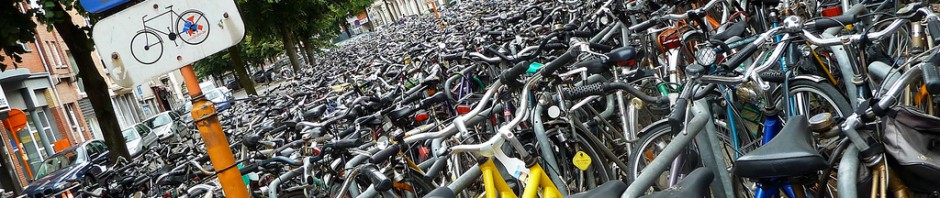
Gatekeeper Courses

It’s an endless rotation of conversation. About open education.

I get paid to talk about and to advocate for open education. Mostly I get to share open educational resources. Can I tell you how awesome that is?

My favorite conversations are the ones with faculty where they learn how open works for the very first time. Their eyes either squint with skepticism or they gaze up to the ceiling pensive in thought.

I just swam in the waters of mathy conversations for almost two days at a regional conference. I did a lot of listening. I did a lot of talking. At a certain point, I changed the conversation back to teaching in some way the best that I could. Otherwise I had very little to say to mathematicians. Though I truly love their brand of dorkery; I just don’t get their jokes.

I got to see one of my former colleagues who I worked with on my very first project with the OER. It was so nice to chat with her, and reflect on very little I knew then about leadership. How very little I understood about making open education part of the conversation for community college educators and administrators. How much I failed. How that work led to the job I have today. How I still love working with/for community college teachers.

And let me tell you. The lone faculty member who is thinking about going rogue is a beautiful thing to witness.

When my colleague and I came arrived at the vendor hall at this small regional mathy conference, it was like an icy wind had blew through the room. I tried to make eye contact and smile at a few folks. I mean, we’re all there working, I thought. My mom taught me to say good morning to strangers. It was my first time not feeling a sense of hospitality arriving some place to chat about open education. Talking about open education and courseware in a crowded room of hard-bound textbook vendors is weird. Let’s just leave it at that.

Our vendor table, however, was constantly surrounded by faculty. They chatted with us, and we loved talking plans with them. Teachers had specific questions. They wanted to get down to it. How does it work? My department isn’t ready for this but I am. My department is ready for this but not my administration. My institution is ready but not the system.

We don’t have the resources to support an effort from scratch. How do we start?

Can you help me?

Hot damn. You bet.

Here’s the thing, I learned how an initiative can create a legitimacy for changing the way we teach. Not just for innovation’s sake. But you know, for the sake of helping students. What a concept! The Completion Agenda from 2010 has generated data that legitimizes some radical curriculum revisions here in 2016. Math and, wait for it–the cost of textbooks–are barriers for community college students realizing their goals. Their dreams.

The guided pathways movement is creating some real momentum for new courses. Interesting courses. Smartly designed courses. For certain pathways.

Community college leadership is looking at programs from a different angle. Curriculum change–at this scale–is made easier through open education. The 5Rs, adapting, and adopting makes a much easier path. The best work of your peers–that is licensed–makes the paths easier to create, design, and sustain.

Administrators and faculty are looking for help and guidance, if you will, and I’m delighted by what I learned from these math teachers. I can’t wait to work with some of them, and I have a stack of emails to write. Follow-up data linking together our great conversations. Plans to write. Before I do that, I need to parse out my doubts and concerns.

What really happens in those guided pathways? Will certain courses be eliminated? Will this redesign be forced on adjuncts who have no say with departmental decisions? I worry for vocational/professional technical programs. Will they lose all access to the humanities? To social science? Is this initiative another way to track poor people? Will the joy and discovery of a liberal arts education only happen for those born with a financial safety net?

As I read more about this policy, my internal Alyson-splainer takes over.

This all seems too much about employment and not education. This all seems too centered on the goals of capitalism. This all seems too aligned with creating good workers not educated citizens. This all seems too good to be true.

Yes. And no. It’s not a binary of right and wrong–as I learned in my humanities courses.

So let me pull out a couple of quotes from “Redesigning Community Colleges for Student Success Overview of the Guided Pathways Approach” by Davis Jenkins. The bolding is mine:

Developmental dead-end. Even before they can proceed with college-level courses, the majority of degree-seeking students in both academic and occupational programs are referred to developmental education. However, research suggests that, as it is typically designed, developmental education serves more to divert students into a remedial track than to build skills for college and help them choose and prepare to successfully enter a college-level program of study in a particular field. The most promising approaches to reforming developmental education involve mainstreaming students in college-level courses with support or providing alternative pathways, especially in math. But improving the success of students in passing college-level math and English is not sufficient to improve completion rates. These efforts need to be tied to efforts to strengthen supports for students to take and pass the key gatekeeper courses for their programs of study, and not only Math and English 101 (p. 3).

Lost in the maze. With so many choices and without a clear roadmap or anyone monitoring their progress, it is not surprising that many community college students indicate that they are confused and often frustrated in trying to find their way through college (p. 3).

Start with the end in mind: map student pathways to end goals. The first step in creating guided pathways is to engage the faculty, with input from advisors, in mapping out programs (p. 10).

Colleges might consider redirecting at least some resources currently spent on conventional forms of professional development toward collaborative efforts, such as providing training, facilitation, and other support as needed by teams of faculty and staff working together to create guided pathways. Doing so would reframe professional development as a strategic activity that supports the collective involvement of faculty and staff in organizational improvement as well as one that supports the professional growth of individual faculty and staff (p.11).

16260753854_9334245f00_z

source

As I read this report and bookmark other sources, I’m reminded of a book chapter that I used to teach in my research courses.

Circa 2006-2008, we read “Shadowy Lines That Still Divide” by Janny Scott and David Leonhardt from the compilation Class Matters. 

Scott and Leonhardt explain:

One way to think of a person’s position in society is to imagine a hand of cards. Everyone is dealt four cards, one from each suit: education, income, occupation, and wealth, the four commonly used criteria for gauging class (p.9).


The open door policy of a community college welcomes students who have none of those cards. Their day-to-day is a roulette of just having enough of the basics. They walk through the community college open door without credentials, a job, or any financial safety net. Generational poverty is the phrase we use to describe their most complex barrier.

My lens, for better or for worse, is concerned with the poor at community colleges. My ideas only get so radical as they intersect with the reality of being poor.

One teacher said to me, “I’m tired of the way my department does things, and I’ve got a grant to write a course. This could change my entire department and be so good for my students. Do you think it’s possible to go that rogue?”

Posted in All The Things | Tagged , , | Leave a comment

Magic In The Machine

I really enjoy asking people about their dreams as it relates to teaching and technology. I encourage them to speak their minds about what they’d like to see and how it can help them in their contexts. When I was an administrator at a community college near a very large city, this was a safe question. A conversation starter. An ice-breaker.

I knew the context. The complications. The population. The capabilities. The network.

It was a safe question for me to ask because I could connect those dreams to our collective reality in a positive way. I could predict the answers because I was very interested in the history of the questions.

Now when I ask this question, it’s a lot more complicated. I’m in a position to help. Or I’m perceived that way. Now when I ask this question, I see many perspectives at once at all levels of the organization. The same dreams. The same concerns. The same realities. The same dreams for students and teachers. The same complications and joys of teaching and learning.

My dreams have slowly progressed from those of a teacher, to a committee member, to an administrator, to a council member, to a system advocate, and to part of growing team. I’m shocked at how my dreams are now so very different yet so very much the same.

What are the barriers to actualizing those dreams?

Sometimes it’s time and money.

Mostly lack thereof.

Sometimes it’s knowledge about technology. Its flaws. Its capabilities. Its potential. Its connection to humans. Its limitations. Its inconsistency. Its unreliability. Its abilities.

Sometimes when I hear what people want for their dreams of technology, I have to politely tell them that we aren’t there yet. It’s just not possible, I’ll say. Someday. We’ll get there. I cite research. Quotes and statistics. I tell anecdotes. I loop back to what’s possible now. What’s impossible now.

In the meantime, what’s the workaround? What’s the best way we can co-create what will solve problems for people in different contexts? What are the best connections to maximize the time and energy of people looking better solutions?

Here’s the thing. Let me tell you a story that keeps spinning in my mind.

I’m old enough to remember record players. My dad used to call me from my room to flip over the record he was listening to while he stayed on the couch reading the newspaper. He’d yell for me when the needle hit the paper on the record. I’d have to leave my kingdom of barbie dolls to flip the damn record.

Before the creation of the remote control, I’d stomp down the damn stairs to change the channel on the television for my dad.

I used to dream of record players that didn’t need a human to flip the album over. TVs that didn’t have dials. I’m sure I prayed to all gods I no longer believe in to make that happen for me. It would be magic, I thought.

One can now talk to remote controls to change the channel or bring up catalogs of movies on the television.

One can plug in a small device that holds 10,000 songs.

Somebody had my same dreams and created the machines to make it happen.

Somebody co-created the magic brain in the machine.

Posted in All The Things | Tagged , | Leave a comment

Robot Tasks & Creative Brains

When I first started teaching online, I kept an on-going document of my most common responses to students. At the time, I felt like the worst teacher ever. My inner writer wanted to personalize every single message to students to prove that I cared. Your audience, I’d teach my students, means everything to writers.

Yet. There I was plagiarizing myself over and over again to maximize my professional and personal time. To maximize my time to learn new ways of teaching. To maximize my time in the woods with friends. To maximize my time with a young student trying to sort out her life. To maximize my time helping a new colleague learn the ropes of teaching at a community college. To maximize my time.

My guilt spirals were laced with the velvety feeling of finally making enough money to pay my bills without my credit card. All the while, my course evaluations were sprinkled with criticisms from students who either loved or hated my class–which by extension meant they either loved or hated me. Sometimes I didn’t open my course evaluations for months because I couldn’t stand the hot and cold of student responses. How I would have loved a simple, “Meh. Your class was okay.”

Back then, I thought, if only there was a way to organize my interactions with students better. The Command+C and V keys were worn on my laptop from overuse. Copy. Paste. Name. Individual comment. Copy. Paste. Individual comment. Rinse. Repeat.

As an online teacher, I began to feel like robot. Less than perfect. Worse than effective. Truth be told, I got really bored. That feeling along with the dead end reality of being an adjunct forced my interests to roam elsewhere.

Finding instructional design and educational technology by way of open education saved me. My bored brain started building synapses again. My self-inflicted feelings of mediocrity started to create something new. Something interesting. Something open to possibilities.

Lately people I care about send me articles to read because they know I’m “into technology.” Sometimes it’s people in the field asking, “have you read_______?” Sometimes it’s friends who really don’t know what I do for a living but they think I might be interested. At the same time, I might see that very same article rolling by on the Twitter machine with reactions or favorites. Sometimes, especially lately, it takes me longer to read said articles than I’d like to admit. It takes me even longer to blog about it.

Learn Different: Silicon Valley Disrupts Education by Rebecca Mead is one of those articles. Ho hum, I thought. Sigh. Disrupts. Ick. Okay. Welp. Bookmark. Save for later. Then I read it, and I have to admit that I can’t stop thinking about this article.

Here are few quotes in italics (copy, paste) and my reactions below. Nothing’s in stone. Thinking out loud. Copy, paste. Copy. Paste.

Tuition is about thirty thousand dollars a year.

Well, must be nice. Not my people. I almost stopped reading there.

If the reason you are having your child learn a foreign language is so that they can communicate with someone in a different language twenty years from now—well, the relative value of that is changed, surely, by the fact that everyone is going to be walking around with live-translation apps, [Max Ventilla] said.

Kinda like how everyone has access to the Internet and democracy is actualized! Hooray, Silicon Valley. Wait. What smells like crap? I almost stopped reading there.

Most of the people who end up doing well in Silicon Valley did very well academically, but they often have a very strong viewpoint about how it could have been better.

Hmmm. I bet you are really really male. Bravo. I’d rather watch ice form then hear more about this we’re-so-successful-now-let’s-do-better-now-that-we’re-rich. I almost stopped reading there.

The Bill & Melinda Gates Foundation has poured billions of dollars into education grants, including for research on digital tools and personalized learning.

Well, yes. And I know that’s problematic for some. Acceptable for others. Worrisome. But here’s what I know for sure. Some of those dollars are allowing me to work really hard with a group of very smart people that I’m growing to love. We’re helping create real change for students and teachers at community colleges. That investment is tied to the work I’m doing and it is helping redefine the narrative of the really poor at community colleges. Just you wait and see.

If you know anything about me, then you know I believe in the open door policy of community colleges. Digital tools and personalized learning are part of the puzzle. I can’t let the mystery be. There are many problems to solve for this demographic. I read on.

Educators are stakeholders in AltSchool’s eventual success: equity has been offered to all full-time teachers.

Huh. Wait. What? You mean to tell me that a teacher who is being recorded by videotape in her classroom feels like a stakeholder in the school?! Wow. I have some snake oil to sell you. Still I read on.

The point of the hackathon was to sketch out in code potential solutions to “robot tasks”—routine aspects of a teacher’s job that don’t require teaching skills. Kimberly Johnson, the head of product success and training, addressed the team. “Basically, what we have told teachers is we have hired you for your creative teacher brains, and anytime you are doing something that doesn’t require your creative teacher brain that a computer could be doing as well as or better than you, then a computer should do it,” Johnson said.

I’ve been thinking quite a bit about my “creative teacher brain” of the past as a result of this article. Perhaps I’m making a bigger deal out of these claims than it’s worth. In a world of the quick moving stream of information, this article made me pause. Think.

“Robot tasks” are part of teaching sometimes, and we can build effective tools to make better use of teachers’ time. What’s the potential of the creative teacher brain with effective courseware? What’s the potential of having students understand their own learning with effective courseware?

The article goes on describe creative spaces for learning, and well, that’s nothing new either, yet it’s oh so so Silicon Valley to claim it’s something new and innovative. Dare I say it? Disruptive! (Buzzword Bingo. Drink!)

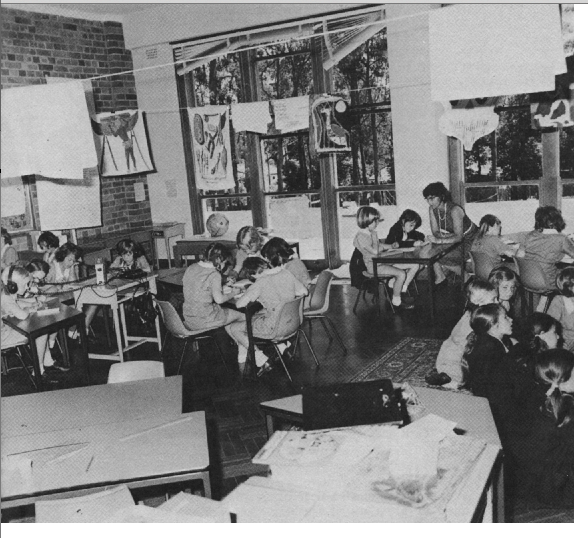
In fact, if you read up on the Open Classroom  you’ll find an interesting story about learning spaces. Perhaps iPads have replaced the aluminum book turnstiles of the 1970s and the bean bags are now Disney-themed BB8s and not corduroy. Unlike this new fangled 30k a year model, the open classroom had legs, so to speak, in public education.

Mead’s observations leave me thinking that some “new” classrooms solve the problems of a very select few. The privileged. The wealthy. The Oh-So-Silicon-Valley. The mostly white folk. The anecdotes about surveillance made me cringe. You need to read this article yourself.

To a computer measuring keystrokes, a student zoning out because he’s bored is indistinguishable from one who is moved by her book to imagine a world of her own.

Yes. I don’t think watching a video of a student having a private moment of dreaming is something to assess. Or record. It’s a private moment. Those children in the 70s open classrooms were just left the hell alone. Their private play narratives were magical kingdoms in their minds not some keen insight to their future levels of “persistence” or “grit.” Hey teachers, leave those kids alone (attribution needed).

Technologists have been trying to transform the classroom for decades. In the late seventies, Seymour Papert, a pioneer of artificial intelligence at M.I.T., contended that children’s minds might be profoundly enriched by coding. A child who learns to program “both acquires a sense of mastery over a piece of the most modern and powerful technology and establishes an intimate contact with some of the deepest ideas from science, from mathematics, and from the art of intellectual model building,” Papert wrote in his book, “Mindstorms,” which was published in 1980.

How Audrey Watters is not cited in this article is beyond me. She’s one the best journalists on this topic and it’s a damn shame for us when she’s not brought into the conversation. Watters has been citing/celebrating Papert for quite some time. She makes us all ask hard questions about these turn-key solutions.

From the back of the room, a woman spoke up: “Did you test it with a female?”

Many participants laughed. “I’m serious,” the questioner went on. “A lot of our teachers are females, and they carry phones in different places.”

The members of the bookmark team, all of whom were male, looked deflated. In coming up with their apparently elegant solution, they had not visualized a female teacher slapping her bottom to activate a phone tucked into her back pocket.

At this point, I spent quite a bit of time gazing out the window thanks to this article.

I am convinced that the best learning takes place when the learner takes charge.

Posted in All The Things | Tagged , , | 1 Comment

Sharing The Road Ahead

I am pleased to report that I’ve become a bike commuter. Record rainfall has fallen in Portland, Oregon since I’ve moved to this city, and I embrace my chicken-shitedness as a cyclist. I was not going to start bike commuting when the rain was falling by the inches. No way. For weeks I looked out of the steamy bus window as the seasoned Portlandia pedaled by in their scuba-like bike clothes.  Instead of investing in bike fenders, I bought myself fancy wellies and a petite umbrella while I marked days off the calendar. I admit I was inspired by the city commuters, but I waited for the clouds to lift and the mercury to rise before I committed.

The bike citizens of Portland have fully committed to this lifestyle. It rains, yet still you ride. Left coast Portlanders value policies that foster infrastructure for its people who embrace a car-free or car-light lifestyle. There is even a bridge devoted specifically to public transit, pedestrians, and people on bikes. It’s the stuff of fiction in most urban environments. No cars, if you will, can go.

Here’s the thing: I feel guilty because I’m learning to love the sharrow.

If you are unfamiliar with the sharrow, allow me to give you the quick definition. It’s a painted bike symbol on the road alerting drivers that they will be sharing the road with cyclists. For years, I’ve favorited more than my share of tweets hating on the sharrow. I’ve poked fun about the shortcomings policies involving the sharrow. Up until recently, I would have claimed the anti-sharrow corner.

It’s just paint on the road without policy, I’d say. Without education for citizens. Without infrastructure. Without any viable alternatives or ideas for substantive change in the way we connect bikes as a solution to the problem of our dependency on fossil fuels. The sharrow is not the radical change I’d like to see to see in the world.

It’s just paint on the streets, I’d say.

In order for the sharrow to work; there must be a social construction of its meaning. Policy dedicated to the education of a community of people is something I believe in.

The sharrow works when there is a community who understands its role.

Cars and bikes shar(row) the road.

The sharrow is a start. Maybe. Sometimes.

Roads–if you look historically–were built to make the transportation by wheel more efficient. Paved roads pre-date cars.

Roads, nowadays, are owned by drivers of cars rather than riders of bicycles. Bike transportation, however, makes a lot of sense for The People. It doesn’t work everywhere for everyone. I get that.

I’m a bit of a dreamer; I wish we were all a bit more Dutch in our neighborhoods.

In PDX as a cyclist, I feel (somewhat) safe and part of the traffic. Heading into the city, there are so many bikes! People (usually) obey the laws and the system (sort of) works. It’s not perfect; I’ve seen drivers exhibit palpable rage at anyone on a bike. Every city and town I’ve pedaled through in America is no different.

For almost half of my 4.8 mile commute to my office, I’m mostly on a Neighborhood Greenway with sharrows. Lucky ducky me.

Having Open Education Week fall at the same time of the National Bike Summit in Washington DC have many ideas–forgive the pun–spinning in my mind.

Maybe painting the streets with the sharrow teaches people that there may be cyclists. Maybe. 

Maybe I love seeing so many bike symbols on the road while I pedal to my sweet little job. For now, let me share a few wonderful thoughts I’ve had during my first month of off-and-on again bike commuting.

10 Observations While Pedaling: A Memoir

  1. A huge flock–a gander?–of geese flew under The Broadway Bridge on a day I struggled to pedal home. I was so tired from learning all day (woe is me, I know) and the wind was so harsh on the bridge. It made sense to stop and rest to look down the span of the river. I watched the geese extend their wings to glide over the river. It was so lovely.
  2. The PNW winter is a major drag; you have to change clothes four times a day as a bike commuter. Once in the morning then at the office and again in the afternoon and in evening. I’m really excited for the weather to improve.
  3. Green boxes on the street are–by design– to teach drivers to see cyclists. Bikes line up in the green box and the people in cars watch cyclists gather. It’s a genius idea for bike visibility. One day while standing in a green box in Portland, and I counted fifteen people. Thirteen of them were women. Badass, y’all. I wish I could shrink and pink that feeling for everyone who identifies as a feminist.
  4. I’m shocked by the women who wear full-on business clothes during their commute. I put on make-up in the morning mirror, but I wear bike clothes on the way to work. Battles with saddle sores (TMI, alert!) keep me from looking city-cute on the bike. There are women in panty-hose and fancy shoes, and it’s so charming. Maybe they don’t have far to go. Rock on, all you lovely ladies.
  5. Pink sparkles and reflectors are fun! I bought a pink coat. Seriously. It’s bright and easy to see me. That’s the point. Switching from thinking about muddy clothes as a mountain biker to being a city commuter is both depressing and exciting. I’m still processing this change in life. I have fancy-pants lights and reflector tape for my bike frame thanks to my concerned bike geek husband. He set up my bike, and it’s so dorky to interpret newly wrapped handle-bar tape as an expression of love, I know, but it’s so sweet.
  6. The color of the Broadway Bridge reminds of the Golden Gate Bridge. This construction project makes bike commuting problematic, but damn y’all, the bridge was built in 1911. We need to take care of our bridges.
  7. Sometimes when I come to an intersection, I love the person who has slowed down in his or her car. Shoulders behind the wheel relax. I wave. We smile at one another and carry on.
  8. Usually the people I have encountered with mobile technology that plays music annoy the hell out of me. They almost always have really crappy taste in music. One day a very normal-looking workaday man rode by me playing Johnny by the Violent Femmes quite loud. It made me happy for the rest of the day.
  9. When I have lofty thoughts about the future of open education, I can see that we are very much in the sharrow stage policy-wise. That’s frustrating to people who have been in the movement, I suppose, for a long time. It’s also kinda awesome if you’re new to learning about open education. It’s like driving down the street and seeing a bicycle symbol on the road for the first time. More on this idea later.
  10. If I can be there to witness a gaze into the horizon of what it is possible–either by bike or by the Internet–then I’m very happy.

Open education and bike advocacy during the other 51 weeks of the year? Yes. Each passing day. On your left.

This much I know.


Posted in All The Things | Tagged , | Leave a comment

Workshop As A Verb

Between the wish and the thing the world lies waiting. ~Cormac McCarthy

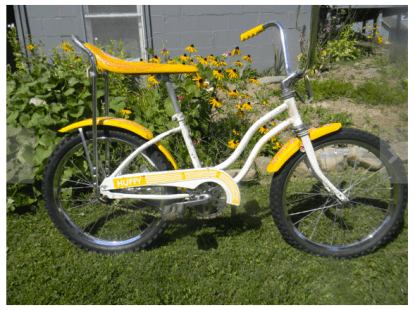
One of my most vivid childhood memories is the day I learned how to ride a bike without training wheels. I remember my dad running behind me with one hand on the back of my yellow banana seat telling me I could do it. At the point where I thought I was doing really well, I looked behind me to get his approval, and I saw that he wasn’t there. The next thing I knew my front tire was stuck underneath a bumper of a car and I crashed hard into the trunk, and then flipped over onto the street. Blood flowed from both elbows.

By the time my dad got to me, I was crying. Tears of humiliation. Tears of failure. “You looked great, kid, until you took your eyes off the prize. Always look where you want to go.”

When I finally found my love of the bike again in my late 20s after the hiatus of my teen years, that “look where you want to go” was the advice I got about mountain biking, skiing, and snowboarding. Where your eyes go, your body, bike, skis, and board will follow as well. Every time I crashed, I accepted failure as part of getting better. If you are crashing, then you are improving so I was told.

That’s advice that is easy to forget. I said this exact quote to a teacher this week who expressed frustration about the current practices of her colleagues. Change, it seems, is so very hard. I said, “You just have to keep your eyes on where you want to go. Look where you want to go. Find people on the Internet who share your ideas. You’ll feel less alone. You may feel isolated here, but there are others just like you on other campuses. I promise.”

That’s advice that is hard to remember.

Screen Shot 2016-02-03 at 8.38.04 PM

Banana Seat Beauty, My First Bike (source)

This past week, I did my first workshop as a Lumen Learning employee, and I LOVED it. (All caps there, so it’s sincere, y’all). I love teaching teachers to do their best work with technology. And I realize that makes me sound ridiculously cheesy, but let me tell you a quick story.

I travelled to Cerritos College in southern California, and I had such a great time talking to really lovely people. Really smart people who care about their students. Really smart people who love the work of the Lumen Learning. Really smart people excited about what we are doing as a company. What we do. 

I felt very proud to now be a part of this story–what we do. 

While I was rushing on my way to another meeting after an online meeting ended, a student stopped me to ask me a question. He said, “Hey, you work here. Can you help me? I’m lost.”

Sure. I don’t work here, I thought, but he looked frantic. “What can help you with?”

He said, “I can’t find the Liberal Arts building. Anywhere.”

I had no idea where I was going much less where that building was, but I had a link to the campus map on my calendar agenda. I pulled it up on my phone, and we looked at it trying to read the screen in the glare of the bright southern California sun. “I’m walking that way too, so we need to go this way, I think. It’s east of where we standing.”

“Awesome. Thanks for helping me. I have to pick up my daughter in hour, but I need to talk to my English professor. I can’t finish my essay until I ask a couple of questions. That class is so hard.”

In that moment, I felt more at home than I have felt in months. I miss students. I miss community college campuses. I miss community college teachers. My friends. Don’t get me wrong, I am really in love my new life in Portland, but it’s a been a really big change. Being back on a community college campus just made me feel at home.

It also felt very familiar to teach teachers new to OER. I’ve done too many workshops about technology to count at this point, and it’s fun for me. Before any presentation, I always think about teaching my very first “workshop” versus teaching a class. Teaching to your colleagues is a different game than teaching students. Teaching teachers is harder. A lot harder. No training wheels. I just hopped right on and starting pedaling.

Back then, I was terrified to present to my peers. Terrified. My husband, thank my lucky stars, made me laugh by sending me quotes from Cormac McCarthy novels via email. He has now upgraded to clever text messages and emojis, and I feel incredibly lucky to have his friendship. Because, let me be honest, what I advocate for is a big change for a lot of faculty, and it can be exhausting. They sometimes feel threatened. They sometimes feel pressured. They sometimes feel intimidated. In short, I see on their faces what I felt the very first time I did a workshop on technology.

The fear of failure.

What I learned—and this is the thing—there were always one or two people in the room who didn’t say a word. They didn’t smile. Didn’t react. Didn’t show any signs of support, and I felt that I failed them. I’d feel like a failure because I didn’t win over every single person in the room. Truth be told, when I did presentations and focused on those one or two folks I had “failed,” I’d put on a happy confident face, shake their hands, and then I’d fall apart with self-loathing in my car on the way home. Or I’d drink heavily with my non-academic friends. You know, healthy reactions to leadership issues.

Then two days later–sometimes a month later–my inbox would light up with emails. Voicemails would appear will invitations to come to department meetings. Questions would come from people quoting those who were somewhat silent in the audience.

Invitations would start with the words, “I have more questions than answers now that I’ve seen your presentation. You gave me a lot to think about, but I needed time to process it all. Can we talk? I’d love to workshop an idea with you.”

Using the word, “workshop” as a verb–I love it. It’s like riding a bike on familiar trails. It was nice to pedaling that way again. We can look where we want to go together.

Posted in All The Things | Tagged , , | 2 Comments

Learning As A Community


When I started graduate school again in 2010 as an education major, I was pretty unsure of what the future would hold for me and higher education. Learning communities were all the rage from about 2004-2009 at the community colleges where I worked, so I thought I’d focus my research on how this style of teaching could adapted to the online or hybrid curriculum. For the record, I never got to teach a learning community course because they were either the exclusively scheduled for full-time faculty or I couldn’t justify the extra (unpaid) prep time it would take to collaborate with another teacher.

Three of my favorite colleagues taught a biology, chemistry, and English composition learning community that I thought was the bees’ knees for pre-nursing students. This was before the hullabaloo about STEM, and I thought they were onto something big. When the English teacher started talking about retiring, she asked me if I’d be interested in taking her place. I was so honored, but I had to turn it down because my teaching load of six composition courses and my freelance work were just too overwhelming. And I’ll be honest and admit that the science teachers intimidated the hell out of me even though they were incredibly nice.

Then The Recession hit.

Funding for learning communities dried up. Courses were unbundled (surprise! that word is back). Faculty stopped pitching ideas. There are dead links to learning community course materials in the dusty corners of the Internet.

I’d like to think that the learning community is an idea with legs in 2016.

In 2008, Matthew Zeidenberg published “Community Colleges Under Stress” through the Community College Research Center.

Read the following quote as a Venn Diagram with open education, effective courseware, and supported professional learning for teachers. Add more circles focused on recent conversations about competency-based education, the unbundling of the curriculum, and guided pathways for students.

See these Venn Diagrams swirling around the conversation about free community college.

From Zeidenberg in 2008:

Another promising strategy that could potentially improve the efficacy of remediation is the “learning community,” in which groups of students take a number of courses together, with faculty coordinating the teaching. In this arrangement, a remedial course can be coupled with a college-level subject course. A student might take a remedial English course in combination with college-level history and sociology courses. The reading and writing in the remedial course would use materials from the college-level course. Learning as a group can create a sense of teamwork and connectedness that can improve student motivation and success. In addition, if students see a connection between remedial courses and college-level success, it may motivate them to work harder in the remedial courses. An experimental evaluation by Susan Scrivener and colleagues of learning communities at a community college in Brooklyn, New York, found some positive impacts of the program. Students in the learning community had better outcomes during the semester in which the learning community was implemented and completed the college’s remedial English requirements faster.

Note the bolded sentences. That’s the thing.

At the time of this publication in 2008, most of the people I worked with did not know about open education, open educational resources, or that there was a movement of people working to build on this idea. It’s still not a mainstream idea for many faculty members. That’s changing, and it’s very interesting to see it unfold.

The challenges our students and teachers face, however, remain very much the same.

We now have powers to build and blend courses in ways that could support learning communities. Now that I work for Lumen Learning, I see how courseware gets created, how it’s used to generate meaningful data about student performance, and how it can change everything for teaching and learning online. And I believe that, by the way, or I wouldn’t have accepted this job.

Honestly I made a joke about learning communities, and I remembered this research I did for an adult education class titled “A Foot In the Door” where I interviewed three adult returning students about their educations. All three of them faced external pressures such as health problems, jobs, transportation, and child-rearing that made it difficult for them to get to campus. They all admitted that they sometimes struggled to get to campus because of their personal lives. I was curious why they didn’t take online classes where they could have more flexibility with their schedules.

To my surprise, all three students who were very different, expressed how the lack of community they felt as online students drove them away from online courses. In a face-to-face class, they told me, they felt part of community and they liked the personal attention of the teacher. They liked feeling like they were a part of a community learning together.

Here’s what I wrote in 2010 as my reflection about this research paper and presentation (feel free to laugh at my mention of specific products. I did):

I am left with larger questions regarding my future role as an educator. How can we, as online teachers, help enrich the adult returning student’s perspective of online learning? Do adult returning students prefer face-to-face classes to online classes? If so, why? Will communication technologies like Elluminate, Skype, and teleconferencing alienate or entice this demographic? Will technologies that allow more “virtual” face-to-face interaction online, help adult returning students who have only limited access to traditional learning spaces? As more of my own teaching takes place online or in hybrid classes, I wonder if I am losing opportunities for teaching students like my interviewees, a demographic I care a great deal about at EvCC. Despite my seeing them all as ideal candidates for online classes, they see themselves as poor fits for this style of learning.

All three students are emphatic about needing direct human interaction in their learning process, yet some of the practical challenges they cite in being students could perhaps be remedied with the benefits of asynchronous learning.

That bolded sentence–that’s the thing. Still. In 2016.

Direct human interaction. Personalized learning. Personalization. Connection. Personal connection. Community. Learning as a person in a community.

It can be done with technology, and I’m very excited about this learning community that I now call my day job. It’s an idea with legs, as they say.

Let me close with another quote from Zeidenberg in 2008:

Limited finances are hobbling the ability of community colleges to fulfill their multiple missions. Although more money is not the solution to all problems, it is clear that it is better, all things being equal, to be less reliant on part-time faculty and to allocate money to support strategies such as tutoring and mentoring, supplemental instruction, individualized student counseling, and programs to assist students to succeed in college.

That’s the thing. In 2016. Still.


Posted in All The Things | Tagged , , | 2 Comments

Files & Files: A Memoir

It’s funny. I think I was a better blogger when I was an unhappy grump about my job. What to do when I spend a lot of time reading and writing at work? And I dig it! In my free time I’m checking out local bars and restaurants, watching movies, binging on television shows, reading books, knitting–anything else it seems these last eight days–but writing.

My 100 day commitment is on hiatus, but I can file what I did create during that time as a somewhat successful writerly feeling. I’m rejoicing, right? I have finally found satisfying work with people I really like–in a city where I can see living long-term. Holy hot damn, I have stumbled upon the tri-fecta happiness with the jobby job.

You see, there have been many times in my life when I have loved The People, but not The Work. The Work, but not The Place. The Place, but not The Work. Two out three, I can tolerate it for a time. One of the three; I get bored and/or slowly slip into depression and self-loathing. Zero out of three? Well, that usually ends badly.

When I don’t write, I organize. I’m on a mission to get my files of memorabilia, research, writing, and artifacts from the past together in some usable and searchable form. Or I’m throwing it away (recycling when I can). In my last post, I wrote about eliminating piles and piles of paper before my migration to Portland. There were three piles I didn’t tackle a month ago because I wasn’t ready to face them.

1] My files from my years as eLearning Director–a short era, now that it’s in the rear view mirror. 2] The files from my M.Ed. degree–an era I survived yet remember little of anything significant. And 3] My files from when I pretend I’m a writer–a long era now as I’m now reminded every time I look in the mirror these days.

Here’s the thing.

Everything has somehow shaken down to this grouping of files. This list of interests. Four drawers of a metal cabinet are now one tidy wooden wine crate. Labeled. Organized. Easy to find. Mighty damn tidy-like.

OER-related. From my very first notes when I discovered that the acronym meant open education resources to my latest very long to-do list at work.

Status: Useful, relevant, and meaningful. Big smooch, I love this file.

Adult education. This is an on-going file that I’ve been keeping since I taught my first community college class in 2003. Sometimes I call them non-traditional students. Sometimes I call them adult-returning students. Sometimes I call them adult learners. Sometimes I call them life-long learners. They’re a motley bunch that I like to think about since I’m kind of juvenile at heart.

Status: Potentially useful as I learn more about community college policy. Potentially useful for others planning online programs. Or not.

Grad-school research and papers. These are mostly disposable assignments that feel like a waste of time since none of them are publishable nor are they usable for others. I mostly hate this file. The writing was sort of applicable to my career, but not to my thinking. Most of the assignments were very rigid. Hot tip: If you teach grad students in education, then you need to rethink your assignments. Have your students write a philosophy of educational technology and pedagogy based on the readings you select. Make them blog about their thought process daily for weeks. Help them write an outline for a journal article using a wiki that they build with like-minded peers. Model how to be a scholar in the field of educational technology. Show them how to create a portfolio of artifacts from all of the above summarizing their pedagogy. Everything else is a giant waste of their time as future teachers.

Status: Unclear why I’m keeping all of this other than it is a symbol of a hard batch of years. Publishable works unknown. Prolly not. Potentially useful as kindling for a bonfire.

iClicker/SRS research. In 2015, this file actually became a book chapter.Yay! I’m hoping to present more on this idea. What I once thought was becoming a kind of dated and obsolete “tech tool” is always new someplace to somebody.

Status: This research shows cell phone polls make teachers and students happy when the stars align with meaningful questions about coursework. Cell phone polls may be the best technology we have in the classroom to date, yet it’s the least understood by teachers. The ubiquity of the cell phone allows for interactive use of technology that is easy to use. Why not keep writing about it?

Teaching teachers to teach online. This research dates back to 2009 when I started think about how most training seriously lacked any conviction about how to forget about the face-to-face. How to think about teaching without referring to the face-to-face. How to think of teaching in a whole new way. This file connects to everything above. I’m just not sure what to do with it anymore, but I’m still training/teaching people at my new gig.

Status: Keep adding to it. There’s got to be something useful for somebody; I just haven’t figured it out yet, but I will. 

Presentations. All of the notes, proposals, and blurbs for presentations from the last five years.

Status: One more year, then recycle it. It’s A Mess, Like Me: A Memoir.

Le Livre Maintenant. This is the file that haunts me as the novel(s) I’ll most likely never write.

Status: Hair Shirt. The one thing I can’t seem to make happen when all of the above takes most of my time. Sometimes all of the above feel like pretty successful endeavors.  

My best failures. This damn file makes me laugh at myself.

Status: Ongoing, high-maintenance, biggest file of them all. Tune in for more details. More to come in 2016.

This will be my last post of 2015 because I’m heading to the mountains on Tuesday to do some snow-shoeing during the day and some wood fired hot tubbing at night. Happy New Year, readers.

Status: Happy. Very happy. Mountains, here I come. 


Posted in All The Things | Tagged , | 2 Comments

A Path Of Recent Thought

I think of this as my main blog, and I want to keep it that way for now since some people actually tune in. I don’t know who you all are, but thanks for placing your needle on the record of my thoughts from time to time.

I want to explain– and record what I’ve been up to with writing. You know, just in case you care how I’m getting bloggy with it these days.

If you follow this blog, you know that I sometimes write about the way I classify life.

1] There’s the jobby job–the activity which results in a paycheck.

2] The hobby job–the activity which results in no paycheck, but makes me very happy.

3] Then there are my beloved Adventures. The part of life that doesn’t connect to money, the material, or intentional mindfulness about being happy. It just happens.

I’ve been searching for all three to come together and that’s the moment I want to record right now.  The jobby job feels like a hobby job and it’s a total adventure. A Memoir.

This is where it gets really interesting: I’m writing everyday. I’m reading everyday. Intentionally. Mindfully. Adventurously. And it all kind of connects in interesting ways.

Here’s the path of my recent thought.

Sometime in October, I committed to writing one short article a day for the latest iteration of the federated wiki. I now have written 55 posts since October 27, 2015. That’s pretty incredible for me given how much my life has changed during this time. I’ve also written elsewhere in paper journals, on debit card receipts, and on bar napkins, but I haven’t written here to explain what I’m up to and how to follow.

But for what it’s worth, as they say, dear readers. Here’s the thing.

Sometimes I’m writing here on this blog you are reading, obviously.

Since October, I have for many days written here.

Then all my posts got magically moved to the wikity.cc which connects to other people writing together to my own site. Heretofore, I will continue my 100 day project there.

I just glanced through the pages featuring forkable content for the massess and my work–the entire record of my days–is all there. I shared my entire thought process as I wrote an outline for a book that I’d like to write. A book I’d like to write.

Wait. Hear that? It’s the broken record I keep playing in my mind.

I’ve now spent a year writing with the federated wiki. It’s changed my way of thinking about time and learning.

Time as it relates to teaching and learning.

Time as it relates to teacher collaboration.

Time as it relates to open educational pedagogy.

Time as it relates to sharing my learning in a community.

Time as it relates to publishing one’s ideas to share with others.

During this time, I’ve taken up yoga again and I’ve been looking up words that my teachers use as they explain the poses that are now so hard. Dammit. Three years ago, they were so easy for me. Learning poses again has made me both frustrated and sad. Thrilled and motivated.

Each day, my teacher said, connects to the Samvatsara. I had no clue what she meant because I was focusing on not passing out from pain. I’ll look that up later and write about it, I thought.

Samvatsara, turns out is a Sanskit word meaning year. Each day connects to the year. Intentionally. Mindfully. Adventurously.

Posted in All The Things | Tagged , , | 1 Comment

Converging Pathways For Professional Learning

This is the keynote speech that I delivered on December 11, 2015 at Clark College for their faculty professional development day. If you follow this blog, you may recognize some of what I’ve written. If you follow my blog for the latest iteration of the federated wiki, then you’ll recognize some of those posts were actually drafts for this longer piece. Somehow my commitment to write a post for a 100 days straight helped me draft this keynote. You can’t plan this stuff, folks, sometimes it just happens. I’ll blog about that later.

This keynote–my very first–fell on the ears of faculty right before grades were due. Right after their Vice President of Instruction talked to them about budget cuts, removal of programs, and major changes to their institution right before introducing me. As I looked out into the audience of faculty, their exhaustion was palpable. I imitated the voice of Yoda, voices from a scene from Monty Python, and I can’t believe I did that in front of 200 people. A Memoir.

Here’s what I said:


I would like to thank Michelle Bagley and Lorraine Leedy for taking a risk and following the sage advice of our professional learning heroine at the state board, Jennifer Whetham, and inviting me here to be your keynote speaker. Standing up here, I can look into the audience and empathize with all of your positions on campus here at the end of the quarter–three days before grades are due. I can feel the Godzilla lasers shooting towards me as you sit there being forced to hear words of optimism about teaching from somebody who now works for the private sector!

Yet. I know what it’s like to be in the audience today. I’ve been a newly hired adjunct learning the ropes of teaching at a community college fresh out of graduate school. I’ve been a seasoned adjunct I-5 flying warrior stressed out beyond belief about my course load between several colleges. I’ve been an administrator who was part of the team responsible to plan such an event like today, and I’ve strategized with senior administrators on how to pay for such an event.

And although I never rose to the ranks of full-time tenured faculty, I was lucky that I had champions among the tenured who saved me a seat at their table making feel a part of their departments. I’ve also collaborated with student services staff, librarians, human resources, enrollment services, just to name a few, to plan a retreat-like setting for professional development like today. If you have a champion in this room today, I encourage you to make time for one another today. I’ve been lucky to work directly with two Anna Sue McNeil winners–the great Lolly Smith and the inspiring Peg Balachowski–when I was at Everett Community College and I’m grateful for that time. We don’t make enough time for that kind of gratitude for our colleagues. Let’s do that for ourselves today.

Setting the tone for today’s activities is truly an honor and I’ll admit an absolute joy. Preparing for such a responsibility carries with it all of the love and caring that goes into teaching a class without the hard work of assessment. Without the hard work of endless student emails. Without the hard work of teaching in 21st century.

Standing in front of  you today, I am not a teacher nor are you my students, but rather you are my peers, my colleagues, my network, and my future friends. What happens here today is something I will reflect on for months to come, and although I left the great SBCTC for the private sector; I’m now with a company, Lumen Learning, who is committed to the success of the very demographic we serve–and I have to be honest–I still think of the SBCTC as “us.” And I think I always will.  

I am committed to our success, and I’m very proud of this system.

We welcome all learners with our open door policy, and our jobs as community college educators present new challenges and responsibilities in the 21st century classroom. Teacher collaboration is more important than ever, yet studies show that faculty are increasingly isolated and carry greater responsibilities than their predecessors. Rather than turn the corner towards despair and teacher burnout, let’s take this moment to (re)envision pathways for flexible and open professional learning. Today I’d like to ask questions that we won’t be able to answer, but it’s the start of a conversation we need to have.

What are useful creative ways of using the digital space for teacher collaboration? What are some of the possible “guided pathways” for meaningful faculty collaboration? I’d like to encourage you to reflect on how you  can participate and help create a new community of practice(s) for teaching and learning in the digital age.

Teaching and Learning

When I talk about “teaching and learning,” I’m not just talking about or to teachers. I’m not just talking about degrees, certificates, or accomplishments. Whether you are faculty support, student services, administration, staff, or some other undefined role in betwixt and between, we all participate in teaching and learning on our campuses. When I say, “faculty” I mean all faculty. FT, tenured, part-time, adjunct, academic, professional technical, vocational, occupational, etc.

In short, if you are here today and you work on this campus, in this state, and in this consortium: student success is all of our jobs.

Let me repeat that: student success is all of our jobs.

And it’s an incredibly hard job that just gets harder.

Over the last year or so, I’ve been thinking quite a bit about the notion of time as it relates to teaching and learning. As it relates to our work. As it relates to working with teachers and students.

A few years ago, I attended the American Association of Community Colleges conference, and the keynote was James Collins, the author of Good to Great, and he was a very charismatic speaker working the crowd with lots of data charts, statistics, research, and snazzy graphics. Much unlike the keynote you have here today. He used catch phrases everyone seemed to know with images of buses, hedgehogs, and foxes. I was not the intended audience for this message, I don’t typically read business management texts, but I got his point, he told leaders that they needed to understand who they needed to work with before they know the what that has to be done. In short, the people were more important than the company mission. 

This is quite the opposite of teaching. We get to create the the what (our curriculum) and we have no idea who will walk in the door (our students). And yet we still have to be leaders.

Turns out the president of my college was also in the audience for that same keynote. He came back to the campus with messages about how we need a Week Zero for students and that was going solve the woes of attrition. He declared that the there were several new federal initiatives that were going to help our students succeed. His letter to the campus had phrases like Achieve The Dream, the Completion Agenda, Guided Pathways, and although policy at the federal level seemed suddenly enlightened, things back home at the state and local were a bit austere with budget cuts. Sound familiar?

I will acknowledge that my lens at the director level was different than a president’s yet his message to the campus was clear: we need to care his about the Week 0 for students. Week 0, translated to me as somebody investing in mentoring and professional development for faculty, that we needed a Week -1 or even Week -2 for faculty. We can’t have students feel prepared before classes begin if faculty do not feel that way. How do we make that Week -1 happen when so many of you are off contract? Overbooked. Over committed. Over-committeed (that’s a new word). Overworked. Overextended. So very overworked.

We have a day like today. This is our Week -1 and sum of what we can do together today is greater than our parts. It’s time to relax into our own learning. And on a day so close to a new Star Wars film debut; I have to quote the mighty philosopher Yoda: “There is no try. Only do or do not.”

There Is No Try

To prepare for today, Michelle and Lorraine sent me an article to read and based on the title, here’s what I envisioned:

Screen Shot 2015-12-12 at 10.35.48 AM

In “Massages in the Library: Running a Course Design Spa for Faculty” by Karla Fribleyshe has a few quotes that help legitimize the idea that if we are going to create institutional and systemic change for education, faculty need open and flexible time to collaborate with other teachers. Perhaps if we can substantiate the need for this time for faculty, it will be eventually be easier to make this case for student learning.

Fribley states, “Ask any faculty member about their biggest challenge today, and many of them will say, “There’s never enough time!” Studies have shown that faculty work longer hours than their predecessors, and feel stress from their workloads.

Planning an event like today, she claims helps because,

a faculty member often ends up getting help in areas they hadn’t anticipated…The unstructured aspect of the day makes it easy for faculty to choose the help that interests them most, at the time that interests them. For the event planners, it provides an excellent opportunity to collaborate one-on-one with faculty on their courses.

That’s what today is. Time for you. Time to improve you. For you. Time to recover from the brutal schedule we call fall quarter. We can’t have an honest conversation about student success without addressing how we fail at being nice to ourselves. We can’t have an honest conversation about our problems without talking about how we can improve. I had a rule when I was an administrator, if you were going to complain about a problem, you had to bring a solution. Chicken Little, I would tell my team, doesn’t work here.

So how to take back the time? How do we remember that the sky will not fall if fail? We start by small gestures of kindness towards ourselves. Take a moment and think about running into one of your students five years from now. What do you hope they remember about your course? Your teaching? Your class?

Let’s take a moment to reflect. Take a blank sheet of paper in front of you. Draw a circle. What made you fall in love with your discipline? Now draw a circle around that circle. Write what you love teaching others. Now draw another circle. What do you love about the future of your career?  

Screen Shot 2015-12-12 at 11.15.42 AM

What you have drawn in those concentric circles connects and overlaps with the sessions we have planned for you today. That overlap will happen in the form of conversations, workshops, and having lunch together. All of you are Venn Diagrams that overlap make this college stronger. John Venn, the inventor, of the diagram describes his visual aid:

We endeavor to employ only symmetrical figures, such as should not only be an aid to reasoning, through the sense of sight, but should also be to some extent elegant in themselves.

Today’s program is elegant in itself. What I like about the program today are wonderful mentions of sustainability, teaching and learning, active learning, open education resources, engagement, and this buffet style professional learning can become meaningful pathways to help your students. Recognizing our motivations is the key. 

Motivation To Mentor

A couple of years ago, I presented quite a bit on mentoring. Having benefited from mentorship myself as an inexperienced teacher, I was curious about what motivates us to mentor others. Why teachers need mentors. And I think they do.

In Mentoring Adjunct Faculty To Improve Success, which is an article I wrote for NISOD, I wanted to support the idea that adjuncts–who are often unsupported and more isolated than their full-time peers–need mentors. Helping them directly benefits our students, I believe. 

The teacher ego can be a fragile thing, and cross-disciplinary mentorship can enable teachers to talk about pedagogical practices without belaboring details of content. Oftentimes, when two teachers from the same discipline collaborate, they end up talking about their intellectual interests and not instructional design concerns. While teachers need content-intensive discussions, they also need assistance with classroom management, time management, and assessment strategies.

We need to support teachers who have long-term goals on short-term contracts. How do we do that? We examine our motivation to teach. What we wrote in those circles and how they connect to others. We also find connections in hashtags, blogs, articles, and social media. The popular definition for this community is our personal learning network as lifelong learners. Those are pathways to collaboration.

If student success is all our jobs, then we want them to be lifelong learners.

In “Engendering Competence Among Adult Learners” a chapter in Enhancing Adult Motivation to Learn: A Comprehensive Guide for Teaching All Adults by Raymond Wlodkowski, he gives readers interested in education tips on how to engage adult learners.

Many students, especially adult returning students, have limited time for their studies.

Wlodkowski reminds us:

In some instances, adult learners need courses and training not so much because they need them but because they need jobs, the promotions, and the money for which these learning experiences are basic requirements. This is the reality for many adults, and it may be one about which they feel they have little choice. “Just tell me what to do” is their common refrain (p. 312).

Much of this text is to remind educators about the importance of empathy when many students have not had the experience of controlling, thus succeeding in education. In addition, he tries to give educators strategies for helping their adult students who are often burdened by their additional responsibilities.

He writes,

The strategies that relate to the motivational purposes of respect, self-efficacy, expectancy for success, and deepening engagement and challenge are most effective in this regard (p. 312).

Much of his advice is based on the face-to-face model of teaching yet his advice is transferrable and meaningful to online course designers and faculty. For those of you who work as mentors or in faculty support roles, his teachings on the “five pillars of motivating instruction–expertise, empathy, enthusiasm, clarity, and cultural responsiveness” are particularly useful when working with faculty (p. 93-94). If you’re faculty, those five pillars are the foundation to your pedagogy.

A basic way for an instructor to use the motivational framework is to take the four motivational conditions from the framework and to transpose each into questions to use as guidelines for selecting motivational strategies and learning activities for a lesson plan. The guided pathway of learning.

  1. Establishing Inclusion: How do we create or affirm a learning atmosphere in which we feel respected by and connected to one another.
  1. Developing Attitude: How do we create or affirm a favorable disposition toward learning through personal relevance and learner volition?
  1. Enhancing Meaning: How do we create engaging and challenging learning experiences that include learners’ perspectives and values?
  1. Engendering Competence: How do we create an understanding that learners have effectively learned something they value and perceive as authentic to their real world?

In What We Know About Guided Pathways by the CCRC, researchers have created a useful report about systemic change to promote academic success for community college students. A major strength of community and technical colleges is the ways in which students can select their courses as “a buffet.” This freedom of choice is especially useful for adult returning students exploring new learning opportunities and citizens interested in life-long learning.

For students who are trying to transfer to a four-year university or complete a certificate program, however, this freedom–especially for first-generation college students–can be unnecessarily confusing and challenging. Students make costly mistakes and lose momentum with their education. They often can’t find a pathway. This is especially true of a first generation student. And thankfully, we’re getting better about helping them.

The CCRC propose the following:

Making the kinds of institution-wide changes called for in the guided pathways reform model is challenging and requires committed leaders who can engage faculty and staff from across the college.

In terms of faculty professional development, they identify the current status quo for faculty:

  • Learning outcomes are focused on courses, not programs.
  • Instructors are often isolated and unsupported.
  • Metacognitive skills are considered outside the scope of instructio

Focusing on meaningful professional development for faculty would include the following:

  • Faculty collaborate to define and assess learning outcomes for entire programs.
  • Faculty are trained and supported to assess program learning outcomes and use results to improve instruction.
  • Supporting motivation and metacognition is an explicit instructional goal across programs.

A similar sentiment about personalizing learning is reflected in an interview with Maya Richardson featured in the blog post The Importance of Student Control of Learning, Especially For Working Adults.

The personalized learning part of it is taking ownership, she says, I think it motivates. As an adult learner, it’s really important to find that you have some control over—when I go in, I know what I want to learn. I hope I know what I want to learn, and I hope I learn it at the end.

That declaration of what we want to learn helps keep us on a sane pathway of learning. Our schedules in academia are often unrealistic and hectic. For every stressed out student, there is faculty member stressed twice as much.

The Growing Edge

In How To Stay Sane by Philippa Perry, there is a section titled “Learning” where she discusses neural plasticity, differing levels of stress, and psychotherapy. “Good stress” and “moderate levels of stress” promotes “the neural growth hormones that support learning” according to Perry (p. 75). She goes on to describe her work with a client:

To work at this level we cannot be too comfortable, because then new learning does not take place; but nor can we be too uncomfortable, for then we would in the zone where dissociation or panic takes over. Good work takes place on the boundary of comfort. Some psychotherapists refer to this place as ‘the growing edge’ or ‘a good-stress zone’…The good stress zone is where our brains are able to adapt, reconfigure and grow…

We must be doing something genuinely new, and must pay close attention, be emotionally engaged and keep at it.

New pathways will form if two or more of these conditions are met, but we will ideally meet all four at once (p. 73-83).

I love the use of “growing edge” in lieu of “cutting edge.” This growing edge kind of learning can be messy, unpredictable, and quite uncomfortable. Very unlike our academic training which values perfection. Showing up to any of these workshops today could be messy. A public declaration of admitting you don’t know much about something, but you want to learn.

Amy Collier and Jen Ross take up this idea with research on messy learning and I love their brilliant word: not-yetness.

So what does all of this mean for educators? Here are some ideas. Embracing not-yetness means making space for learning opportunities that:

promote creativity, play, exploration, awe

allow for more, not fewer, connections…

transcend bounds of time, space, location, course, and curriculum

The ill-defined, the un-prescribed, the messy can lead to the unexpected, the joyful.

Today might get a little messy. We might discover some paths that we have not explored. We might learn how our Venn Diagrams of motivation overlap with others. Our path may join up with others. That can be joyful.

Mike Caulfield, the director of Blended and Networked Learning at WSU-Vancouver–a university where I hope a lot of local Clark College students may transfer–writes extensively about the future of online collaboration, teaching, and learning. How we connect on the internet and how we use the digital space to collaborate, and I’m quite the fan of the future he’d like to see for teaching and learning. He conjures a vision of a curated and cultivated garden in his latest keynote. And although I’m using his words a bit out of context, this paragraph conjures up a lovely image of a garden for teaching and learning. 

He writes,

This is true of everything in the garden. Each flower, tree, and vine is seen in relation to the whole by the gardener so that the visitors can have unique yet coherent experiences as they find their own paths through the garden. We create the garden as a sort of experience generator, capable of infinite expression and meaning.

That’s my hope for today. I’d like for us to spend some time in the garden created by the planners of today so that the guided pathways we are creating for our students are beautiful, creative, changing, and awe inspiring.  

Let me conclude with the words of Jen Whetham to bring this path full circle. Especially now since I have mixed metaphors for almost an hour, I’d like to close with mentioning my best failure of 2014-2015. The “Bring Your Dead” scene from Monty Python’s Holy Grail sums up my FLC failure, and Jen somehow assured me that what we did was useful. Our path of failure may guide others towards success. A year’s worth of work that just fell apart somehow became something else in other people’s gardens. She wrote:

This is emergent work, folks, and I appreciate the creativity and innovation you have shown as we begin to explore, as a system…[with] “Communities of Practice 2.0.”  We are…beginning to “tap into the potential of the digital space.”

This collaborative journey to continually push the purpose and function of [teaching and learning] is not a linear one.  It requires imagination and pushing boundaries and stepping well outside of our comfort zones.  It requires re-reading what could be perceived as “mistakes” as the potential for new direction and expansion.  We must continue to ask questions to which there are not simple or elegant answers.

There are no simple or elegant answers in teaching and learning.

Thank you.


Posted in All The Things | Tagged , , , , , | 5 Comments

The Great PDX Migration: A Memoir

“What sticks to memory, often, are those odd little fragments that have no beginning and no end…” ― Tim O’Brien, The Things They Carried

Oh the possessions I have shed! I’ve moved away from Bellingham (again), and the last few weeks have been filled with cleaning, packing, driving, and carrying really heavy items. Moving is so time-consuming and there is still so much to do. But first, I have to tell you two stories.

The Things I Carried

There are things I have carried with me each and every time I pack boxes to move. I’ve moved across the country from the East Coast and then to several states; Wyoming, Montana, Colorado, California, Washington, and now Oregon. Each time, I seem to collect more stuff, but this time around, I was very selective about what I carried with me. We are also moving into duplex that has less than half of the space of the house we have lived in for six and half years, thus I’ve had a reckoning about my belongings. In the last month, I have shed half of my library of books, one third of my clothes, a quarter of my outdoor gear, and three-fourths of my paper files. It’s led to me to a new edict in life: if I don’t want to carry it to my next house or if I don’t want to pay to eventually throw it away because I can’t give it away, I will not buy it.

I only got lost three times in total nostalgia simply because I didn’t have time. Once I cracked open a journal from a year when I was really unhappy (I didn’t recognize myself on the page, so that’s good). And once I sat down and read an entire book amidst the dust and piles of books. The book was By Central Station I Sat Down and Wept by Elizabeth Smart, mostly because I love that title and the memories I have of the class where I was assigned to read it as a wee lass of an undergraduate. What I underlined and wrote in the margins charmed me, and unlike that wretched horror-show I was in that bad year journal, I liked what I saw of myself quite a bit in the margins of that book. I’d take her out for a beer. We’d make fun of that sad sack of depression called Alyson circa 2007-2009. In the pages of books I gave to the Goodwill, I found so many notes from people I have loved, bookmarks from bookstores of different cities I’ve been to, and notes in the margins of books with thoughts that no longer make sense. Countless scraps of paper with phone numbers and email addresses of people I no longer remember.

Although it’s been weeks since I’ve posted here, I have been blogging daily for the federated wiki library project, and that’s been really hard to do from my cell phone. Without wifi or a dependable schedule, writing daily has been a challenge but I’ve done it for almost 30 days straight. More on this later, but I’m digging my self-made project that (I hope) will help advance the next step of the federated wiki’s evolution. Or maybe just my evolution as a writer. My process has been sporadic, but I’ve tweeted/favorited ideas I want to come back to, then I’ve tried to write something meaningful later in the day. Mostly, I’ve learned how hard it can be to work from your phone.

I had to cancel the household wifi in order to set up the move between Bellingham and Portland, and being wifi-less, I realize, is a first-world problem of the highest order, but the internets is a major part of what I do for a living and for fun. So these last two weeks have been rough. This is wifi-less living is a reality for a great many students who take online classes, and albeit it’s amazing to “work” from your phone, it’s really difficult to do the most basic functions from the cell phone that I have.

Here’s the thing, or the two stories I’ve had brewing in my mind:

Five Victories, Or The Great Reckoning of Stuff 2015:

1. Thanks to RRAD, my second mountain bike will go to a young girl who will learn to mountain bike in the magical forest we call Galbraith. It’s a Kona that I bought in 2003, so she’s going to have a I learned-how-to-shred-on-an-old-school-local-bike-from-some-old-lady-who-knows-Chris. A seriously badass story when she grows up to tell her future partner who will dig chicks who ride bikes. Thanks to Chris Mellick, an old school brah with a big heart, for helping out parents and kids with such an expensive sport. Our giant pile of bike gear will go to good use, and I wish we had donated all of it sooner.

2. My needle and yarn stash of ten years is in one bag. I kept my sewing machine, candle making supplies, and stained glass tools as a shrine to the little crafty hippy I once was and hopefully will be again someday. I have yet to sew curtains for my VW van, but I will.

3. I got rid of the clothes that I wouldn’t be caught dead in today but kept around for one vain reason. Periodically, I’d check to see if these Army pants still fit from circa 1991 that I wore almost everyday for four years. They do sorta fit, but not like they used to. Fuck it, I’m more muscular now, I told myself, grabbed another beer and put them in the donation pile. The other item is a dress that I wore several summers in a row that still fits but I’ve since learned that baby doll dresses are for tall women, not Hobbits like me. What the hell was I thinking?

4. I got rid of the entire paper record of my time as a teacher. All of my evaluations, student samples, handouts, notes, textbooks, student portfolios, reflections, and everything that I thought would one day help me get a job as a full-time tenured English Composition teacher at a community college. All of it. The stack of papers was about as tall as me, and I’m just under five feet, three inches. The filing cabinet went to the Goodwill.

I kept four things thinking it may be useful for others: A] the notebook I put together for the accreditation process as part of my admiration for our department chair. If I hadn’t liked him so much, I would have phoned it in, but I worked really hard on that teacher portfolio. It still holds up as a record of my teaching philosophy. That department was really good to me, and it’s part of why I stayed at that college for so long. You know, I wasn’t too bad of a teacher. I coulda been somebody. I coulda been a contender…B] And I kept just enough to maybe add to Lumen’s catalog should we need more ideas for composition teachers. Some of my assignments could be useful to others. C] I also kept the thank you cards from my students, which I had to stop reading because I was getting weepy. I’m so curious about some of them. If they fulfilled their dreams. If they made it. What happened to them. Some of them had such terrible home lives; it’s a miracle they made it through my class. D] I also kept a stack of syllabi only to show my progression in thinking about teaching and learning with technology. It’s hilarious. The revisions to my course policies were especially interesting to me and could help other teachers. There may be a someday preso in that stack that could help others learn from my stupidity.

5. I got rid of the gear that I’ve kept for sentimental reasons, but I don’t use anymore now that I have upgraded almost everything. All of the hiking, backpacking, skiing, snowboarding, and camp supplies from the ’90s and early ’00s that I’ll never use again, are now gone.  I realized I have photos of me using that gear, so why I kept all of it is just beyond me. Hopefully, somebody can get some use out of that gear. It all still works despite the massive amount of duct tape repairs.

Cyclocross Season ’15 My Worst Yet: A Memoir in Three Parts

1. I haven’t written about bikes in awhile, because guess what? I haven’t been riding them. It’s been incredibly hard to find time for the bike during these massive changes in my life. I haven’t consistently exercised since August, I’ve been sitting in front a computer, on airplanes, in cars, and in front of the fire reading/writing more than I’ve been raising my heart rate. Thus, in part, why those Army pants don’t fit anymore. Dammit.

Screen Shot 2015-11-27 at 4.18.09 PM

Photo Credit: Somebody in my family capturing meaty little me on a bike for the first time. Note race face and chubby thighs even back then.

2. I’ve done three races and I’ve either come in last place or second to last place, which you know, kinda stinks. My first race with the Expert Women was an eye-opener of how fast those ladies are and how I have no business being out there with them. No frickin’ business. I’m an A category in experience, but I’m borderline category B/C with ability and fitnesss. Because I had “won” the other categories, I had promised to upgrade to encourage other women to advance. What a shit show mistake, but I did it.

At one race, I just decided to have fun and heckle back at some very drunk dudes. I had listened to them yell “It’s run-up not a walk-up” for the entire race before mine, so I had already planned my response when I passed them. For the record, this was an incredibly hard run-up and only the fittest of the fit could actually ride it, and I doubt that dudes who were drunk off their asses before noon were ripping up it. During my race, I heard them yelling their taunt phrase , so I looked over at them and said, “Screw you!” grabbed the hand-up, took a shot of whiskey, and threw down my Dixie cup with dramatic flare. The crowd roared with laughter, and let’s face it, cyclocross is a spectator sport and it was my time to give back to the masses. It was my first race where I wasn’t serious and hot damn was it fun to ham it up a bit.

3. This is my last season on my Redline cross bike that I plan to turn into a commuter bike. It’s been a good cross bike for me, and I’ve liked riding an old school bike frame from a Washington company. This time next year, I hope to be writing about my new CX bike, my first CX race season in Portland, and how much I love living there. Hopefully I’ll find my way back to the mid-pack fitness again.

I started this blog post from Bellingham and I’m finishing it at a coffee shop near my new home in Portland. I had a really great six-half years in the Ham this time around, and I’m happy that little town full of friends is still within a morning’s drive. The great reckoning wasn’t really about my stuff at all, it was really about the hope I’m carrying now about my life and my career. I now have a job that I know I will completely love in a very interesting new city. Lucky ducky me.

Posted in All The Things | Tagged , , | 5 Comments